AJP NOW
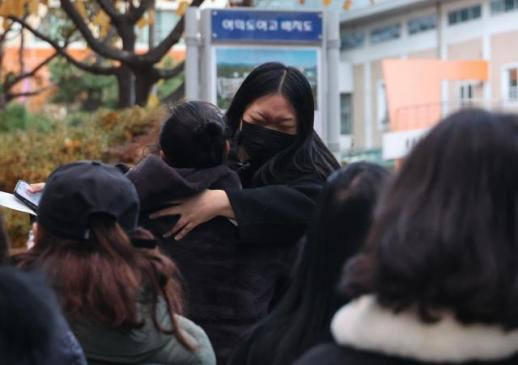
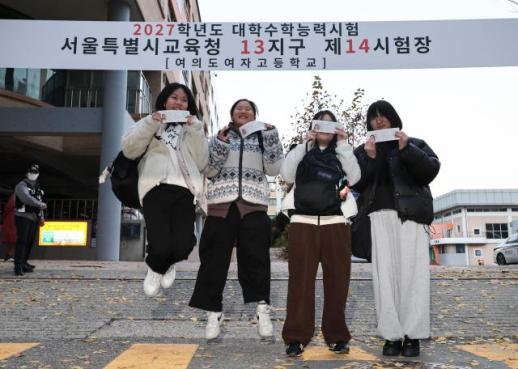
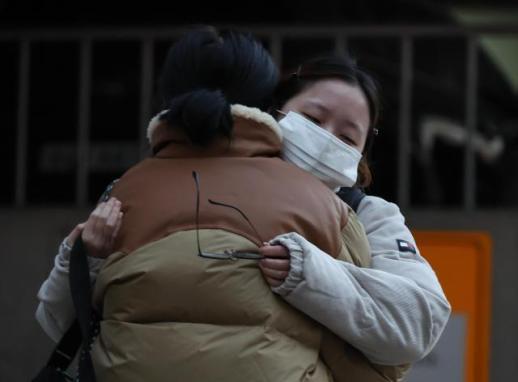
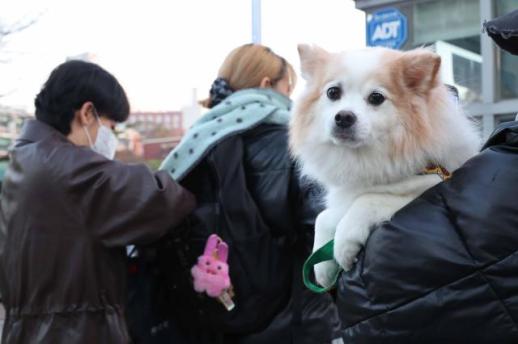
An online chat group of more than 1,600 students, mostly high school seniors criticized the Education Ministry on Saturday over what it calls management failures during the annual nationwide university entrance exam earlier this week. They questioned the ministry's hasty and inadequate anti-cheating measures, saying many schools failed to apply security stickers to clothing buttons that could conceal miniature cameras and did not properly inspect students for sm
A magnitude 6.7 earthquake struck Peru's central Andes on Friday evening, sending residents of the capital Lima rushing into the streets, but authorities reported no immediate casualties or damage. The quake struck at 7:09 p.m. local time, with its epicenter about 34 kilometers north of Junín at a depth of 108 kilometers, according to the U.S. Geological Survey (USGS). Peru's Geophysical Institute and local officials reported no immediate injuries or
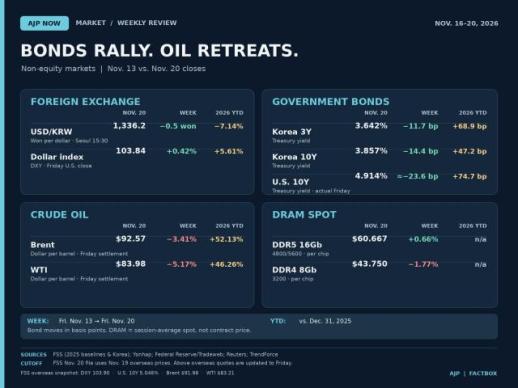
Government bonds rallied and oil prices declined during the week ended November 20 as investors sought safer assets. South Korea's benchmark 10-year government bond yield fell 14.4 basis points from the previous Friday to 3.857 percent, while the three-year yield dropped 11.7 basis points to 3.642 percent. The U.S. 10-year Treasury yield ended Friday at 4.914 percent, compared with roughly 5.15 percent a week earlier. The won was almost unchanged at 1,336.
The Nasdaq Composite lost 10.02 percent in the week to November 20, making it one of the biggest losers as it bore the biggest blow from selloff in artificial intelligence shares. The weekly rout, its worst since 2020, followed Nvidia's latest earnings and Anthropic's record initial public offering. The S&P 500 shed 8.61 percent and the Dow Jones Industrial Average 8.02 percent, with both entering correction territory. South Korea's KOSPI dropped 7.9
Wall Street suffered its worst weekly rout in years as the great artificial intelligence selloff wiped more than $4 trillion off Nasdaq-listed companies, with neither Nvidia's strong earnings nor Anthropic's record-breaking stock market debut able to rescue the trade that had powered the U.S. bull market. The tech-heavy Nasdaq Composite plunged 10 percent for the week, its steepest loss since the COVID-19 crash in March 2020, erasing all its gains for 2026.
President Donald Trump renewed his call for Nvidia to reinstate its ousted founder and former chief executive Jensen Huang Friday, defending the AI chip pioneer amid a Chinese espionage controversy while leaving open the possibility of a broader semiconductor trade agreement with Beijing. "I think the company, if they were smart, they’d take that brilliant man, accept an apology, and let him go back," Trump told reporters. Huang resigned earlier this
President Donald Trump threatened sweeping penalties against American technology companies building data centers overseas Friday, declaring that artificial intelligence computing infrastructure must remain in the United States to prevent China from gaining an advantage in the global AI race. "We’re not allowing data centers to go into other countries because China will take all of them, and we’re not allowing that to happen," Trump told reporte
President Donald Trump declared his historic meeting with Chinese President Xi Jinping and Russian President Vladimir Putin a resounding diplomatic success Friday, describing the chemistry among the three leaders as "fantastic" even as their talks in Shenzhen produced few concrete breakthroughs on Ukraine or nuclear arms control. "It was big. It was great, great electricity—unbelievable. The relationship was fantastic between the three of us,&qu
An online chat group of more than 1,600 students, mostly high school seniors criticized the Education Ministry on Saturday over what it calls management failures during the annual nationwide university entrance exam earlier this week. They questioned the ministry's hasty and inadequate anti-cheating measures, saying many schools failed to apply security stickers to clothing buttons that could conceal miniature cameras and did not properly inspect students for sm
South Korea will freeze its official property assessment ratio at 69 percent for apartments in 2027, keeping a key property tax benchmark unchanged for a fifth straight year. The Ministry of Land, Infrastructure and Transport (MOLIT) said Friday the decision reflects housing market conditions, recent tax reforms and public acceptance of the property assessment system. The target ratio will remain at 69 percent for apartments and other multi-unit housing, 53.6 percen
South Korea faces another bitterly cold weekend, with temperatures forecast to plunge to minus 9 degrees Celsius (16 degrees Fahrenheit) by Sunday. The Korea Meteorological Administration (KMA) said Saturday morning lows would range from minus 8 to 2 degrees Celsius, with Seoul dropping to minus 5 degrees. The cold snap comes as students prepare for university entrance interviews and written exams over the weekend. The freezing weather follows heavy snowfall tha
An event promoting kimchi, South Korea’s traditional fermented cabbage dish, was held in southern Seoul on Friday, according to the Ministry of Agriculture, Food and Rural Affairs. The event, held at aT Center in Yangjae-dong, was part of the annual celebration of "Kimchi Day," which falls on Sunday this year and marks its seventh year. The festival featured kimchi tastings, cooking demonstrations and competitions involving Korean and international p
More than 80 percent of recently married South Koreans spent more on their weddings than expected, as hidden charges for photography, dress rentals and venue catering pushed bills beyond initial estimates, the Korea Consumer Agency (KCA) said Friday. A survey found that 80.4 percent of 46 respondents married within the past year faced unexpected costs. Among wedding photography services, 55 percent charged separately for digital photo files, raising the average tota
Promoting Korean cuisine overseas has been discussed with the Culinary Institute of America (CIA) in New York, South Korea's Ministry of Agriculture, Food and Rural Affairs said on Friday. The discussions come as CIA has introduced a 10-session pilot course on Korean cuisine this fall, following several one-off lectures in previous years that highlighted Korean temple food and culinary traditions. The ministry plans to work with CIA to broaden Korean food educat
A suspected locally contracted cholera case has been reported in South Korea for the first time in about 10 years, the Korea Disease Control and Prevention Agency (KDCA) said on Friday. The patient, who had not traveled overseas in the previous two months, tested positive for toxigenic Vibrio cholerae O1 Ogawa on Wednesday after seeking emergency treatment for vomiting and diarrhea last week. The patient will remain in isolation until two consecutive follow-up tests
Former first lady Kim Keon Hee challenged South Korea's Supreme Court ruling Friday, saying she could not understand her conviction in a stock-price manipulation case and accusing legal authorities of bowing to political pressure, a day after her four-year prison sentence was upheld. "I will never understand why I was found guilty of stock manipulation at Deutsch Motors," Kim told the Seoul Central District Court. “How long will you keep giving
A magnitude 6.7 earthquake struck Peru's central Andes on Friday evening, sending residents of the capital Lima rushing into the streets, but authorities reported no immediate casualties or damage. The quake struck at 7:09 p.m. local time, with its epicenter about 34 kilometers north of Junín at a depth of 108 kilometers, according to the U.S. Geological Survey (USGS). Peru's Geophysical Institute and local officials reported no immediate injuries or
President Donald Trump renewed his call for Nvidia to reinstate its ousted founder and former chief executive Jensen Huang Friday, defending the AI chip pioneer amid a Chinese espionage controversy while leaving open the possibility of a broader semiconductor trade agreement with Beijing. "I think the company, if they were smart, they’d take that brilliant man, accept an apology, and let him go back," Trump told reporters. Huang resigned earlier this
President Donald Trump threatened sweeping penalties against American technology companies building data centers overseas Friday, declaring that artificial intelligence computing infrastructure must remain in the United States to prevent China from gaining an advantage in the global AI race. "We’re not allowing data centers to go into other countries because China will take all of them, and we’re not allowing that to happen," Trump told reporte
President Donald Trump declared his historic meeting with Chinese President Xi Jinping and Russian President Vladimir Putin a resounding diplomatic success Friday, describing the chemistry among the three leaders as "fantastic" even as their talks in Shenzhen produced few concrete breakthroughs on Ukraine or nuclear arms control. "It was big. It was great, great electricity—unbelievable. The relationship was fantastic between the three of us,&qu
What was meant to be President Donald Trump's 90-minute victory lap over his diplomatic swing through the Philippines and Shenzhen turned into an "Apprentice"-style audition for his potential successors, with Vice President JD Vance and Secretary of State Marco Rubio competing for the spotlight ahead of the 2028 presidential race. Standing behind Trump throughout Friday's White House briefing, the two Republican presidential prospects offered contr
Grand Theft Auto VI reached Northeast Asia this week on three different terms, uncut in South Korea after a near-ban, in a separate build in Japan and absent from China. South Korea’s Game Content Rating Board deadlocked 3-3 in September between an adults-only rating and an outright refusal, according to meeting minutes obtained by the gaming outlet Inven. The board approved the game for players 19 and older by an 8-to-1 vote in October, after two postponeme
Russian President Vladimir Putin ruled out a partial cease-fire with Ukraine after Kyiv struck the Crimean Bridge, speaking after meeting U.S. President Donald Trump and Chinese President Xi Jinping in Shenzhen. Putin said Russia had been weighing a cease-fire on Black Sea shipping or a halt to strikes on energy infrastructure, but that both options were now off the table. The strikes this week destroyed much of the road section of the only bridge linking Russia t
Investors from mainland China and Hong Kong were shut out of Anthropic’s initial public offering, the largest on record by money raised, as Washington and Beijing draw lines around artificial intelligence. Anthropic, the maker of the Claude chatbot, sold 980 million shares at $83 each, raising $81.3 billion and valuing the company at an estimated $1.5 trillion. Banks handling the deal refused orders from institutional investors based in mainland China and Ho
Government bonds rallied and oil prices declined during the week ended November 20 as investors sought safer assets. South Korea's benchmark 10-year government bond yield fell 14.4 basis points from the previous Friday to 3.857 percent, while the three-year yield dropped 11.7 basis points to 3.642 percent. The U.S. 10-year Treasury yield ended Friday at 4.914 percent, compared with roughly 5.15 percent a week earlier. The won was almost unchanged at 1,336.
The Nasdaq Composite lost 10.02 percent in the week to November 20, making it one of the biggest losers as it bore the biggest blow from selloff in artificial intelligence shares. The weekly rout, its worst since 2020, followed Nvidia's latest earnings and Anthropic's record initial public offering. The S&P 500 shed 8.61 percent and the Dow Jones Industrial Average 8.02 percent, with both entering correction territory. South Korea's KOSPI dropped 7.9
Wall Street suffered its worst weekly rout in years as the great artificial intelligence selloff wiped more than $4 trillion off Nasdaq-listed companies, with neither Nvidia's strong earnings nor Anthropic's record-breaking stock market debut able to rescue the trade that had powered the U.S. bull market. The tech-heavy Nasdaq Composite plunged 10 percent for the week, its steepest loss since the COVID-19 crash in March 2020, erasing all its gains for 2026.
SEOUL, November 20 (AJP) — Bitcoin plunged more than 10 percent over the past week, sliding toward $60,000 as fears of further U.S. interest rate hikes and a deepening selloff in artificial intelligence (AI) stocks drove investors away from risky assets. The world's largest cryptocurrency traded at $61,993 as of Friday in Seoul, down 10.18 percent from a week earlier, according to CoinMarketCap. Ether fell 9.8 percent to $1,748, while the platform's Fe
The Korean won briefly weakened past 1,340 per dollar Friday as a sharp stock market selloff and fears of further U.S. interest rate hikes drove investors away from riskier assets, before exporters' dollar sales helped limit its losses. The dollar closed Seoul's daytime foreign-exchange session at 1,336.2 won from the previous day's 1,330.0 won. It climbed as high as 1,340.3 won around midday before retreating. The dollar index, which measures the U.S.
South Korean stocks plunged more than 5 percent Friday, sending the benchmark KOSPI below 4,900 for the first time in 10 months as allegations of U.S. chipmakers violating export controls on China rattled semiconductor shares and triggered trading curbs on both Korean stock markets. The KOSPI tumbled 267.93 points, or 5.21 percent, to close at 4,869.96, its lowest finish since January 20. The index opened 4.08 percent lower before extending its losses, triggering fi
South Korea's exports surpassed $1 trillion for the first time Thursday, powered by booming semiconductor demand that accounted for 42.7 percent of shipments this year, making it only the fourth country to reach the milestone after the United States, Germany and China. According to the Korea Customs Service on Friday, the historic threshold was crossed at 2:09:38 p.m. on November 19, when an export declaration for a semiconductor shipment was approved at Incheon
Foreign investors sold a net 240 trillion won ($180 billion) in South Korean stocks through October 2026, selling in every month except August, regulatory data showed Friday. Foreigners sold a net 25.98 trillion won ($19.5 billion) in October alone, including 25.02 trillion won on the KOSPI and 963 billion won on the KOSDAQ, according to the Financial Supervisory Service (FSS). The second straight month of selling was led by investors from the Americas, who pulled o
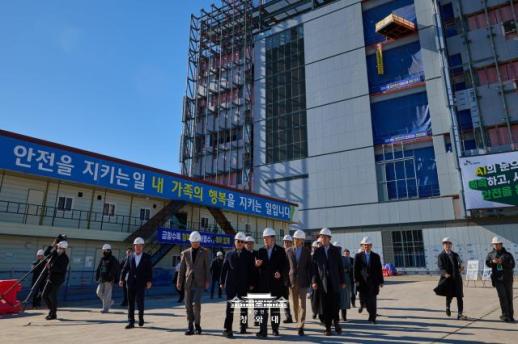 South Korea presses with AI build-out despite jitters
South Korea is pressing ahead with its data center and chip buildout despite growing talk of a slowdown in the United States and fears of an artificial intelligence (AI) bubble, with President Lee Jae Myung visiting a $5.2 billion SK data center construction site.
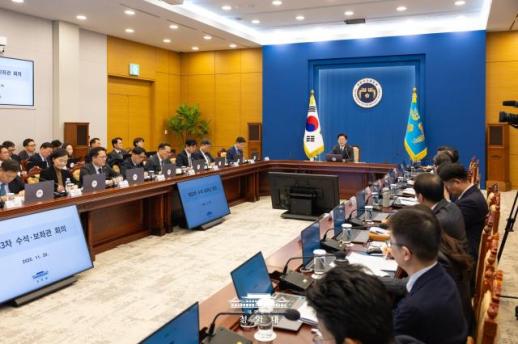
The aftermath of South Korea’s annual state-administered college entrance exam has turned into a hunt for cheats, with President Lee Jae Myung putting up at least 100 million won ($75,000) for every confirmed case of misconduct and promising to multiply the reward according to the number of offenders involved.
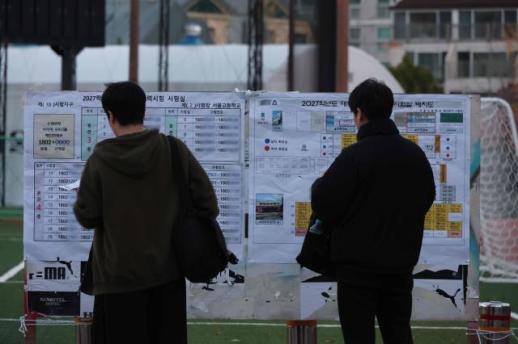
Universities are stepping up security measures for upcoming essay tests and admissions interviews after more than 100 cases of cheating were discovered in this year's university entrance exam earlier this week.
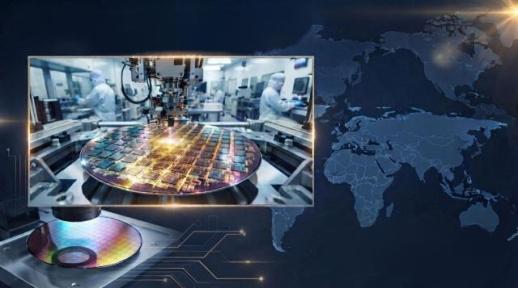
South Korea appears to be heading for stronger economic growth, at least on paper, largely thanks to rising global demand for semiconductors as investment in artificial intelligence (AI) is expected to continue to grow.
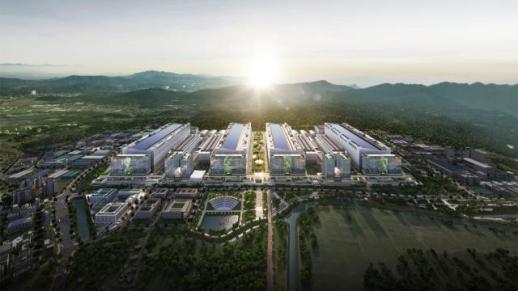
SoftBank Group founder Masayoshi Son explored a $1 trillion takeover of South Korea's SK hynix, the world's leading supplier of high-bandwidth memory (HBM) chips for artificial intelligence, according to The Information, in a moonshot deal that would have valued the company at nearly twice its current market capitalization.
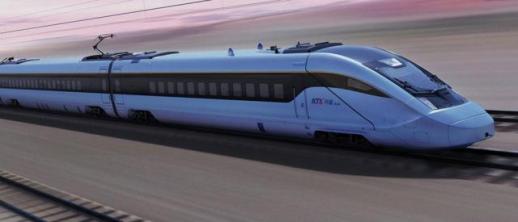
A freight train derailed at a railway station in the administrative city of Sejong early Saturday morning, disrupting train services, according to railway operator Korea Railroad Corporation (KORAIL).
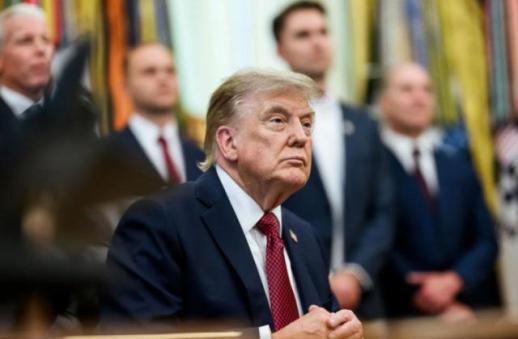
U.S. President Donald Trump said Friday that the situation on the Korean Peninsula was discussed during a historic trilateral meeting with Chinese President Xi Jinping and Russian President Vladimir Putin in Shenzhen, China.
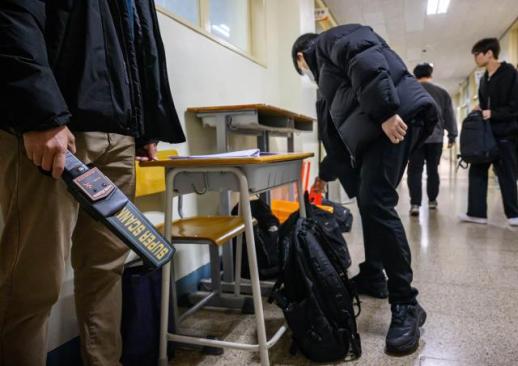 Editorial: Korea needs new direction in education and a new chief
South Korea’s education system stands at a crossroads. Artificial intelligence is transforming how knowledge is produced and shared, how industries operate and how people work. Yet education remains bound to examinations, scores and university rankings. A system that should be preparing the country for its future is preoccupied with administering its past. The government must confront whether the Education Ministry has the vision, authority and leadership to meet this tra
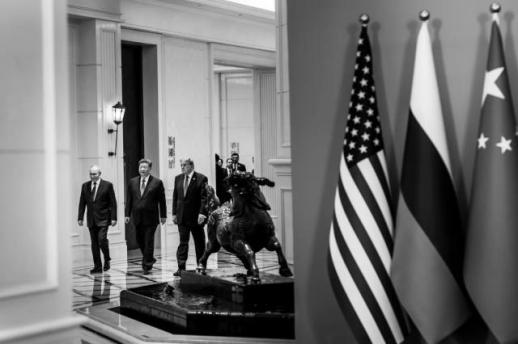 Shenzhen review: Adults missing from the room
Donald Trump arrived in Shenzhen accustomed to being the event. At previous gatherings in Europe and Asia, other leaders had organized their diplomacy around his demands, his displeasure and his appetite for applause. This time, the American president entered a production whose political purpose had already been established by his host. Xi Jinping occupied the center as convener and apparent go-between. Vladimir Putin received the recognition he wanted. Trump supplied the Americ

AJP Video


 BIGBANG drops 'GiiiRIP' celebrating 20th anniversary
K-pop group BIGBANG released a surprise digital single "GiiiRIP" on Friday, its second new song in three months as the group continues a world tour marking its 20th debut anniversary, YG Entertainment said. The track, released at 2 p.m., follows "BiiiG," which arrived in August to coincide with the anniversary of the group's 2006 debut. "GiiiRIP" blends heavy electronic sounds with hip-hop rhythms, contrasting high-pi
 Richard Osman gives AJP a clue to his next mystery
 Seoul stocks cheer China's move toward K-wave opening