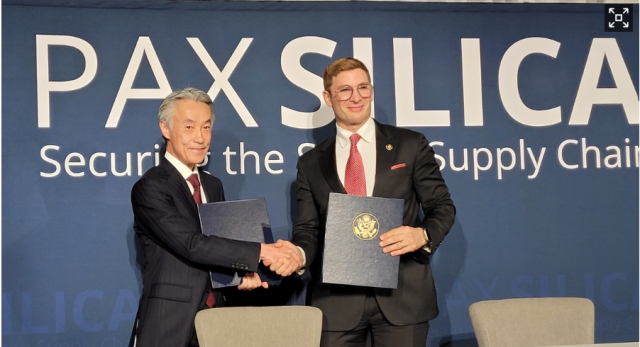
SEOUL, December 13 (AJP) -South Korea and Japan on Saturday joined a new U.S.-led strategic grouping that goes beyond the so-called “Chip 4” alliance, bringing together the core microchip and artificial intelligence supply chain — from critical minerals and energy to chipmaking equipment, design and advanced manufacturing — across the Asia-Pacific and allied economies.
The initiative, branded Pax Silica, reflects Washington’s growing push to reinforce a trusted technology bloc amid mounting concerns that China could weaponize its dominance over key materials essential to semiconductor and AI chip production.
According to the U.S. State Department factsheet, inaugural meeting was held Saturday in Washington D.C. with officials from Japan, South Korea, Singapore, the Netherlands, the United Kingdom, Israel, the United Arab Emirates and Australia — countries that collectively host many of the world’s most advanced semiconductor, AI, equipment and infrastructure firms.
South Korea is home to global memory chip leaders Samsung Electronics and SK hynix; Japan supplies essential chipmaking materials, precision components and equipment; the Netherlands hosts ASML, the world’s sole producer of extreme ultraviolet (EUV) lithography machines required for advanced-node manufacturing; Israel is a hub for semiconductor design, cybersecurity and AI software; the United Kingdom plays a central role in chip architecture and advanced research; Singapore serves as a regional manufacturing, logistics and data-center hub; the United Arab Emirates is emerging as a major investor in AI infrastructure and energy-intensive computing; and Australia provides critical mineral resources vital to semiconductor and battery production.
Seoul's foreign ministry did not issue a separate statement on the alliance, a low profile reflecting its awkwardness towards the hidden political agenda.
Notably absent is India, despite its rising profile in semiconductor design, electronics manufacturing and critical mineral sourcing, underscoring unresolved frictions in U.S.–India relations under the Trump and Modi administrations.
Unlike Chip 4, earlier supply-chain coordination efforts focused narrowly on fabrication or export controls, Pax Silica is designed as an end-to-end framework spanning the entire technology stack — from upstream mineral refining and energy inputs to semiconductor design, advanced packaging, AI computing infrastructure and logistics.
The State Department described Pax Silica as a “secure, resilient and innovation-driven silicon supply chain” initiative rooted in cooperation among trusted partners, with the explicit aim of reducing coercive dependencies while enabling large-scale deployment of artificial intelligence.
While the department did not name China directly, the timing and scope of the initiative coincide with growing alarm in Washington and allied capitals over Beijing’s tightening export controls on rare earth elements and other materials critical to military, semiconductor and electronics manufacturing.
China accounts for more than 70 percent of global rare-earth mining and processing capacity, a concentration that U.S. officials increasingly view as a strategic vulnerability in an AI-driven economy.
U.S. officials framed Pax Silica as part of a broader shift in economic statecraft, where secure supply chains, trusted technology and resilient infrastructure are increasingly seen as pillars of national power and long-term growth.
The initiative responds to rising demand from U.S. partners for deeper coordination on technology and economic security, the recognition that AI will reorganize global value creation, and the need to protect sensitive technologies and critical infrastructure from undue access or control by countries of concern.
“AI is reorganizing the world economy,” the State Department said, noting that economic value will increasingly flow through all layers of the AI supply chain — driving demand for semiconductors, energy, advanced manufacturing, data centers, transportation logistics and new markets yet to be created.
The name “Pax Silica” draws on the Latin word pax, meaning peace and stability, paired with silica, the compound refined into silicon — the foundation of modern computing chips. U.S. officials likened the concept to earlier geopolitical orders such as Pax Americana, positioning Pax Silica as an economic and technological framework for an AI-driven era.
Under Secretary of State Jose W. Fernandez Helberg directed U.S. diplomats in Washington and overseas to operationalize the summit’s outcomes by identifying infrastructure projects and coordinating economic security practices across missions, the department said.
Copyright ⓒ Aju Press All rights reserved.