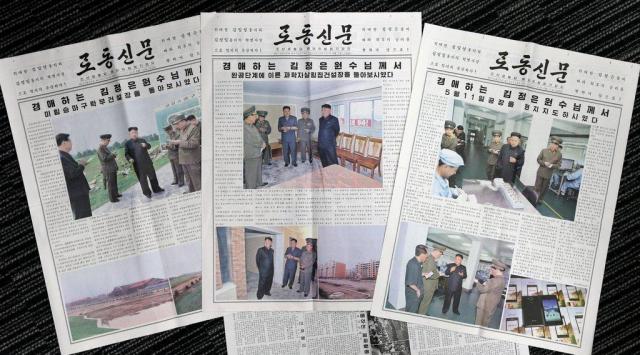
Under the revised rules, South Koreans can access the newspaper at facilities that handle special materials — including the Unification Ministry’s North Korea Information Center and the National Library of Korea — without submitting an application or additional identification, Vice Unification Minister Kim Nam-jung said at a briefing. Restrictions on copying have also been eased, removing the requirement for written approval.
The regulatory change was first proposed during a ministerial briefing to President Lee Jae Myung on Dec. 19. Lee reportedly said South Koreans are fully capable of distinguishing propaganda from fact. The issue was later discussed formally among the Unification Ministry, the National Intelligence Service and other relevant agencies last Friday.
In the same vein, the ministry is reviewing whether to expand access to certain North Korean websites by revising the Information and Communications Network Act, in an effort to help the public better understand North Korea. About 60 North Korea–related websites — including Rodong Sinmun and the Korean Central News Agency — are currently blocked in South Korea. The ministry noted that the widespread use of VPNs has already weakened the effectiveness of such controls, creating a gap between policy and reality.
The government also plans to continue consultations with the National Assembly to expedite passage of a pending bill governing the use and management of North Korea–related materials.
Rodong Sinmun, published entirely in Korean, primarily carries speeches and directives by North Korean leader Kim Jong Un, along with policy lines of the Workers’ Party. As the party’s official organ, it promotes the superiority of the regime and its ideology, while also covering international affairs and inter-Korean relations. Although it does not have a dedicated culture section, it occasionally carries cultural articles.
Academics welcomed the move as long overdue.
“It is appropriate to reclassify Rodong Sinmun as ‘general material,’” said Kim Yong-hyun, a professor of North Korean studies at Dongguk University. “Reading it will hardly make South Koreans become sympathetic toward North Korea. It is time we respond to North Korean issues with confidence.”
Koh Yu-hwan, also a professor of North Korean studies at Dongguk University, said the restrictions had long been outdated. “Since 1994, when I founded the Department of North Korean Studies and began teaching, not a single student has turned into a pro–North Korea sympathizer or joined a Juche faction simply by reading Rodong Sinmun,” he said.
Access to the North’s official mouthpiece could instead help deepen public understanding of the regime as it really is, said Park Jie-won, a Democratic Party lawmaker and a key architect of the landmark 2000 inter-Korean summit in Pyongyang.
“Allowing people to read it directly can be the most effective form of national security education — and even anti-communist education,” Park told AJP.
Copyright ⓒ Aju Press All rights reserved.