
Reports describing a U.S. military operation in Venezuela, including the detention of President Nicolás Maduro, have sent shockwaves far beyond Latin America. Regardless of how final details are verified, the global response itself is revealing. Questions that once dominated international debate — legality, due process, sovereignty — have quickly given way to a more unsettling assumption: that such actions are now plausible.
This shift marks a deeper transformation in the international system, from a rules-based vocabulary toward a language shaped increasingly by power.
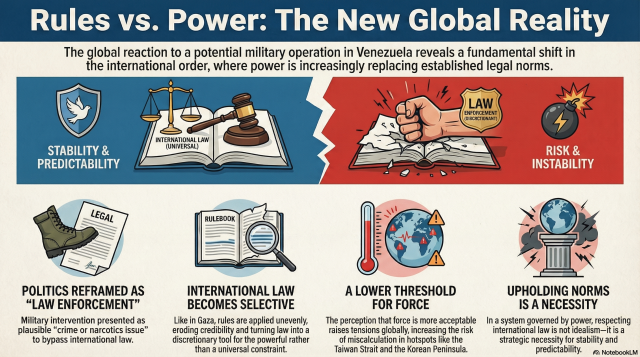
At the core of the controversy lies a familiar but dangerous logic. By denying the legitimacy of a government and reframing a political confrontation as a matter of crime, counterterrorism, or narcotics enforcement, military intervention can be recast as a form of law enforcement.
Recognition is withdrawn, immunity is questioned, and coercion is presented as necessity. When this reasoning gains acceptance, international law risks losing its function as a universal constraint and becoming instead a discretionary instrument.
This pattern is not confined to Venezuela. In Gaza, international courts and humanitarian institutions have repeatedly warned of civilian suffering and legal obligations under international humanitarian law.
Yet enforcement remains uneven, filtered through alliance politics and strategic calculations. The result is an international order that appears strict toward some actors and flexible toward others. Such asymmetry erodes credibility and invites cynicism. Rules that apply selectively cease to function as rules at all.
For Western democracies, this moment presents a particular challenge. The legitimacy of the postwar international order has rested not only on power, but on the claim that power is restrained by law.
When legal norms are seen as contingent on alignment, the moral authority of that order weakens. This does not merely damage global trust; it undermines the very framework that smaller and middle powers rely upon for stability.
The consequences extend directly to East Asia. In the Taiwan Strait and on the Korean Peninsula, the perception that the threshold for the use of force has lowered — even if no actor explicitly seeks conflict — accelerates military buildups and narrows diplomatic space. In such environments, miscalculation becomes more likely, and crisis management replaces long-term cooperation as the central task of diplomacy
For countries without overwhelming power, survival depends neither on moral absolutism nor on unprincipled opportunism. It depends on principled pragmatism. Respect for international law, due process, and civilian protection is not rhetorical idealism; it is a strategic necessity.
Norms provide predictability in a system otherwise governed by asymmetry.
At the same time, realism cannot be ignored. Alliances matter, deterrence matters, and dialogue must be preserved even when values diverge. But realism that abandons standards altogether quickly turns into dependency. The challenge for responsible states is not to choose between principle and strategy, but to bind them together — using norms to anchor policy while diplomacy manages risk.
There is also a responsibility beyond governments. In moments when legal language is used to justify force, journalists, scholars, and public intellectuals carry a heightened duty. Verification must precede amplification. Human consequences must not be reduced to abstractions. Silence, in such moments, can function less as neutrality than as quiet consent.
As the international system drifts back toward the language of power, standards become more costly — and more valuable. Abandoning them may appear expedient. But history suggests the price of erosion is always paid later, and often by those least able to afford it.
*The author is the President of Global Economic and Financial Research Institute (GEFRI)
Copyright ⓒ Aju Press All rights reserved.
