

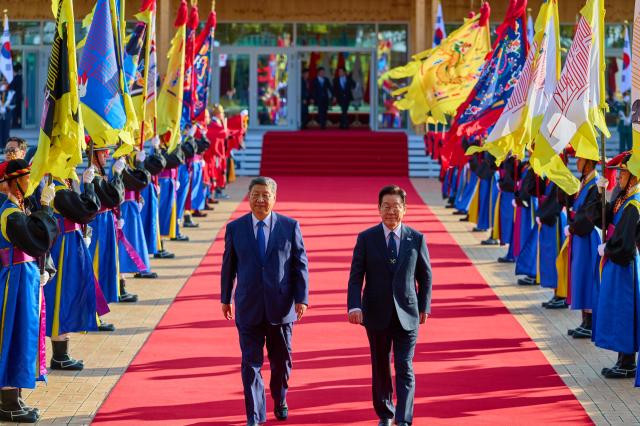
President Lee Jae Myung and Chinese President Xi Jinping are set to exchange what many analysts describe as “ceremonial cordiality” at a time when Beijing has moved closer to North Korea and Seoul’s strategic room for maneuver remains constrained by intensifying U.S.–China rivalry.
The South Korean presidential office, however, framed the summit as a necessary reset.
Kang Yoo-jung, spokesperson for the Blue House, said the meeting is “meaningful in restoring the long-stagnant relationship between the two countries and rebuilding a mutually beneficial and future-oriented partnership as inseparable neighbors.”
Lee echoed that message upon meeting South Korean residents in Beijing, calling the “full restoration” of bilateral ties the primary objective of his visit.
Carefully Calibrated ‘One China’ Messaging
The diplomatic tone was set ahead of the summit. In an interview aired on China Central Television, Lee said he “respects the ‘One China’ policy,” a remark that immediately drew scrutiny at home.
Woo Jung Moo, professor of political science and international relations at Dongguk University, interpreted the comment as a deliberate attempt to lower friction rather than a substantive policy shift.
“It should be understood as acknowledging China’s position without revealing South Korea’s own stance on Taiwan,” Woo said, stressing that Seoul continues to emphasize peaceful resolution and does not endorse any unilateral attempt to alter the regional order by force.
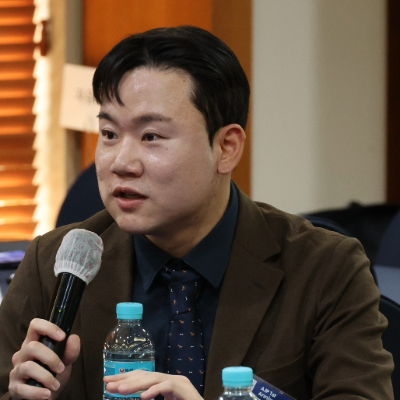
“The phrasing ‘respecting One China’ reflects South Korea’s long-held diplomatic language since normalization, not China’s unilateral ‘One China principle,’” Kim said, adding that the administration appeared to calibrate its message carefully ahead of the summit.
Park Han-jin of Hankuk University of Foreign Studies also viewed the positioning as pragmatic, noting that it reaffirmed South Korea’s diplomatic principles while anchoring them to universal values such as regional peace and stability.
Domestic Political Divide
The summit has exposed sharp divisions within South Korea’s political sphere.
Kim Sang-hoon, a lawmaker from the People Power Party, warned that Seoul risks undermining trilateral security cooperation with the United States and Japan. “China consistently maintains a dominant posture,” he said, expressing concern over possible fallout for advanced technology alliances with Washington.
By contrast, Kim Joon-hyung of the Rebuilding Korea Party called the summit “a long-overdue restoration” of Korea–China relations after what he described as years of diplomatic stagnation.
Limits on North Korea Impact
Most experts agree the summit is unlikely to produce meaningful progress on inter-Korean relations.
Kim Hyun-Wook, president of the Sejong Institute, said Korea–China economic ties have shifted from complementarity to competition, limiting the scope for cooperation. Still, he noted that any easing in U.S.–China tensions could marginally expand diplomatic space around North Korea.
Lee Wang Hwi of Ajou University was more blunt. “China’s influence over North Korea is limited,” he said, adding that Pyongyang’s deepening ties with Russia now outweigh Beijing’s leverage.
Woo Jung Moo concurred, arguing that North Korea would seek to dilute any joint messages emerging from Seoul and Beijing by leaning further on Moscow.
Park Han-jin offered a more conditional view, suggesting that sustained trust-building between Seoul and Beijing could, over time, expand China’s willingness to play a stabilizing role — though likely only in exchange for concessions linked to economic or regional issues.
Strategic Ambiguity and Economic Reality
On the broader trajectory of Korea–China relations, views diverge sharply.
Former presidential economic security secretary Ahn Se Hyun argued that geopolitical shifts leave China little choice but to adopt a more conciliatory approach toward South Korea, even as the bilateral relationship remains structurally constrained by the U.S.–ROK alliance.
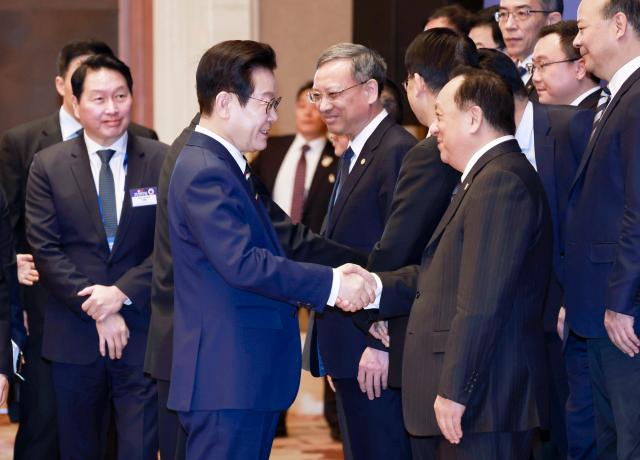
Lee Jung-tae of Kyungpook National University countered that despite security frictions, Korea and China remain deeply economically integrated, making outright confrontation unrealistic.
Several scholars emphasized the importance of expanding non-political exchanges. Kang Jun-young of Hankuk University of Foreign Studies said economic, social and cultural interaction with Taiwan should continue as long as it remains non-political, while Lee Han-eol of Pusan National University stressed the value of student, academic and business exchanges in reducing misperceptions.
Copyright ⓒ Aju Press All rights reserved.
