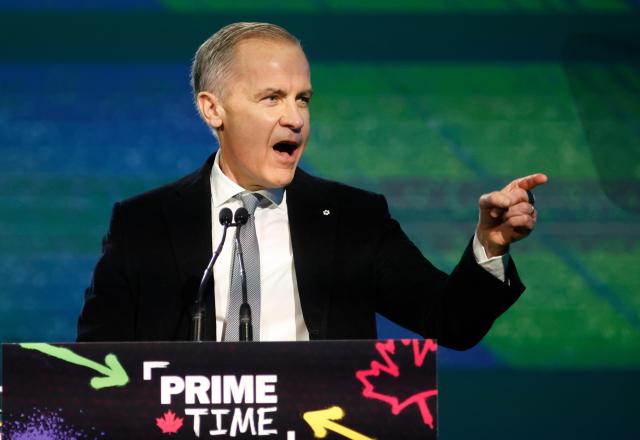
Arguing that the rules-based international order long led by the United States is breaking down, Carney called for a coalition of middle powers grounded in “value-based realism.” Whatever its feasibility, the message is likely to resonate in South Korea, another middle power facing similar geopolitical uncertainty.
Carney’s point was straightforward: With the Trump administration pressing allies in trade and security in a blunt, one-sided way, countries like Canada can no longer rely on the old order and must prepare for U.S. unpredictability. Rather than being pulled along by bilateral talks with a hegemon, middle powers should cooperate.
“In a world of great-power competition, countries caught in between have a choice — compete with each other for favor, or combine to create a third path with influence,” Carney said. “Middle powers must act together. If we are not at the table, we are on the menu,” he warned.
Carney’s unusually forceful tone toward Canada’s closest ally reflects the past year. Since returning to the White House a year ago, President Donald Trump has treated U.S. partners harshly — at times brutally — in the name of maximizing national interest. He has derided Canada as a weak neighbor and said it should become the 51st U.S. state.
Trump has accused allies of exploiting the United States on trade and security, and has openly dismissed the multilateral trading system that has bound countries together for decades. He imposed large tariffs not only on rivals but also on allies such as Canada.
Trump’s latest provocation is his demand to take control of Greenland, a Danish territory. Like most European countries, Canada opposes what it sees as Trump’s imperial thinking. Carney lamented that “great powers have begun using economic integration as a weapon, tariffs as leverage, financial infrastructure as coercion, and supply chains as exploitable vulnerabilities.”
Carney’s speech drew broad praise. Nobel Prize-winning economist Paul Krugman contrasted “Courageous Carney” with “Demented Donald.” Middle powers such as Sweden and Mexico publicly backed Carney’s call for a middle-power coalition.
As expected, Trump attacked the speech, arguing Canada was ungrateful to the United States, which buys nearly 70% of Canadian exports.
South Korea’s government, too, has remained silent. It depends heavily on the United States for both security and trade, and with key trade and tariff negotiations underway, it has little room to criticize Washington publicly. Since taking office in June, President Lee Jae Myung has been anxious to avoid provoking Trump.
Carney’s idea of building a middle-power coalition against great-power pressure may sound fair and persuasive, but it would be difficult to execute. Such solidarity could quickly be seen as anti-American or anti-Chinese, and participants could be pulled deeper into great-power rivalry. For countries like South Korea, it could invite U.S. suspicion or Chinese retaliation, harming trade or security interests.
Middle powers may be easy to define by economic size or population, but their political, economic, social and cultural structures vary widely, making consistent collective action hard.
Still, Carney’s speech offers ideas South Korea could weigh. Under the banner of “value-based realism,” Canada aims to build different coalitions issue by issue based on shared values and interests. It also includes a plan to link the Trans-Pacific Partnership with the European Union, potentially creating a new trade bloc of 1.5 billion people. In short, Canada is seeking deeper global engagement through geographic diversification.
South Korea has pursued geographic diversification for years with limited results, constrained by its geopolitical vulnerability amid surrounding great powers. But the picture could change if it strengthens cooperation with like-minded middle powers such as Canada, Japan and Australia. A coalition of market-based democracies committed to multilateralism could add weight, especially if it also links with European and Nordic middle powers.
Carney’s proposal to connect the TPP — renamed the CPTPP after the United States withdrew — with the EU carries particular implications for South Korea. South Korea is seeking to join the CPTPP, led by Japan and Australia. If it were to join a CPTPP closely linked to the EU as Carney envisions, it could open new opportunities and serve as a safeguard in a dangerous era of great-power competition.
In that sense, South Korea’s delegation at Davos may not have applauded openly in front of U.S. representatives, but it likely welcomed the message quietly.
*The author is a professor of the Graduate School of Global Service at Sookmyung Women's University.
![[이병종 숙명여대 글로벌서비스학부 교수]](https://image.ajunews.com/content/image/2024/10/02/20241002130529793020.jpg)
About the author:
▷Ph.D. in journalism and communication, Yonsei University ▷AP correspondent ▷Newsweek Korea bureau chief ▷President, Seoul Foreign Correspondents’ Club
* This article, published by Aju Business Daily, was translated by AI and edited by AJP.
Copyright ⓒ Aju Press All rights reserved.