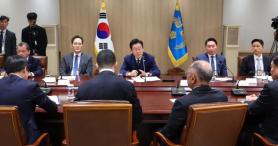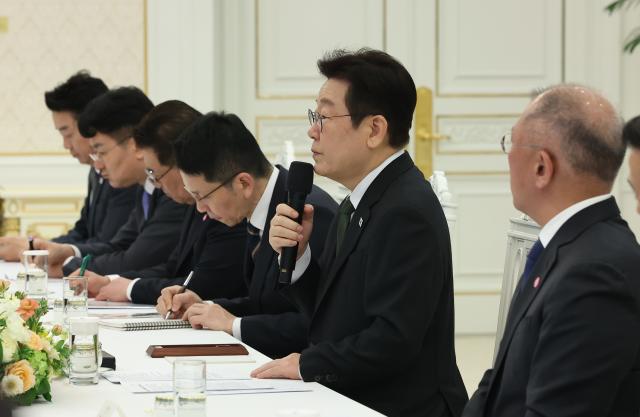
“As our companies work hard and the economy gradually begins to recover, I hope the fruits of growth will be shared more broadly,” Lee said at a meeting with conglomerate chiefs at Cheong Wa Dae on Tuesday. “Those benefits should spread evenly to small and medium-sized businesses, regional communities and the younger generation.”
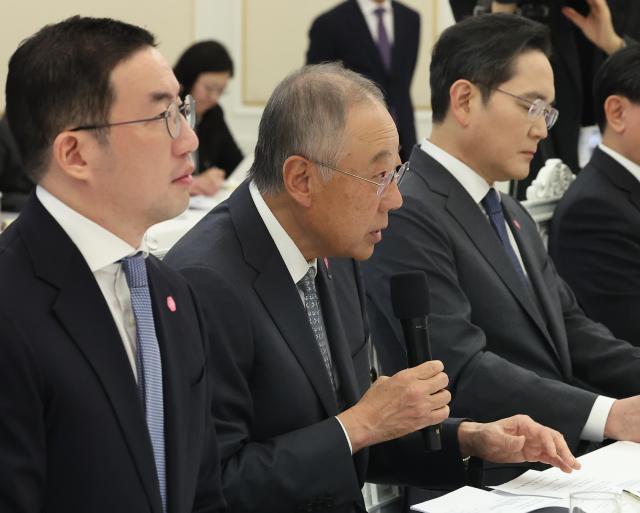
It was the first dinner hosted for conglomerates by the president.
Federation of Korean Industries Chairman Ryu Jin said the nation’s top 10 conglomerates plan to invest 270 trillion won in regional cities and provinces over the next five years. Combined with other corporate investment plans, the total is expected to reach around 300 trillion won.
According to the FKI, if fully implemented, the pledged investment could generate up to 525 trillion won in production and 221 trillion won in added value.
The move reflects growing concern over widening economic polarization. While large exporters have posted record earnings, many small and medium-sized firms continue to struggle amid weak domestic demand.
Government data showed that the manufacturing production index for large companies rose 3.0 percent last year to a record 118.8, while that of small firms fell 3.3 percent to 98.3, the lowest level on record.
Advanced industries such as semiconductors and batteries remain concentrated in the Seoul metropolitan area, accelerating youth outflows and deepening regional disparities.
“The economy is like an ecosystem,” the president said. “Just as grass, grasshoppers and rabbits are needed for tigers to thrive, smaller firms, regional communities and young people must also prosper.”
Major investment projects will focus on semiconductor facilities, battery research and production, carbon-neutral infrastructure and renewable energy.
Samsung Electronics has pledged to newly hire 60,000 workers domestically and invest 450 trillion won over five years, including in R&D and facilities. The company plans to expand hiring in semiconductors, biotechnology and artificial intelligence.
SK hynix will invest 19 trillion won in an advanced packaging plant in Cheongju, with total employment effects expected to exceed 10,000 jobs. It is also preparing to launch its M15X plant for next-generation memory production.
Hyundai Motor Group has announced a 125.2 trillion won domestic investment plan for 2026–2030, including hydrogen infrastructure and electric vehicle facilities in Ulsan and the southwest region.
LG Group plans to invest 100 trillion won domestically over five years, with LG Innotek expanding operations in Gwangju and Gumi.
POSCO Group will invest about 5 trillion won this year in steel, battery materials and LNG projects, including hydrogen-based steelmaking facilities.
Other groups, including Hanwha Aerospace and GS Group, are expanding investments in defense, wind power, LNG and small modular reactors.
Lee said the government plans to foster five major regional hubs and three special self-governing provinces, urging companies to align their investment strategies with national development plans.
“The government will create new centers of growth in regions and invest intensively,” he said. “I hope companies will move in step with these efforts.”
He added that special legislation will be introduced to support renewable energy clusters and energy cities, while giving greater weight to non-capital regions in fiscal allocations.
Advances in transportation and digital infrastructure have narrowed the gap between Seoul and regional areas, making regional investment increasingly attractive, Lee said.
During the meeting, conglomerates also shared plans to hire a combined 51,600 workers this year, including 12,000 at Samsung and 8,500 at SK, presidential spokesperson Lee Kyu-yeon said.
Samsung and SK hynix both posted record operating profits last year, driven by surging demand for artificial intelligence chips.
Copyright ⓒ Aju Press All rights reserved.