
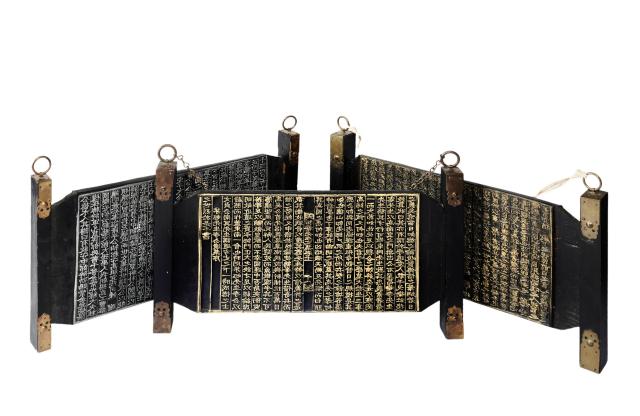
The Korea Heritage Service and the Overseas Korean Cultural Heritage Foundation said they received three woodblocks used to print collected works from the late Joseon period and the Japanese colonial era, donated by an American and a Korean American owner.
The donation ceremony was held on Feb. 8 (local time) at the Korean Empire legation in Washington.
The items are woodblocks for Cheokam Seonsaeng Munjip, Songja Daejeon and Beonamjip. The foundation said Americans who worked in South Korea in the early 1970s bought them as souvenirs and took them to the United States.
The Cheokam Seonsaeng Munjip woodblock, carved in 1917, was used to print the collected works of Kim Do Hwa (1825-1912), who served as a militia leader in the Andong area during the Eulmi Righteous Army uprising in 1895. The foundation said there were originally more than 1,000 related woodblocks. In 2015, 19 Confucian woodblocks were collectively inscribed on UNESCO’s Memory of the World Register as “Korean Confucian Woodblocks.” In 2019, with support from Riot Games, the foundation bought one matching woodblock at a German auction and donated it to the Korea Studies Advancement Center; it has now received another of the same type.
The foundation said the woodblock had been purchased from an antique dealer in South Korea by Alan Gordon (1933-2011), an American who worked for the U.S. Agency for International Development’s Korea mission in the early 1970s, and taken to the United States. After his death, his wife, Tamra Gordon, kept it and in 2025 inquired about donating it to the Smithsonian’s National Museum of Asian Art; it was then transferred to the foundation’s U.S. office and returned through the donation.
The Songja Daejeon woodblock, carved in 1926, was used for a compilation of writings, a chronology and other materials related to Song Si Yeol (1607-1689), a Confucian scholar of the late Joseon period. The work was first published in 1787. The foundation said all the original woodblocks were destroyed by the Japanese military in 1907, and descendants and Confucian scholars recarved them in 1926. The 11,023 recarved woodblocks were designated a Daejeon city tangible cultural heritage in 1989. The foundation said Alan Gordon bought this woodblock from an antique dealer in South Korea and gave it to his younger sister; it was returned along with the Cheokam Seonsaeng Munjip woodblock.
The Beonamjip woodblock, carved in 1824, was used to print the collected works of Chae Je Gong (1720-1799), a civil official who played a central role in state affairs during the reigns of King Yeongjo and King Jeongjo. Of 1,159 woodblocks, only 358 survive, the foundation said. Like the Cheokam Seonsaeng Munjip woodblock, it was included in the 2015 UNESCO Memory of the World inscription.
The foundation said an American who worked in South Korea in the early 1970s bought the woodblock from an antique dealer, took it to the United States and gave it to the family of Kim Eun Hye, a Korean American. After the foundation’s U.S. office confirmed the background and proposed a donation, Kim agreed, and the woodblock was donated and returned with the others.
* This article has been translated by AI.
Copyright ⓒ Aju Press All rights reserved.