
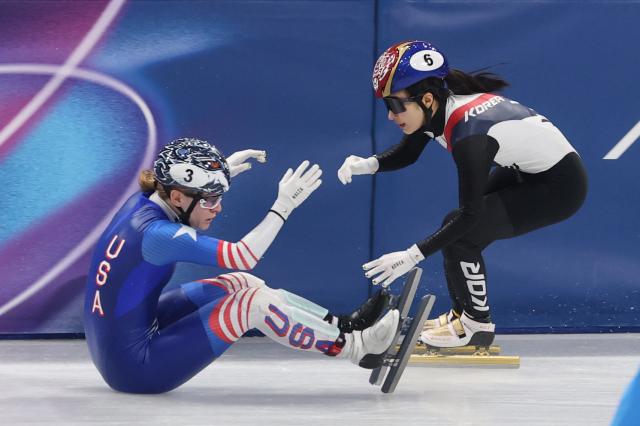
On Feb. 10 in Milan, U.S. skater Corinne Stoddard loses balance and falls in front of South Korea’s Kim Gil-li during the short track mixed relay semifinal at the Milano Ice Skating Arena at the 2026 Milan-Cortina d’Ampezzo Winter Olympics. [Photo=Yonhap]
The U.S. short track team blamed “soft ice” after a series of falls and a collision in the first short track event of the 2026 Milan-Cortina d’Ampezzo Winter Olympics, saying the conditions affected the mixed 2,000-meter relay and shook up the medal race.
U.S. national team skater Andrew Heo, a Korean American, said after the mixed relay on Feb. 10 (Korea time) that the ice felt duller than what the team is used to. “With a lot of spectators, the temperature went up, and I think that made the ice dull,” he told reporters in the mixed zone.
“If the ice is too soft, you can’t apply power properly,” Heo said. “I think that’s why there were a lot of falls.”
In the mixed 2,000-meter relay semifinal, the United States was leading when Corinne Stoddard slipped in a corner and dropped as far as fourth, missing the final. Stoddard collided with South Korea’s Kim Gil-li of Seongnam City Hall, and both skaters went down on the track.
South Korea crossed the line third, missing its chance to compete for a medal.
The U.S. team had other shaky moments. In the quarterfinals, Stoddard also fell, but a chain collision among other skaters in the same heat helped the United States advance in second place.
Another Korean American skater, Brandon Kim, also pointed to the ice. He said sharing the venue with figure skating appeared to make the surface different from other competitions. “Short track and figure skating need different ice, but it seems there wasn’t enough time to change it,” he said.
“When the ice is hard, you’re stable in the corners, but when it’s soft, it’s difficult,” he said. “We can’t change the ice, so we just have to do our best.”
U.S. national team skater Andrew Heo, a Korean American, said after the mixed relay on Feb. 10 (Korea time) that the ice felt duller than what the team is used to. “With a lot of spectators, the temperature went up, and I think that made the ice dull,” he told reporters in the mixed zone.
“If the ice is too soft, you can’t apply power properly,” Heo said. “I think that’s why there were a lot of falls.”
In the mixed 2,000-meter relay semifinal, the United States was leading when Corinne Stoddard slipped in a corner and dropped as far as fourth, missing the final. Stoddard collided with South Korea’s Kim Gil-li of Seongnam City Hall, and both skaters went down on the track.
South Korea crossed the line third, missing its chance to compete for a medal.
The U.S. team had other shaky moments. In the quarterfinals, Stoddard also fell, but a chain collision among other skaters in the same heat helped the United States advance in second place.
Another Korean American skater, Brandon Kim, also pointed to the ice. He said sharing the venue with figure skating appeared to make the surface different from other competitions. “Short track and figure skating need different ice, but it seems there wasn’t enough time to change it,” he said.
“When the ice is hard, you’re stable in the corners, but when it’s soft, it’s difficult,” he said. “We can’t change the ice, so we just have to do our best.”
* This article has been translated by AI.
Copyright ⓒ Aju Press All rights reserved.