Yet political developments are still often judged through a Western lens, with democracy and market economies assessed by how closely they align with Western standards. The key question is whether Asia should continue defining itself in comparison with the West or develop its own framework based on its history and experience.
This series, part of "Asia Insight," begins with the idea that Asia should develop its own language to explain itself and reinterpret democracy and market economics in an Asian context. Its first case study is Bangladesh's recent change of government. Since gaining independence in 1971, Bangladesh has experienced military coups, authoritarian rule, dynastic politics, and street protests.
Democracy in Bangladesh has repeatedly been challenged, and elections have at times sparked conflict and division. The two major parties, the Awami League and the Bangladesh Nationalist Party (BNP), have competed for power for decades, reflecting not only political rivalry but also competing visions of national identity.
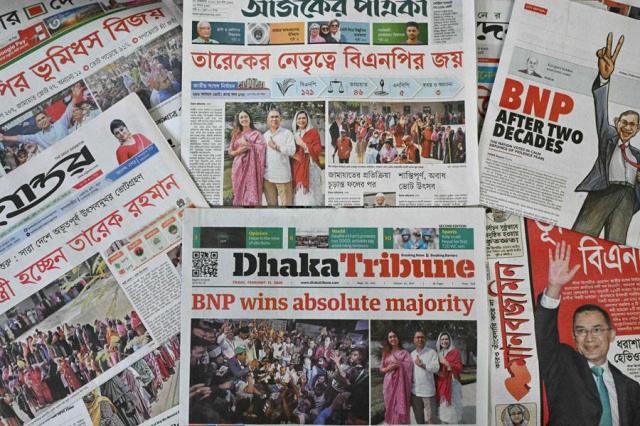
The 2026 general election last Friday marked a major turning point in Bangladesh's political trajectory. A BNP-led coalition secured widespread voter support through a nationwide campaign and strong party organization, winning well over a majority of seats amid high turnout on election day. Voting and counting proceeded relatively smoothly under the oversight of international monitors and domestic election authorities, and despite some objections, the results were accepted without large-scale clashes.
The outcome was significant beyond a simple win or loss, demonstrating that power could change hands through ballots rather than force. The process, in which Tarique Rahman returned home after 17 years in exile and emerged as the leading candidate for prime minister, was presented as a transfer of power through constitutional procedures rather than military intervention or emergency rule. During the post-election transition, efforts were made to avoid sharp confrontation, and the new leadership pledged to prioritize national stability and the restoration of normal governance.
The implications extend beyond Bangladesh, as Asia confronts overlapping pressures from U.S.-China rivalry, rising protectionism, energy-security uncertainties, and rivalry over technological dominance. Global supply chains are being reshaped, and middle powers are pursuing balanced diplomacy to avoid overdependence on any single major power.
Bangladesh, too, signaled its intention to guard against excessive reliance on one country and diversify its diplomatic and economic strategy, a concern shared by many nations in Southeast Asia. The question of whether states become arenas for great-power competition or achieve strategic autonomy is not unique to Bangladesh.
Still, an election victory is only a starting point. Democracy is not built on votes alone; it also requires judicial independence, press freedom, a political culture that respects the opposition, and transparent governance.
Post-election restraint and limits on the use of power are seen as central tests for the new government. If the rule of law weakens, markets can become instruments of privilege; if institutional trust collapses, sustainable economic growth is undermined. Whether Bangladesh’s political shift leads to durable democratic institutions will depend on the decisions made in the coming period.
South Korea offers valuable lessons. It emerged from colonialism and war, democratized through grassroots struggle against authoritarianism, and became an economic success story through strategic industrialization, educational investment, and technological prowess.
South Korea's development was shaped by a combination of public checks on power, a strong rule of law, peaceful democratic transfers of government, and a market economy governed by transparent rules. While the system was not perfect, it was continually refined and improved, demonstrating that democracy is an evolving process rather than a fixed condition.
Bangladesh and South Korea already share extensive people-to-people exchanges. Many Bangladeshi workers are employed in South Korean businesses, gaining valuable experience with industrial technologies and skills. This goes beyond labor migration, serving as a channel for social learning. Exposure to contract reliability, compliance with safety regulations, production management systems, e-government, and digital administration provides an unseen foundation for growth. Such experience could help set new standards in Bangladesh’s industry and public sector when these workers return their home.
Across Asia, political progress has been shaped by long periods of colonial rule, military dictatorships, and single-party dominance. The path has not been smooth, marked by setbacks and turmoil, but civic awareness steadily accumulates, and greater access to education and information makes it increasingly difficult to maintain monopolies on power.
Market economies require transparency and predictability, which can drive institutional reform. An Asian perspective does not reject freedom but seeks to integrate it within each country's history and culture, balancing communal values with individual rights while pursuing both growth and fairness.
This is where "Asia Insight" begins. The goal is not to deny Western perspectives but to build an indigenous Asian language for understanding Asia itself.
Bangladesh's change of government is presented as more than a single country's political event, a case that shows both the possibilities and limits of democracy in Asia. The underlying principle is that sustainable prosperity becomes possible when power derives from the people, law stands above authority, and markets operate under fair rules and that these principles belong to no single civilization.
Truth, justice, and freedom are universal values, and Asia plays a role in upholding them. No longer peripheral, Asia becomes central when it defines itself on its own terms and interprets the world in its own voice. Bangladesh's transition is one chapter in that story, and "Asia Insight" turns the first page.
*The author is an AJP columnist.
Copyright ⓒ Aju Press All rights reserved.