
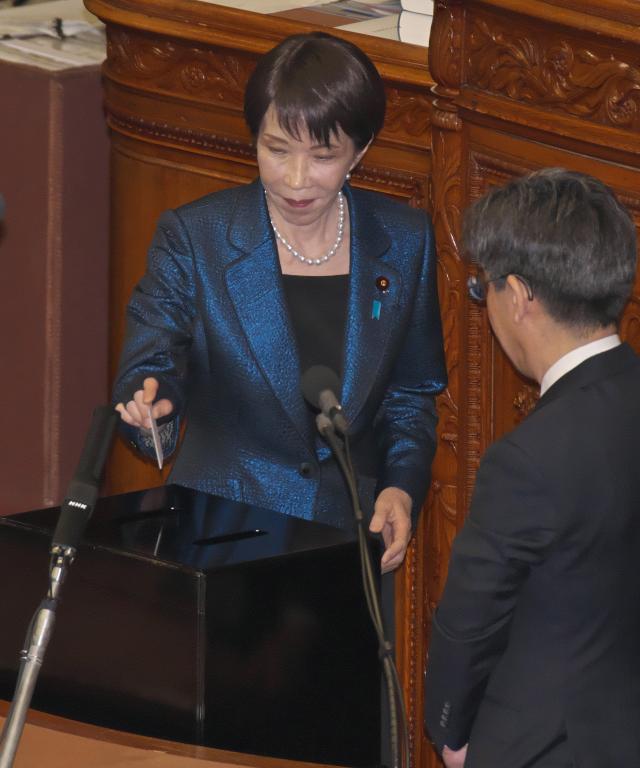
The soaring popularity and landslide election victory of Sanae Takaichi stand out in Asia, especially in a political culture where women have long been sidelined. Her rise has been hailed as a breakthrough moment for Japan — proof that even one of the world’s most male-dominated political systems can change.
Yet her ascent also invites a quieter, more uneasy question: Is she standing on what Western scholars call a “glass cliff”?
With the Liberal Democratic Party now holding its largest-ever majority, Takaichi wields rare political authority. Backed by more than two-thirds of the lower house, her government can push through legislation with little resistance. The Economist has described her as the most powerful woman in the world today.
But power, in politics, does not always mean security.
The idea of the “glass cliff” builds on the familiar notion of the “glass ceiling.” While the ceiling describes barriers that block women from rising, the cliff explains what often happens after they break through. Women are disproportionately elevated to leadership when institutions are already in deep trouble — when risks are highest and failure is most likely.
The concept was developed in the mid-2000s by Australian scholars Michelle Ryan and Alex Haslam. Studying corporate leadership in Britain, they challenged the claim that women fail because they lack ability. Instead, they found that women are often chosen precisely when organizations are faltering — when male leaders step aside and a “new face” is needed to absorb political and social shock.
Politics provides vivid examples.
In Britain, Theresa May took office in 2016 after the Brexit referendum plunged the country into uncertainty. Her predecessor, David Cameron, resigned after losing the vote. The Conservatives turned to a woman to lead amid chaos. May resigned three years later, becoming Britain’s second female prime minister after Margaret Thatcher.
Her successor, Liz Truss, followed a similar trajectory. She entered office after Boris Johnson fell amid scandals and crises. Britain was grappling with inflation, energy shocks and post-pandemic disruption. Truss lasted just 45 days — the shortest tenure in modern British history.
In such cases, political failure is rarely treated as situational. Instead, it is often framed as proof that women “cannot lead.” The burden of collapse is placed on gender, not context. The glass cliff then reinforces the very stereotypes that once formed the glass ceiling.
South Korea offers its own cautionary tale.
The country became the first in Northeast Asia’s Confucian-influenced societies to elect a woman president with Park Geun-hye. Her impeachment and imprisonment marked one of the darkest chapters in modern Korean politics. Yet discussion of her downfall has frequently blended institutional failures with judgments about her gender.
As a result, many now doubt whether South Korea will elect another woman president anytime soon.
The pattern extends beyond the presidency. Under successive administrations, women have often been appointed to sensitive posts during turbulent periods — sometimes to signal reform, sometimes to soften political backlash.
One recent example was former lawmaker Lee Hye-hoon, nominated by President Lee Jae Myung as the first head of the Ministry of Planning and Budget. Her appointment was meant to bridge political divides and project change. But amid polarization and investigations involving her family, she ultimately fell.
Formally, her downfall rested on political conflict and allegations. Informally, it added to public skepticism toward women leaders. In the current administration, all three ministerial nominees who failed confirmation hearings were women — a coincidence that risks hardening invisible barriers.
Against this backdrop, it is natural to feel both hope and unease about Takaichi.
Her decisive election victory reflects genuine public support. Voters were drawn to her frank style, her economic agenda and her outsider image in a male-dominated system. Calling a risky snap election in the middle of winter, she secured a historic supermajority and emerged with an overwhelming mandate. Few Japanese leaders in recent decades have entered office with such momentum.
Yet Japan’s political culture remains deeply patriarchal — in many respects more rigid than South Korea’s. Women remain underrepresented in parliament, corporate leadership and senior bureaucracy. In such an environment, symbolic elevation followed by disproportionate blame is always a risk.
If Takaichi succeeds, she will expand the boundaries of what is possible for women in Japanese politics. If she fails, her fall may be framed not as a political setback, but as evidence that “this experiment” with female leadership did not work.
That narrative would not stop at Japan’s borders. In a region where women leaders remain rare, her fate will be closely watched in Seoul and beyond.
The glass cliff is not destiny. It is a structure created by institutions that seek renewal without accepting responsibility. Breaking it requires more than applauding women when they rise. It requires judging them by the same standards — and granting them the same margin for error — as men.
Takaichi has earned her mandate. She deserves to be evaluated on policy, competence and results, not on her gender. For the sake of future leaders who hope to break Asia’s political ceilings, one hopes she will not be pushed toward a cliff — and that she will be allowed, finally, to walk on solid ground.

*The author is a contributing columnist to the Aju Business Daily.
About the author:
▷Former CNN Seoul bureau chief ▷Former ambassador for cultural cooperation at the Foreign Ministry ▷Former president of the Korea International Broadcasting Foundation (Arirang TV) ▷Former senior secretary for overseas publicity at the presidential office ▷Former president of the Seoul Foreign Correspondents’ Club ▷Former New York Times reporter ▷Visiting professor at Ewha Womans University’s Graduate School of International Studies
*This article originally published on the Aju Business Daily was edited into English by AJP.
Copyright ⓒ Aju Press All rights reserved.
