SEOUL, February 26 (AJP) - Financial stability concerns have re-emerged as the decisive variable in South Korea’s monetary policy outlook this year as inflation and economic growth return to target range.
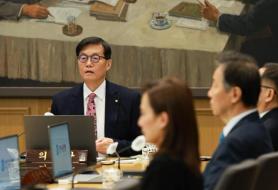
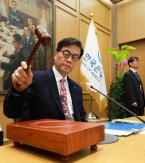
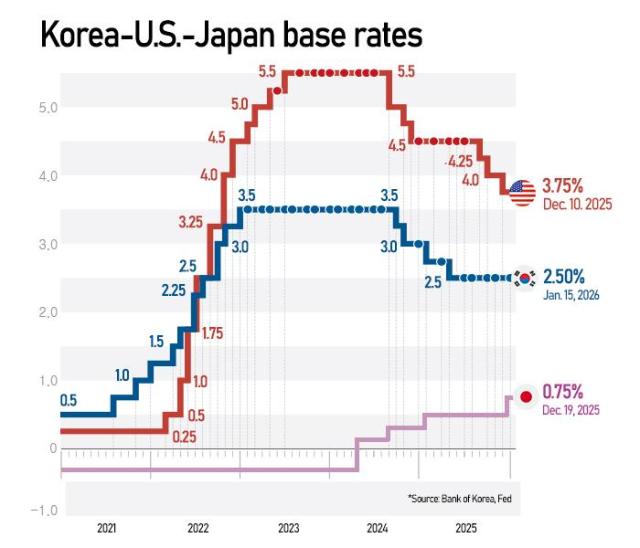
The Bank of Korea’s Monetary Policy Board on Thursday unanimously kept the benchmark rate unchanged at 2.5 percent, where it has remained since the May 2025 cut.
“With inflation expected to remain stable near the target level, economic growth is projected to improve at a stronger-than-expected pace,” the BOK said in its statement.
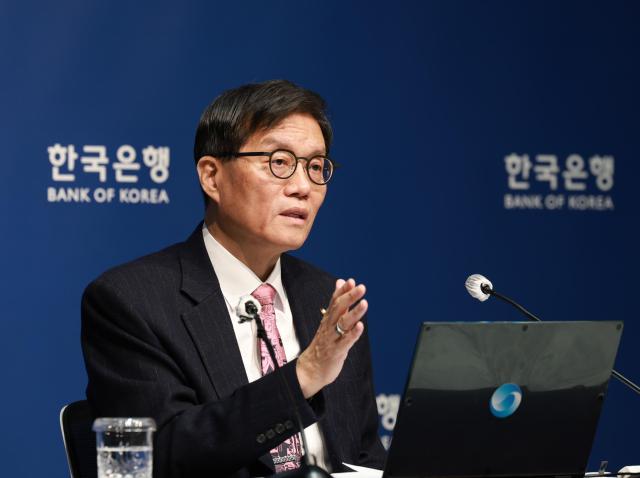
Governor Rhee Chang-yong in a post-meeting briefing shared the internal concerns over the gap between the overnight policy rate and the three-year government bond yield as “excessive,” saying rates could move higher in the second half should financial imbalances intensify.
Markets interpreted the decision as extending the pause rather than preparing for tightening.
The three-year government bond yield fell 5.6 basis points to 3.068 percent, while the 10-year yield declined 4.6 basis points to 3.510 percent, reflecting expectations that policy neutrality may last longer than previously thought.
Improving macro conditions also lessen the rationale for further easing.
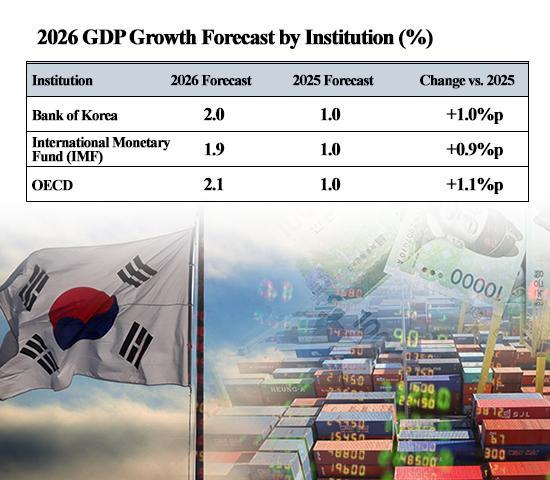
The BOK revised up its 2026 growth forecast to 2.0 percent from 1.8 percent projected in November.
Consumer price inflation is expected to reach 2.2 percent, broadly in line with last year’s 2.1 percent pace. The projections are consistent with outlooks from the International Monetary Fund and the OECD.
If realized, the economy would be running at its estimated potential growth rate after slowing to 1.0 percent in 2025.
Notably, the BOK in January removed language referencing further easing from its policy statement — a subtle but meaningful shift in forward guidance.
Liquidity and leverage back in focus
Thursday’s meeting placed heavy emphasis on excess liquidity and leveraged asset investment, particularly in real estate and equities.
Household credit reached 1,978.8 trillion won ($1.38 trillion) in the fourth quarter of last year. Policymakers have repeatedly warned that household loans — especially property-related borrowing — have approached levels that threaten financial stability and must be reduced.
The red-hot equity market has added to those concerns. The KOSPI surged 3.1 percent on Thursday, topping 6,200 a day after breaking above the 6,000 milestone, raising renewed debate over asset-price overheating.
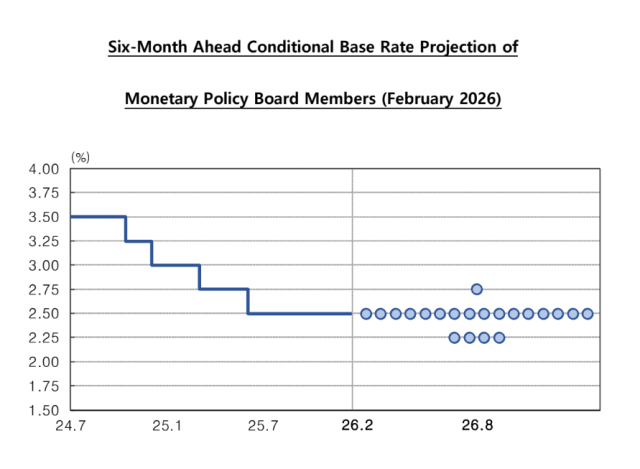
While the BOK’s six-month dot plot still assigns a higher probability to a rate cut than a hike, it effectively signals prolonged neutrality unless clearer directional signals emerge.
What appears to concern policymakers most is the composition of growth.
According to the BOK’s Economic Outlook report released Thursday, growth excluding the IT sector is projected at just 1.4 percent within the revised 2.0 percent headline forecast. That compares with the same 1.4 percent non-IT projection when overall growth was previously estimated at 1.8 percent.
The data suggests that Korea’s recovery is becoming increasingly dependent on semiconductors and IT exports — a concentration risk that complicates policy normalization.
Copyright ⓒ Aju Press All rights reserved.