SEOUL, March 3 (AJP) - The government will come up with support for small and mid‑sized exporters hit by the Middle East conflict following the U.S.‑led military action against Tehran dubbed "Operation Epic Fury" last week.
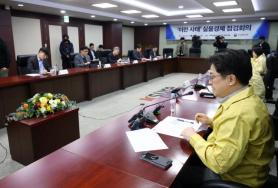
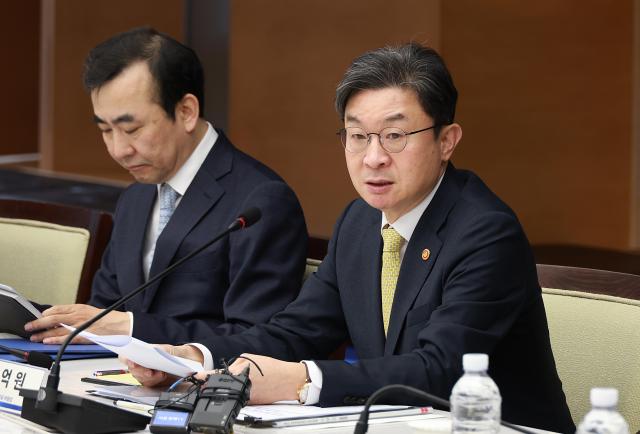
According to the Financial Services Commission (FSC), a financial support program worth approximately 13.3 trillion won (around US$9.2 billion) will be provided to exporters affected by the conflict. The decision was made at a meeting chaired by FSC Chief Lee Eok‑won on Tuesday at the government complex in Seoul, held to discuss support measures with other financial authorities and agencies including the Ministry of Economy and Finance, the Bank of Korea, the Financial Supervisory Service, Korea Development Bank, and Industrial Bank of Korea.
Under the program run by the Korea Development Bank (8 trillion won), Industrial Bank of Korea (2.3 trillion won), and the Korea Credit Guarantee Fund (3 trillion won), financial authorities plan to quickly provide funding and interest-rate reductions to affected firms, while also operating a counseling center to support them.
The FSS said South Korea's overall exports to the region are not large, but some vulnerable SMEs that rely heavily on the Middle Eastern market will require tailored assistance.
Participants forecast that volatility in stock and foreign exchange markets could increase depending on how the situation develops, with possible spillovers to the real economy. They agreed to closely coordinate across agencies to monitor markets and respond as needed.
Lee said South Korea's economy and financial markets have solid fundamentals and sufficient capacity to weather the situation, but he urged the implementation of pre-arranged measures to shore up stability if necessary.
He also said authorities will strictly punish unfair trading that takes advantage of market uncertainty, including the spread of fake news and price manipulation, and vowed to inspect suspicious activities.
Global markets on the previous day reflected the heightened risk from the Middle East, with international oil prices jumping early before giving back some gains. Major stock markets mostly fell or remained flat, while gold prices and the U.S. dollar rose. West Texas Intermediate (WTI) crude increased 6.3 percent from the prior session.
The FSS said a joint financial market task force will maintain a 24-hour monitoring system until markets stabilize and will closely share developments with relevant agencies.
According to the Financial Services Commission (FSC), a financial support program worth approximately 13.3 trillion won (around US$9.2 billion) will be provided to exporters affected by the conflict. The decision was made at a meeting chaired by FSC Chief Lee Eok‑won on Tuesday at the government complex in Seoul, held to discuss support measures with other financial authorities and agencies including the Ministry of Economy and Finance, the Bank of Korea, the Financial Supervisory Service, Korea Development Bank, and Industrial Bank of Korea.
Under the program run by the Korea Development Bank (8 trillion won), Industrial Bank of Korea (2.3 trillion won), and the Korea Credit Guarantee Fund (3 trillion won), financial authorities plan to quickly provide funding and interest-rate reductions to affected firms, while also operating a counseling center to support them.
The FSS said South Korea's overall exports to the region are not large, but some vulnerable SMEs that rely heavily on the Middle Eastern market will require tailored assistance.
Participants forecast that volatility in stock and foreign exchange markets could increase depending on how the situation develops, with possible spillovers to the real economy. They agreed to closely coordinate across agencies to monitor markets and respond as needed.
Lee said South Korea's economy and financial markets have solid fundamentals and sufficient capacity to weather the situation, but he urged the implementation of pre-arranged measures to shore up stability if necessary.
He also said authorities will strictly punish unfair trading that takes advantage of market uncertainty, including the spread of fake news and price manipulation, and vowed to inspect suspicious activities.
Global markets on the previous day reflected the heightened risk from the Middle East, with international oil prices jumping early before giving back some gains. Major stock markets mostly fell or remained flat, while gold prices and the U.S. dollar rose. West Texas Intermediate (WTI) crude increased 6.3 percent from the prior session.
The FSS said a joint financial market task force will maintain a 24-hour monitoring system until markets stabilize and will closely share developments with relevant agencies.
Copyright ⓒ Aju Press All rights reserved.