
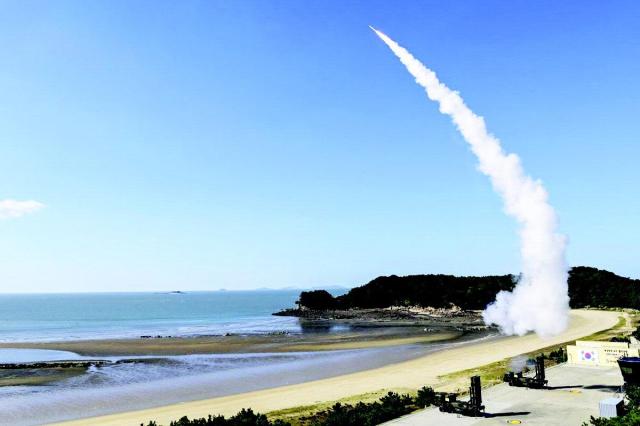
The defense industry said Tuesday that the United Arab Emirates used the South Korean-made medium-range surface-to-air guided weapon system to intercept multiple Iranian missiles. With forecasts that Iran could fire ballistic missiles toward countries near U.S. forces, the UAE fielded Cheongung-II and it was used operationally, the industry said. The UAE’s air defense network is known to include the U.S.-made Patriot, Israel’s Arrow and South Korea’s Cheongung-II. The UAE military said its overall interception rate across its air defense systems was above 90%.
Often described as a Korean version of the Patriot, Cheongung-II is a medium-range surface-to-air missile system jointly produced by LIG Nex1, Hanwha Aerospace and Hanwha Systems. If wartime demand accelerates local deployment, related sales are expected to be reflected starting this year.
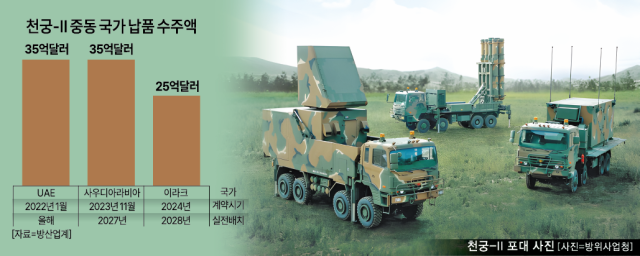
The system is a so-called “K-one team” project involving major South Korean defense firms. LIG Nex1 handles system integration and the operations control center; Hanwha Systems supplies the multifunction radar; Hanwha Aerospace provides launchers and munitions. Kia supplies the vehicle platform.
Cheongung-II is widely seen as costing about half as much as the U.S. Patriot, helping it gain traction in the Middle East, where demand for guided weapons is high. The push by some countries to reduce reliance on a single supplier has also supported broader interest in South Korean defense exports.
Chae Un-saem, an analyst at Hana Securities, said Lockheed Martin’s Patriot PAC-3 surface-to-air missiles have an annual production capacity of about 600 rounds despite plans to increase output. “The unit price is also very high at $4 million, making it more than twice as expensive as Korea’s Cheongung,” Chae said.
South Korea recently signed a $35 billion memorandum of understanding on defense cooperation with the UAE, adding to expectations of further exports. Details were not disclosed, but forecasts have pointed to additional contracts for medium- and long-range weapons to build a layered air defense network.
Experts said continued instability in the region could keep export momentum going for South Korean defense companies.
Nam Myeong-ryeol, head of Korea University’s K-Defense Industry Center, said tensions are rising as Iran attacks not only Israel but also multiple areas where U.S. forces are stationed. “More Middle Eastern countries are likely to seek South Korean weapons that combine performance and price competitiveness, fast delivery, and the ability to operate and sustain the systems,” he said.
* This article has been translated by AI.
Copyright ⓒ Aju Press All rights reserved.