
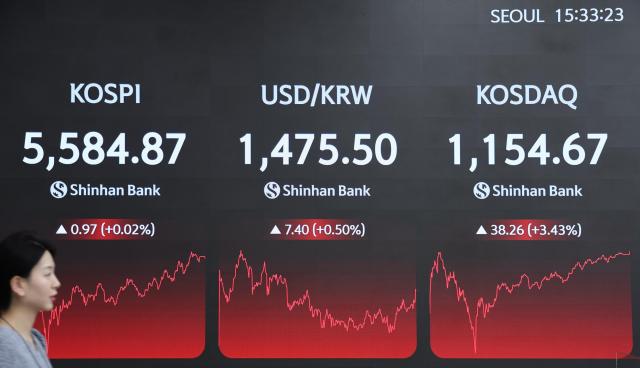
Volatility tied to the Iran situation has prompted some South Korean retail investors to treat the market swings as a buying opportunity, tapping bank credit lines to invest in stocks. Overdraft-style personal credit balances at major banks have surged in a short period while deposits have fallen, suggesting money is moving quickly into the market.
As of March 5, personal overdraft loan balances at the five major banks — KB, Shinhan, Hana, Woori and NH NongHyup — totaled 40.7227 trillion won, according to the financial industry on Saturday. That figure reflects outstanding amounts actually used and rose 1.2979 trillion won in five days from the end of February (39.4249 trillion won). Adjusted for business days (March 3-5), the increase was effectively nearly 1.3 trillion won in three days.
The balance is the largest for an end-of-month level since December 2022 (42.0546 trillion won). While the data cover only five days, the increase of 1.2979 trillion won is the biggest monthly-scale jump since November 2020 (+2.1263 trillion won).
In the second half of 2020, ultra-low interest rates aimed at cushioning the COVID-19 shock fueled heavy borrowing for home purchases and stock investing. In the second half of last year, overdraft balances also climbed into the 40 trillion won range, reaching 40.0837 trillion won at the end of November, amid strong markets and spillover effects from tighter mortgage rules.
After year-end and early-year bonuses helped bring balances back into the 39 trillion won range, overdraft borrowing has risen again following two days of sharp stock declines on March 3-4 linked to the Iran situation. At some banks, overdraft balances jumped by nearly 200 billion won in five days, an unusual move. Most of the funds are believed to have moved to brokerage firms.
The surge in overdraft-led credit lending contrasts with mortgages, which have been flat or declining amid regulations and weak housing transactions. As of March 5, mortgage balances at the five banks stood at 610.1417 trillion won, down 579.4 billion won from the end of February (610.7211 trillion won).
By contrast, total credit loans — general unsecured loans plus overdraft lines — rose 1.3945 trillion won in five days to 105.0765 trillion won. If that pace holds through month-end, it would be the largest increase since July 2021 (+1.8637 trillion won).
Deposits have also seen sizable outflows. Time deposits at the five banks totaled 944.1025 trillion won as of March 5, down 2.7872 trillion won from the end of last month. Demand deposits, often viewed as idle cash awaiting investment, fell 8.5993 trillion won over the same period, to 676.2610 trillion won from 684.8604 trillion won.
A commercial bank official said deposit rates have generally been rising along with market rates, yet deposits are still shrinking. The official said it is too early to draw firm conclusions but added that credit lending could increase further and more funds could continue flowing into stocks depending on developments in the Middle East and market conditions at home and abroad.
* This article has been translated by AI.
Copyright ⓒ Aju Press All rights reserved.