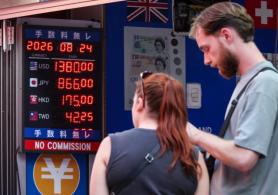
SEOUL, Mar. 12 (AJP) — Foreign investors pivoted to a net sell-off in South Korean financial markets between February and March, marking the first net outflow in six months. The South Korean won continued its steady decline, extending a period of weakness that began last month.
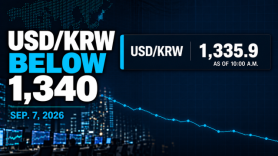
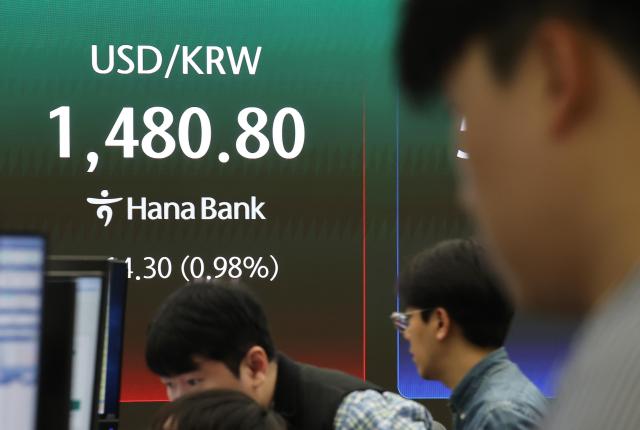
The value of the won has depreciated by 2 percent since February, falling from a January average of 1,439.5 per dollar to 1,469.2 as of March 10 according to a Bank of Korea (BOK) release on Thursday, marking the second consecutive month of decline, following a 1.4 percent weakening in January.
While the won’s fall last month occurred even as the U.S. Dollar Index softened, the current depreciation has been exacerbated by a 1.9 percent surge in the dollar index, fueled by escalating conflict in the Middle East.
Among emerging market currencies, the won’s decline was surpassed only by the Russian ruble, which fell 3.7 percent. In stark contrast, the Brazilian real emerged as the top performer, appreciating by 1.9 percent this month following a 5.7 percent surge last month, bolstered by the Brazilian central bank’s fiscal tightening and interest rate hikes.
While advanced currencies also weakened—with the euro falling 2 percent, the yen 2.1 percent, and the pound 1.9 percent—the underlying drivers differed significantly from the won. The weakness in these currencies was largely driven by dovish expectations: the yen softened following Prime Minister Sanae Takaichi’s nomination of a dovish policy board member, while the euro fell as CPI dipped below the 2 percent target. The won, however, continued to slide despite the BOK ruling out the possibility of rate cuts.
Volatility is also on the rise. The won’s daily fluctuation range expanded from 0.36 percent in December to 0.45 percent in January, reaching 0.58 percent in February.
Foreign portfolio investment saw a net outflow of $7.76 billion, the first shift to negative territory since August. This represents the second-largest monthly net outflow on record, eclipsed only by the $8.97 billion flight during the July 2008 financial crisis.
Equity markets bore the brunt of the exodus, with $13.5 billion in foreign capital exiting the KOSPI. This surpassed the previous record of $11.04 billion set during the onset of the Covid-19 pandemic in March 2020, marking the largest monthly equity outflow in South Korean history.
Conversely, the bond market saw a net inflow of $5.74 billion, as investors engaged in bargain hunting amid falling Korean bond prices. This marks the fourth consecutive month of net inflows into fixed income since October.
External borrowing conditions remain relatively stable. The spread on short-term external borrowing held steady at 11 basis points, while the CDS premium stood at 22 basis points, marginally up from 21 basis points last month.
However, mid-to-long-term external borrowing spreads edged up from 42 basis points to 46 basis points, reflecting deteriorating external conditions, including the Middle East conflict and the blockade of the Strait of Hormuz.

Copyright ⓒ Aju Press All rights reserved.