
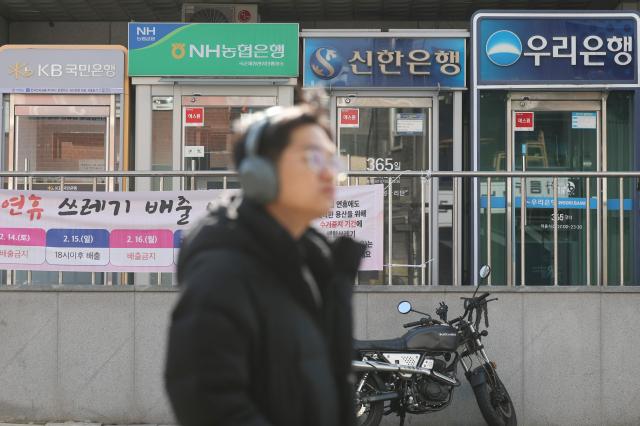
Small-business lending at South Korea’s five biggest banks is rising quickly, in line with the government’s push for so-called productive finance that steers funding toward promising companies.
As of last month, the outstanding balance of small and medium-sized enterprise loans at KB Kookmin, Shinhan, Hana, Woori and NH NongHyup totaled 678.7439 trillion won, the financial sector said Thursday. That was up 2.8385 trillion won from the previous month’s 675.9054 trillion won. Compared with the end of last year, the balance rose 4.3177 trillion won from 674.4262 trillion won.
The increase is attributed to expanded lending to advanced strategic industries and innovative companies, in step with government policy.
In September, the Financial Services Commission held a “productive finance transformation meeting” and announced plans to expand productive finance. The core goal is to reduce policy guarantees tied to real estate and strengthen support for technology and innovation-driven firms.
As banks broaden corporate lending under that policy direction, technology credit loans — often called technology finance — have also turned upward for the first time in three years.
An analysis of Korea Federation of Banks data showed the technology finance balance stood at 319.1068 trillion won at the end of last year, up more than 16 trillion won from 302.7538 trillion won at the end of 2024.
Technology finance had fallen for two straight years after reaching 325.9611 trillion won in 2022, slipping to 304.5353 trillion won in 2023 and 302.7538 trillion won in 2024. It shifted back to growth after topping 307 trillion won in the first half of last year. The five major banks’ technology finance balance was 161.6287 trillion won at the end of last year, up more than 2.4 trillion won from 159.2071 trillion won at the end of 2024 — the first increase since 2022.
Technology credit loans provide funding based on technology assessments for small and venture firms that have strong technical potential but lack collateral or financial capacity. Banks and technology credit bureaus evaluate applicants’ technology and may offer benefits such as higher loan limits or lower interest rates.
The industry expects the trend to continue this year as banks keep expanding lending to companies with technology and growth potential.
KB Kookmin Bank, through an organizational overhaul this year, created a Growth Finance Promotion Division to expand corporate lending centered on productive finance and is operating a dedicated review team for advanced strategic industries. Shinhan Bank said it will supply 72 trillion to 75 trillion won in group-funded loans to general small and mid-sized companies excluding real estate, through the “Ultra-Innovative Economy Growth Support Task Force” it set up last year.
Hana Bank also reorganized its investment banking group, reshaping its investment finance unit into a “productive investment” unit. Woori Bank said it created dedicated investment and financing teams in its IB and corporate groups late last year and will strengthen support for regional growth companies and innovative venture firms.
Shin Yong-sang, a senior research fellow at the Korea Institute of Finance, said the lending expansion is likely to continue as the government keeps emphasizing productive finance. “To keep it as a sustainable policy, banks need supporting efforts such as improving systems for venture capital and business feasibility assessments, and expanding staffing,” he said.
As of last month, the outstanding balance of small and medium-sized enterprise loans at KB Kookmin, Shinhan, Hana, Woori and NH NongHyup totaled 678.7439 trillion won, the financial sector said Thursday. That was up 2.8385 trillion won from the previous month’s 675.9054 trillion won. Compared with the end of last year, the balance rose 4.3177 trillion won from 674.4262 trillion won.
The increase is attributed to expanded lending to advanced strategic industries and innovative companies, in step with government policy.
In September, the Financial Services Commission held a “productive finance transformation meeting” and announced plans to expand productive finance. The core goal is to reduce policy guarantees tied to real estate and strengthen support for technology and innovation-driven firms.
As banks broaden corporate lending under that policy direction, technology credit loans — often called technology finance — have also turned upward for the first time in three years.
An analysis of Korea Federation of Banks data showed the technology finance balance stood at 319.1068 trillion won at the end of last year, up more than 16 trillion won from 302.7538 trillion won at the end of 2024.
Technology finance had fallen for two straight years after reaching 325.9611 trillion won in 2022, slipping to 304.5353 trillion won in 2023 and 302.7538 trillion won in 2024. It shifted back to growth after topping 307 trillion won in the first half of last year. The five major banks’ technology finance balance was 161.6287 trillion won at the end of last year, up more than 2.4 trillion won from 159.2071 trillion won at the end of 2024 — the first increase since 2022.
Technology credit loans provide funding based on technology assessments for small and venture firms that have strong technical potential but lack collateral or financial capacity. Banks and technology credit bureaus evaluate applicants’ technology and may offer benefits such as higher loan limits or lower interest rates.
The industry expects the trend to continue this year as banks keep expanding lending to companies with technology and growth potential.
KB Kookmin Bank, through an organizational overhaul this year, created a Growth Finance Promotion Division to expand corporate lending centered on productive finance and is operating a dedicated review team for advanced strategic industries. Shinhan Bank said it will supply 72 trillion to 75 trillion won in group-funded loans to general small and mid-sized companies excluding real estate, through the “Ultra-Innovative Economy Growth Support Task Force” it set up last year.
Hana Bank also reorganized its investment banking group, reshaping its investment finance unit into a “productive investment” unit. Woori Bank said it created dedicated investment and financing teams in its IB and corporate groups late last year and will strengthen support for regional growth companies and innovative venture firms.
Shin Yong-sang, a senior research fellow at the Korea Institute of Finance, said the lending expansion is likely to continue as the government keeps emphasizing productive finance. “To keep it as a sustainable policy, banks need supporting efforts such as improving systems for venture capital and business feasibility assessments, and expanding staffing,” he said.
* This article has been translated by AI.
Copyright ⓒ Aju Press All rights reserved.