
Foreign-currency liquidity indicators are not yet at dangerous levels, but banks are raising their guard because further moves in the exchange rate could quickly affect capital adequacy.
According to the financial sector on Monday, the foreign-currency liquidity coverage ratio, or LCR, at the five major banks — KB Kookmin, Shinhan, Hana, Woori and NH NongHyup — stood at 142.73% to 203.55% as of the end of February. All five were well above the regulatory minimum of 80%.
The foreign-currency LCR measures how much high-quality liquid foreign-currency assets a bank holds to meet expected net outflows over the next 30 days. A higher ratio indicates more stable foreign-currency liquidity.
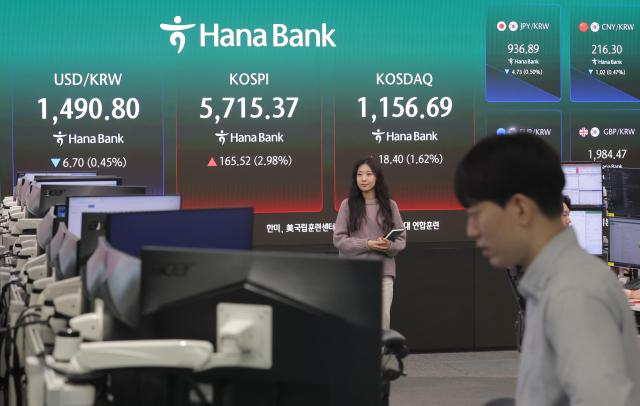
Even with ample room to manage foreign-currency assets, banks are reacting quickly as the won has seen unusually large swings, including a break above the psychologically important 1,500 level. In Seoul trading Monday, the won ended daytime trading at 1,493.6 per dollar, down 3.9 won from the previous session. The day before, it rose above 1,500 intraday for the first time in 17 years.
Market participants broadly expect volatility to increase further depending on whether the war drags on and where international oil prices head.
Sustained upward pressure on the exchange rate could weaken banks’ capital positions. A weaker won raises the won value of foreign-currency assets, increasing risk-weighted assets and putting downward pressure on the common equity Tier 1 ratio, or CET1. The industry generally estimates that a 10-won rise in the exchange rate lowers the CET1 ratio by about 0.02 percentage points.
Financial groups are strengthening internal checks as volatility increases the burden on balance-sheet management. KB Financial Group said it is using hedges to minimize foreign-exchange translation gains and losses excluding investment profit and loss, and is managing exposure at the group level by considering each affiliate’s FX position. KB Kookmin Bank introduced a return on risk-weighted assets, or RoRWA, metric to help manage capital adequacy indicators such as CET1 and the BIS capital ratio.
Shinhan Financial Group said it treats a rise of 2.5% from the previous day, or more than 5% within 10 days, as a crisis and has prepared response measures by threshold level. Hana Financial Group and Woori Financial Group are also operating emergency response systems to monitor foreign-currency liquidity and money-market conditions.
“After the won-dollar rate moved above 1,500 and volatility increased, it will be hard to predict the market for some time,” a financial industry official said. “Groups will likely continue stepping up risk checks and preparing for the possibility of rising corporate funding demand.”
* This article has been translated by AI.
Copyright ⓒ Aju Press All rights reserved.