
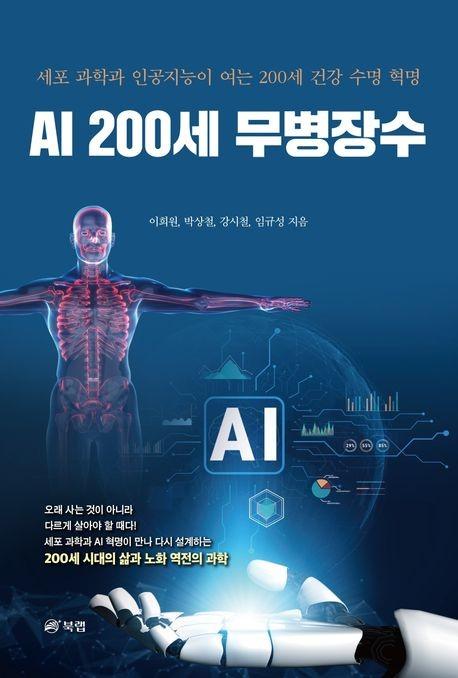
A new book argues that humanity’s long-held goal of living a long life in good health is moving closer to reality through the convergence of artificial intelligence and cellular science.
BookLab recently published “AI 200se Mubyeongjangsu” (“AI: Healthy Longevity to Age 200”). The book challenges the idea that aging is an unavoidable law of nature, redefining it as a condition that can be managed and treated, and it lays out what it calls a scientific roadmap toward a 200-year lifespan.
The book is co-authored by four specialists: Park Sang-cheol, described as a world-renowned scholar in aging studies in South Korea; Lee Hee-won, a CEO who has led development of third-generation human digital twin technology; Kang Si-cheol, a doctor who has worked for more than 30 years in advanced-technology humanities and AI medicine; and Lim Gyu-seong, a clinic director who leads AI health care research and distributes practical health solutions.
The authors align their approach with Harvard Medical School professor David Sinclair’s aging research, and they argue that, with aging now listed in the World Health Organization’s International Classification of Diseases, reversing aging is no longer fantasy but a medical task. A central theme is Park’s proposed shift in thinking that “aging is an active defense process for survival.”
At the core of the book is technology it describes as using AI to decode signals from the human body. It examines how key aging indicators — including telomeres, mitochondria and the epigenome — interact with AI, and it portrays AI as a kind of “human body translator” that precisely analyzes an individual’s metabolic fingerprint to produce optimal, real-time health solutions.
The book also highlights personalized precision nutrition, arguing that people can respond differently to the same foods depending on biological traits. It presents the possibility of AI-designed diets and “life design,” and calls for a “life integrated dashboard” that spans finances, relationships and lifelong learning in preparation for a 200-year era, aiming not only to extend lifespan but to improve quality of life.
It also introduces the Genobiofit solution devised by Lee based on his own health recovery experience. The book describes it as a practical approach developed as an alternative for people who have difficulty exercising, intended to scientifically activate mitochondrial function.
Book information is as follows: The title is “AI 200se Mubyeongjangsu,” co-authored by Lee Hee-won, Park Sang-cheol, Kang Si-cheol and Lim Gyu-seong. The publisher is BookLab Co. The ISBNs are 979-11-7598-171-3 for the print edition and 979-11-7598-172-0 for the e-book.
* This article has been translated by AI.
Copyright ⓒ Aju Press All rights reserved.