SEOUL, March 21 (AJP) - U.S. President Donald Trump signaled a potential shift toward winding down military operations against Iran while he continuing to press key Asian allies, including South Korea, to take a more active role in securing the Strait of Hormuz, a critical global energy artery.
South Korea belatedly joined a statement by Japan and other non-Gulf countries condemning Iran for weaponizing the Strait of Hormuz.
In a post on Truth Social on Friday, Trump said Washington was “considering a gradual wind down” of its large-scale military campaign in the Middle East, adding that U.S. forces were “very close” to achieving their objectives.
He outlined five core goals of the operation: neutralizing Iran’s missile capabilities, dismantling its defense industry, incapacitating its naval and air forces including air defense systems, permanently blocking its nuclear capabilities, and ensuring maximum protection for U.S. allies in the region.
The remarks suggested that Washington may be exploring an exit strategy after nearly three weeks of escalating conflict. However, Trump’s messaging remained contradictory. Hours earlier, he dismissed the idea of a cease-fire, saying, “You don’t do a cease-fire when you’re literally obliterating the other side.”
The ambiguity has left markets and allies uncertain whether the U.S. is genuinely preparing to de-escalate or simply attempting to stabilize oil prices and financial volatility without a concrete disengagement plan.
But developments on the battleground pointed to continued escalation rather than de-escalation.
The Pentagon is deploying additional Marines and three more warships to the region, marking the second reinforcement in a week and fueling speculation over a potential ground operation.
Iran remains defiant. Its newly installed supreme leader warned that “safety must be taken away” from its enemies, while the Islamic Revolutionary Guard Corps rejected claims that its missile capabilities had been crippled.
Israel said it had eliminated key leadership figures within the Basij militia, including its intelligence chief, in targeted strikes.
The conflict has already begun spilling across the region. Gulf states reported intercepting drones and missiles, while NATO withdrew all personnel from Iraq to Europe, underscoring rising security risks.
Oil markets remain on edge. Brent crude settled at $112.19 per barrel — the highest close since 2022 — after briefly spiking to $119 intraday, reflecting fears of prolonged disruption to global energy supply.
Even as he hinted at a drawdown, Trump renewed calls for U.S. allies to shoulder more responsibility for securing the Strait of Hormuz, which Iran has effectively choked off.
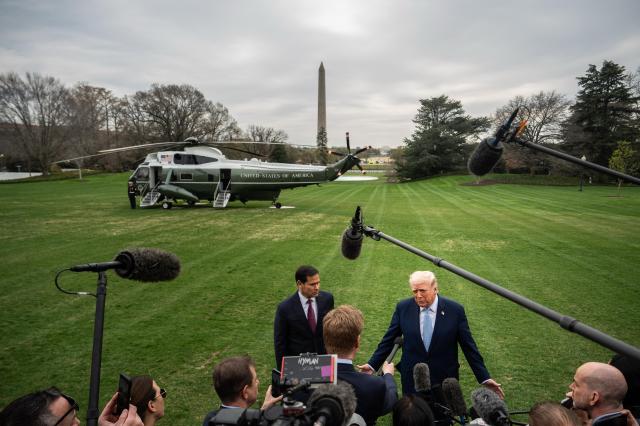
“We don’t use the strait. We don’t need it,” Trump told reporters at the White House. “Europe needs it. Korea, Japan, China — a lot of other people — so they’ll have to get involved.”
He added that countries dependent on the route should “guard and police” it themselves, with the U.S. offering support only if requested.
The remarks reflect Washington’s growing push to shift the burden of maritime security to energy-importing economies, particularly in Asia, even as it continues military operations against Iran.
Seoul has responded cautiously, seeking to balance alliance coordination with domestic and regional constraints.
South Korea’s Foreign Ministry late Friday said it would join a joint statement issued by seven countries — including the United Kingdom, France, Germany and Japan — condemning Iran’s effective blockade of the Strait of Hormuz and calling for the protection of freedom of navigation.
“The decision reflects our fundamental position on ensuring safe maritime routes and the direct impact of disruptions on our energy security and economy,” the ministry said.
The move signals diplomatic alignment with the U.S. and European partners while stopping short of committing to direct military participation such as dispatching naval forces.
The joint statement itself was widely interpreted as a symbolic show of support rather than a binding operational commitment.
Public sentiment in South Korea remains a key constraint.
A Gallup Korea poll released Friday showed that 55 percent of respondents oppose sending naval forces to the Strait of Hormuz, compared with 30 percent in favor.
Opposition was particularly strong among centrists and progressives, while conservative voters were more evenly split.
The data highlights the political risk for Seoul in responding to Washington’s request for military involvement, particularly amid heightened uncertainty over the trajectory of the conflict.
Still, some ruling party lawmakers have suggested leveraging potential participation as a bargaining chip in negotiations with the U.S., including securing greater autonomy over nuclear-powered submarine development.
Copyright ⓒ Aju Press All rights reserved.