
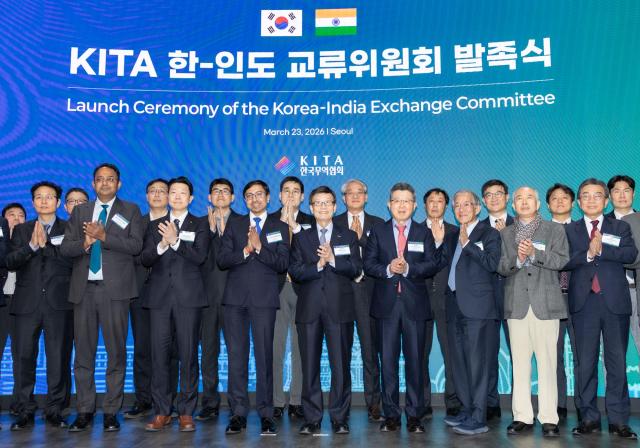
The committee will operate through two groups: an India committee within KITA comprising 28 Korean companies either operating in or seeking entry into India, and a Korea committee under the Confederation of Indian Industry (CII), made up of Indian companies interested in expanding into South Korea.
Founded in 1895, CII is India’s largest private-sector business organization, representing more than 360,000 member companies.
Around 30 representatives attended the launch ceremony, including KITA Chairman Yoon Jin-sik, Indian Ambassador to South Korea Gourangalal Das, and officials from participating firms such as Meta Biomed, Shinhan Bank, LG Electronics, YG-1, Jusung Engineering, Hana Bank, Hyundai Motor, and Hyosung Heavy Industries.
In his opening remarks, Yoon described India as a rapidly growing global manufacturing hub.
“India is the world’s fourth-largest economy and is expected to enter the top three within the next three years,” he said. “We hope the Korea-India Exchange Committee will serve as a practical communication channel at the private-sector level and play a key role in elevating bilateral economic cooperation.”
Ambassador Das also emphasized the potential for stronger bilateral ties, noting that South Korea is an important strategic partner for India, particularly in manufacturing and advanced technology sectors such as semiconductors, shipbuilding and defense.
During an expert session, Korea Institute for International Economic Policy (KIEP) researcher Kim Kyung-hoon presented on recent trends in Korea-India economic cooperation.
Kim highlighted India’s role as a key production base for automobiles, smartphones and home appliances, while noting that South Korea’s exports and investment in India remain at about 30 percent and 20 percent, respectively, compared with Vietnam.
“This paradoxically suggests significant potential for expanding economic cooperation between the two countries,” he said.
The committee plans to co-host the 9th Korea-India Business Forum with CII in the second half of this year to strengthen business partnerships and discuss trade and investment cooperation.
KITA also said it will enhance support for Korean companies operating in India through its New Delhi office, which serves as the secretariat for the Korean Chamber of Commerce in India. The office will share information on local regulations and help relay business difficulties — including customs, certification and incentive delays — to the government.

Copyright ⓒ Aju Press All rights reserved.

![[K-Tech] KITA urges nation to nurture fabless startups to boost semiconductor competitiveness](https://image.ajunews.com/content/image/2025/07/30/20250730134533405210_278_163.jpg)