
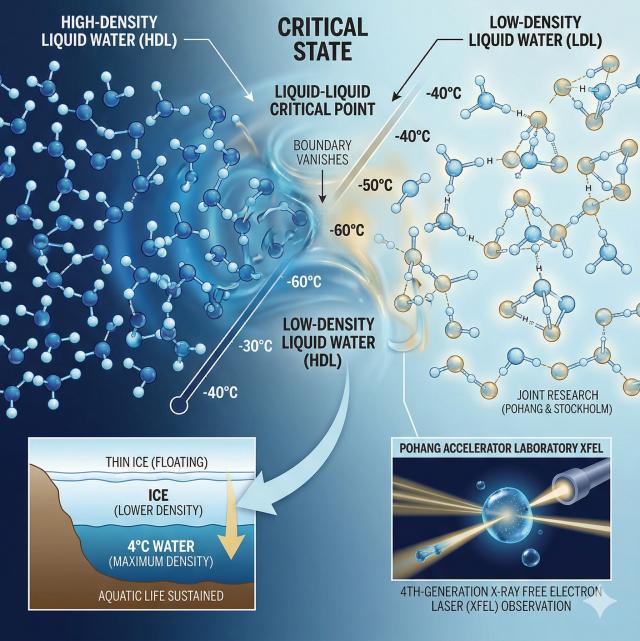
SEOUL, March 27 (AJP) - Water remains the only liquid on Earth that grows lighter as it freezes, a strange physical defiance that prevents the planet’s oceans and lakes from freezing into solid blocks of ice. By capturing the elusive liquid-liquid critical point of supercooled water, a joint research effort has finally explained the 4-degree density anomaly that has served as a biological necessity for life for millennia.
The discovery provides the first experimental proof that water fluctuates between two distinct liquid states, effectively solving a thirty-year mystery that had split the scientific community. This breakthrough represents a fundamental shift in molecular physics, opening a new door for research into everything from climate patterns to the preservation of biological tissues and the fundamental stability of proteins.
Ministry of Science and ICT said Friday that the results, published in the journal Science, were the product of a decade-long partnership between a team led by Kim Kyung-hwan at the Pohang University of Science and Technology and a team led by Anders Nilsson at Stockholm University. To reach this conclusion, the researchers had to peer into "No Man's Land," a temperature range between minus 40 and minus 70 degrees Celsius where water was long considered unobservable.
In this extreme environment, water typically crystallizes into ice so rapidly that its liquid properties vanish in an instant. The joint team utilized the fourth-generation X-ray Free Electron Laser at the Pohang Accelerator Laboratory to bypass this barrier. The facility generates light billions of times brighter than the sun, allowing the researchers to capture molecular movement in a millionth of a second.
By spraying microscopic droplets into a vacuum and using a laser to melt ice into liquid for a fleeting moment, the team pinpointed the critical point near minus 60 degrees Celsius. This is the exact coordinate where the distinction between high-density and low-density liquid phases vanishes. The existence of these two phases explains why water reaches its heaviest state at 4 degrees Celsius before expanding, a quirk that ensures ice floats and warmer water remains at the bottom to shelter aquatic ecosystems.
"When temperature reaches minus 45 degrees, water freezes faster than any available measurement method could previously track," Kim Kyung-hwan said during a briefing at the ministry in Sejong. "This has been called 'No Man's Land' because it was considered experimentally inaccessible. We have challenged this for ten years with persistence, and currently, our team is the only one in the world capable of measuring this region," the professor added.
The roadmap to the announcement began in 2017 when the researchers first proved they could measure unfrozen water below the freezing threshold. In 2020, the team confirmed that two different liquid phases coexist at minus 70 degrees. While the findings provide a definitive answer to a historical mystery, the work serves as a starting point for further precision in how Seoul and international partners map the most essential substance in the universe.
The current data carries a margin of error of 8 degrees, which the researchers intend to refine in a new round of experiments scheduled for May at the facility. Yu Sun-ju, the first author of the study and a doctoral candidate at the university, noted that achieving something never done before was incredibly difficult.
"I realized how incredibly difficult it is to achieve something no one else has done," the researcher said. The experimental results provide the necessary evidence to settle the debate over the liquid-liquid critical point of water.

Copyright ⓒ Aju Press All rights reserved.
