
SEOUL, April 3 (AJP) — More than 18 million viewers tuned in live. Add to that over 30 million registered fans worldwide, and the scale of the moment becomes clear. When the lights rose on March 21 over all seven members of BTS — together on one stage for the first time in nearly four years — it was less a comeback than a global event.
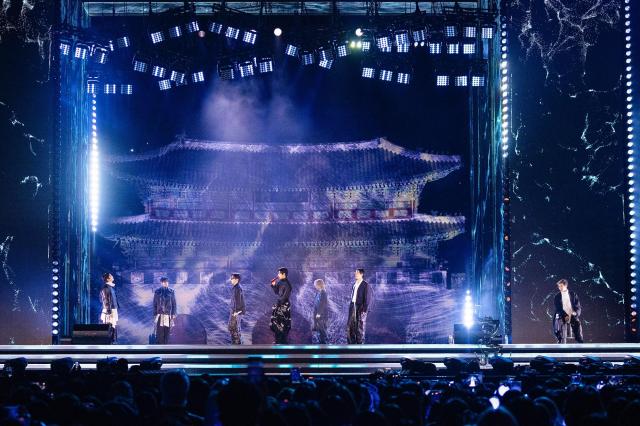
The afterglow has yet to fade. The album ARIRANG has climbed the Billboard charts, and its music videos continue to ripple across platforms. Just as indelible, however, were the clothes: armor-like silhouettes that accentuated the forceful, experimental tracks like “Body to Body,” “Hooligan,” and “FYA,” with the backdrop of Korea’s ancient Gwanghwamun gateway.
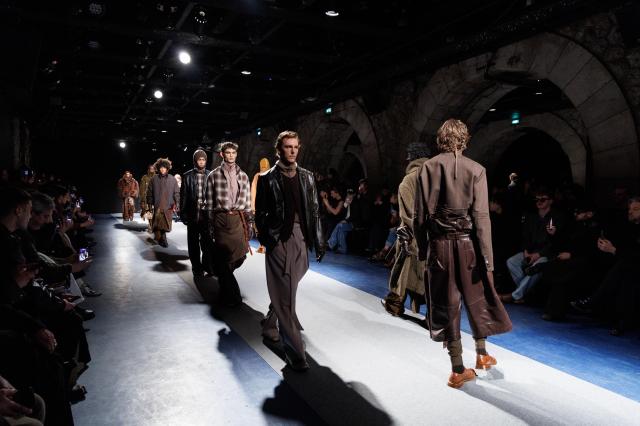
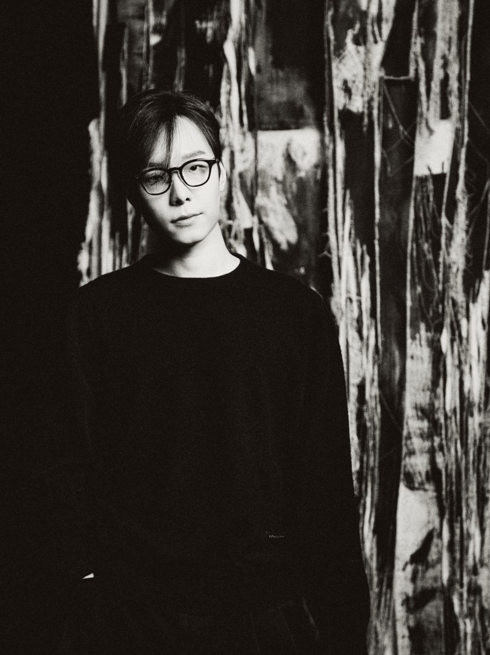
Behind that visual language stood Songzio, the high-end contemporary label founded in 1993 by designer Song Zio — and now steered by his son, Jay Songzio.
“A look comes together when someone wears it,” said Jay Songzio, the brand’s creative director. “When different pieces come together on a person to create a striking look, that’s when I feel it works.”
Based in Seoul and Paris, the label operates roughly 120 stores worldwide, with flagship boutiques in both cities and a new New York location underway. Under Jay Songzio, the house has expanded beyond menswear into womenswear, steadily widening its global footprint.
A collaboration rooted in identity
BTS had worn Songzio before, but the 2026 “ARIRANG” comeback at Gwanghwamun Square marked a deeper collaboration — one that began at the conceptual stage and evolved in tandem with the performance itself.
At its core was a shared intent: to foreground Korean identity.
Songzio’s longstanding philosophy — reinterpreting tradition through a modern lens — aligned naturally with that ambition. The collaboration, initiated by HYBE roughly two months before the performance, sought a distinctly Korean design partner to match both the symbolic weight of the “Arirang” concept and the historic venue.
The choice carried its own message. BTS, long associated with European luxury houses, turned instead to a domestic designer for a landmark return — reinforcing the global positioning of Korean culture across both music and fashion.
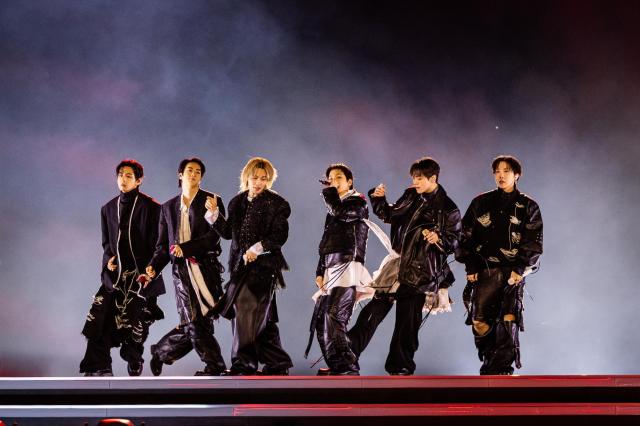
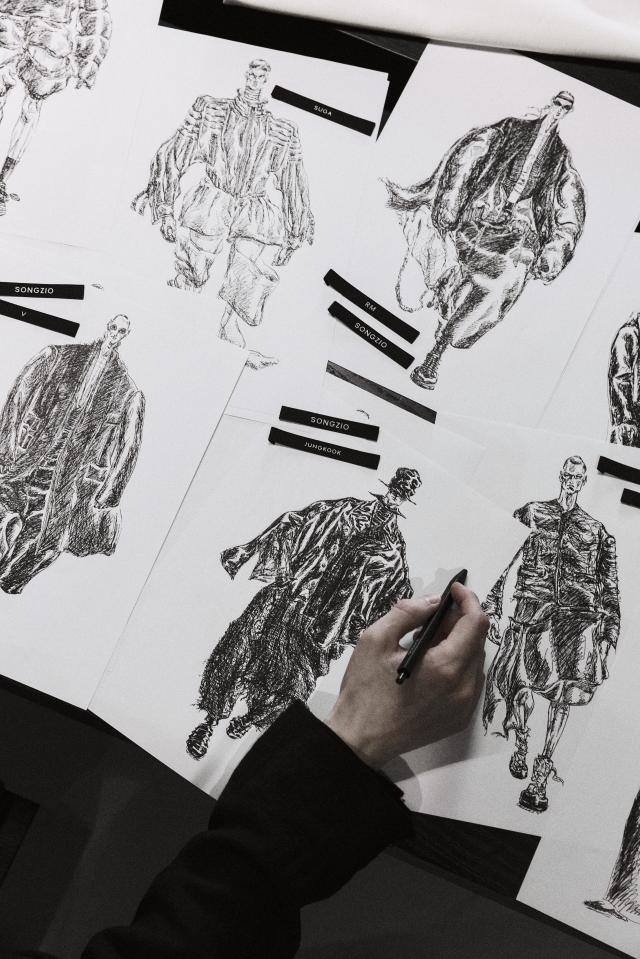
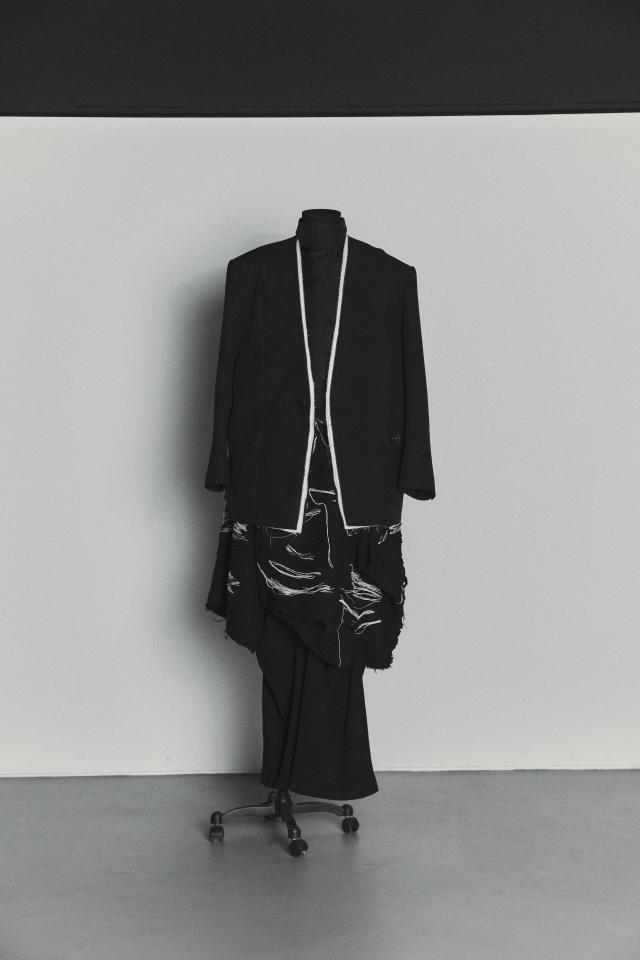
The result was “Lyrical Armor”: a concept merging the strength of traditional armor with a lyrical, almost poetic sensitivity. Drawing on early Joseon-era armor and hanbok worn by artists and performers, the collection envisioned what the brand described as “heroes of a new era who overcome turbulent history to create the future.”
There was no fixed reference point. The designs emerged through an iterative back-and-forth process, evolving alongside the performance narrative.
Each member was assigned a persona: RM as the hero, Jin the artist, Suga the architect, J-Hope a traditional performer, Jimin the poet, V a scholar-like figure, and Jungkook the pioneer.
The group was not passive. Members contributed feedback on color, accessories and silhouette — details that shaped the final look.
Netflix said the performance drew 18.4 million global viewers within 24 hours.
An unconventional path to design
Jay Songzio studied art history and mathematics before spending years in Paris, gradually growing into the brand.
“Fashion became part of my life,” he told AJP. “It naturally blended into my worldview — art, fashion and everyday life don’t feel separate.”
His references range widely: Renaissance and Romantic painting, classical literature, cinema. He sees fashion much like film — a multidisciplinary medium where narrative, character and visual language converge.
At the center of his philosophy lies restraint.
“Even as the world changes, maintaining your own identity is important,” he said, adding that patience is essential.
This sensibility also defines how he diverges from his father. Where Song Zio pursued seasonal reinvention, Jay emphasizes repetition — building a recognizable identity over time.
“Most people don’t follow shows every six months,” he said.
“What matters is leaving a clear impression of what the brand represents.”
Emotion, restraint and ‘avant-garde elegance’
For Songzio, beauty is not stylistic but authentic.
“It’s about how convincingly you express your own language,” he said. “That’s what makes something beautiful.”
Emotion, in his framework, is not excess but discipline.
“Authenticity matters most. You should be able to explain your work naturally,” he said.
He describes his creative state as deliberately restrained — a balance the brand calls “avant-garde elegance,” where experimental form meets composure rooted in Eastern sensibilities.
That restraint is visible even in color.
“It’s a color that suits restraint,” he said of black, describing it as a canvas rather than a direct emotional statement.
His process favors purity — an idea he traces to Pablo Picasso’s notion that it takes a lifetime to draw like a child.
“Purity means expressing your emotions and inspiration without over-filtering,” he said.
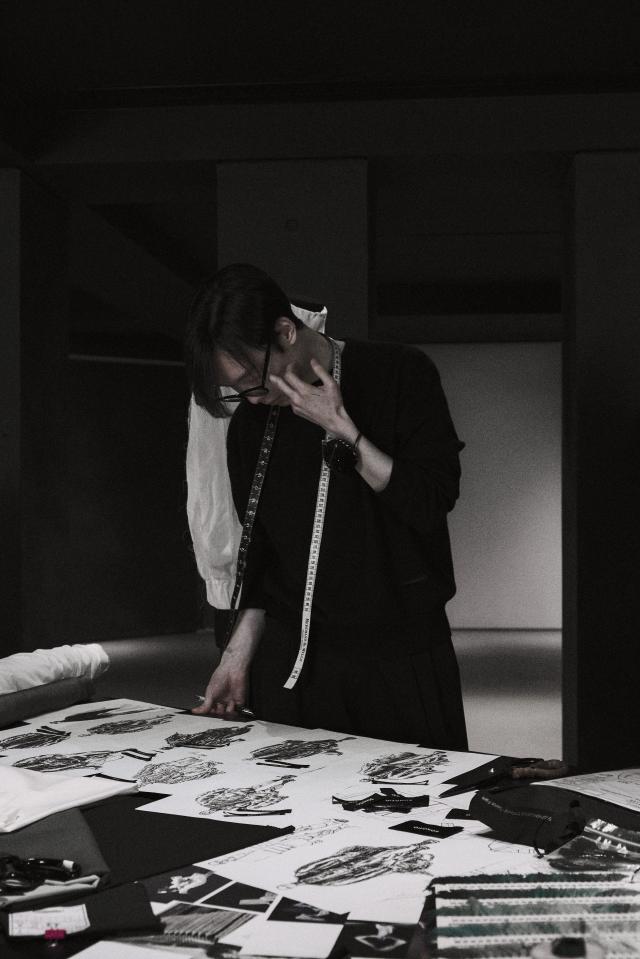
It also informs his technique. He prioritizes hand sketching over digital tools.
“Small differences can create huge results,” he said.
“The tactile process of making clothes matters. Even a small detail — like the placement of a button — feels different when it’s drawn by hand.”
For him, design is unfinished until worn.
“A look comes together when someone wears it,” he repeated.
“When different pieces come together on a person to create a striking look, that’s when I feel it works.”
Reinterpreting ‘han’ on stage
Nowhere did these ideas converge more clearly than in the BTS stage costumes.
The project reimagined “han” — the idiosyncratic Korean sentiment often translated as heart-wrenching sorrow — as a forward-driving force. By merging armor’s rigidity with the fluidity of hanbok, the garments were built to transform through layering, asymmetry and detachable elements.
The scale extended beyond BTS themselves to an 80-member performance team.
“Han is deeply emotional, but it also drives you forward,” he said.
“We wanted to reinterpret it as a forward-looking force.”
He described it as a “common mentality” shaped by Korea’s turbulent history — not merely grief, but resilience and momentum.
Designing for the stage
Rather than impose a single narrative, Songzio approached the BTS collection through individual character arcs.
He was particularly drawn to V’s “doryeong” concept — a young nobleman or scholar-like figure.
“It combines strength and softness, which aligns well with our direction,” he said.
The visual strategy leaned on stark contrast: black and white.
White elements cut through the potential heaviness of armor-inspired forms, sharpening visibility on stage.
Early designs also explored transformability. Layered garments were engineered to evolve during performance, though achieving this without appearing visually heavy proved a technical challenge.
The brand’s ambitions extend beyond the stage. A new flagship in New York is underway, conceived not merely as retail space but as a platform for Korean artists.
Collaborations continue as well, including ongoing work with The Walt Disney Company, reinterpreting figures such as Mickey Mouse through Songzio’s distinct lens.
At its core, the philosophy remains consistent: avant-garde yet elegant, structured yet fluid, rooted in identity yet open to reinterpretation.
The Gwanghwamun stage offered a rare convergence — a moment when that philosophy reached a global audience.
More than a costume project, the collaboration placed Songzio within a broader cultural narrative, one in which Korean design actively shapes how the country presents itself to the world.
Between armor and hanbok, tradition and modernity, restraint and expression, Songzio continues to chart its course — on its own terms.
Copyright ⓒ Aju Press All rights reserved.
