
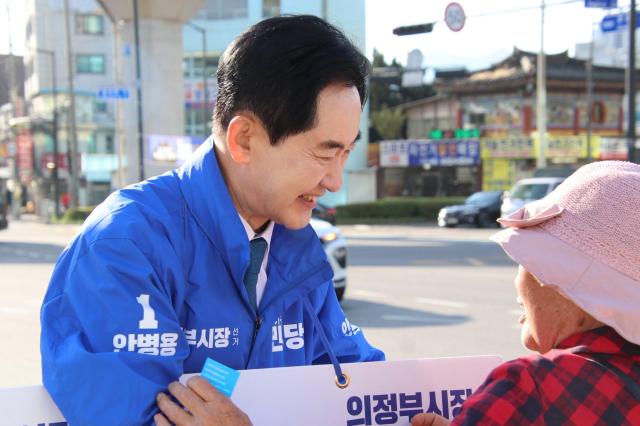
The party’s Gyeonggi provincial chapter said no candidate won a majority in voting held April 19-20, sending the top two finishers to a runoff. The final vote is scheduled for April 25-26.
“Having reached the runoff with strong support from citizens and party members, it is time to prove, confidently and in front of the public, who is best suited to solve Uijeongbu’s many pending issues,” Ahn said in explaining the proposal.
Ahn cited major local challenges including development of returned U.S. military base sites, attracting large companies, the proposed GTX-G line and an extension of Seoul Subway Line 8. He said the runoff should not become a “blind primary” driven by organizational mobilization, and argued that sharply testing candidates’ visions and policy capacity is the minimum owed to citizens and party members.
Ahn said he would follow Kim’s side on practical details such as the debate format, time and venue.
Transportation has been a central theme for Ahn and has also emerged in broader regional policy coordination. On April 20, Ahn signed a joint policy agreement with Kim Han-jung, a preliminary candidate for Namyangju mayor, calling for the extension of Line 8 — currently ending at Byeollae in Namyangju — to Uijeongbu’s Tapseok, Minrak and Gosan areas, and for the plan to be prioritized in the 5th National Rail Network Construction Plan.
They also agreed to pursue a new GTX-G route linking Pocheon, Uijeongbu, Namyangju, Guri and Seoul; strengthen connections between the Seoul Metropolitan Area’s First and Second Ring Expressways; and build an advanced industry and economic belt connecting Uijeongbu’s returned base sites with Namyangju’s Wangsuk new town.
At the time, Ahn said the large-scale national project to bring Line 8 into Uijeongbu “cannot be achieved by the strength of any one city alone,” and would require two local governments to unite and persistently persuade the government and the Ministry of Land, Infrastructure and Transport.
Ahn has also emphasized economic recovery in the runoff. On April 20, he campaigned under the banner of “reviving Uijeongbu’s economy” at the underground shopping arcade at Uijeongbu Station with actor Lee Ki-young and Ahn Jin-geol, head of the People’s Livelihood Economy Institute. Earlier, he held a policy meeting with small business owners, pledging expanded issuance of local currency, tailored support by commercial district, and a regular channel for communication.
“The essence of this election is ultimately a serious economic election asking, ‘Who will revive Uijeongbu’s stagnant economy and help citizens put food on the table?’” Ahn said.
In a message to Kim, Ahn said, “Let’s proudly show citizens how healthy and capable our Democratic Party is,” adding that he hopes for Kim’s “generous and forward-looking” acceptance of the debate proposal. The party’s Uijeongbu primary, now in its runoff phase, could shift from a test of organization to a policy showdown over transportation, the economy and urban development solutions.
* This article has been translated by AI.
Copyright ⓒ Aju Press All rights reserved.