
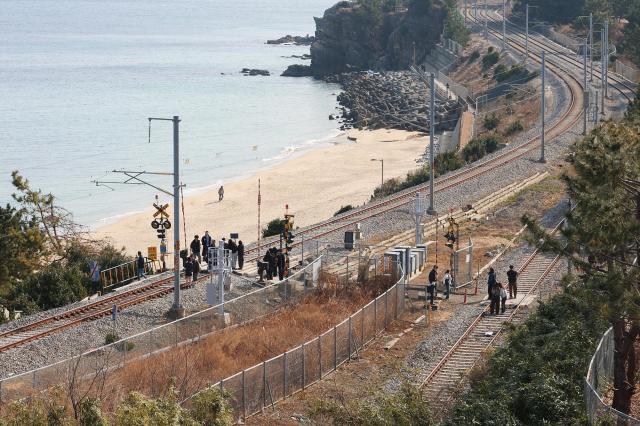
Rep. Lee Cheol-gyu of the ruling People Power Party said he helped secure the reopening of the Hapyeong rail crossing in Donghae, which had been restricted over safety concerns as tourist crowds surged.
Lee said that at a countermeasures meeting on the 20th at the National Assembly with the Korea National Railway, Korail and Donghae city officials, the parties reached a final agreement to resume access on the condition that safety staff be deployed no later than May 1.
The Hapyeong crossing, a Category 1 unmanned crossing in Donghae, recently became known as a popular photo spot, driving a sharp rise in visitors. Korail imposed access limits starting Feb. 9 after repeated concerns about crowding inside the crossing and trespassing onto the tracks, Lee said.
Residents in the Cheongok-dong area, who had used the crossing as part of their daily route, reported major inconvenience. A petition calling for restored access, signed by 5,419 residents, was submitted, the lawmaker said.
Lee said he had continued talks with relevant agencies, including discussions with Korail’s facilities headquarters on April 7, and that the latest meeting produced a plan aimed at both safety and residents’ right of passage.
Lee Cheol-gyu said, “Relieving residents’ inconvenience is a natural duty of a local lawmaker,” adding that repeated consultations produced an outcome balancing safety concerns and public access. He said he would continue to work on local issues, including mobility rights.
Lee Cheol-gyu, industry committee chair, meets Canadian ambassador to discuss supply chains, energy and defense cooperation
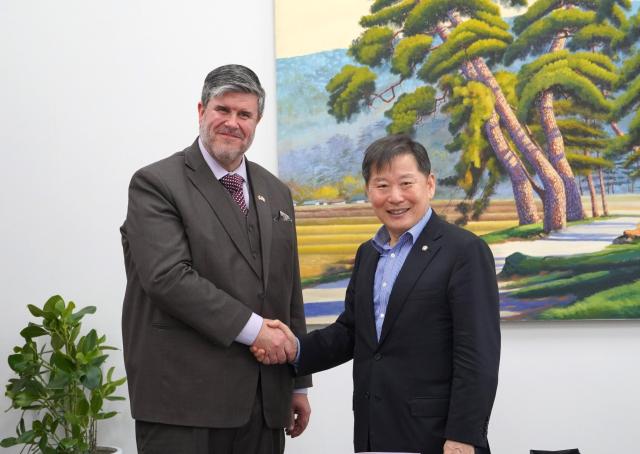
Lee, as chair of the National Assembly’s Industry, Trade, Energy, SMEs and Startups Committee, met Canadian Ambassador to South Korea Philip LaFortune on the afternoon of the 20th and discussed ways to expand cooperation on key issues including supply chains, energy and the defense industry.
The two sides noted that South Korea and Canada have maintained cooperation as key partners, citing historical ties including the work of Dr. Frank William Schofield and Canada’s participation in the Korean War. With exchanges continuing in multilateral settings, the meeting was expected to further broaden bilateral cooperation.
Lee said that amid global supply-chain instability and energy security challenges, securing critical resources and stabilizing supply chains are important. He said Canada’s mineral and energy resources should be combined with South Korea’s manufacturing capabilities to create high value-added outcomes across industries.
LaFortune said South Korea is a key partner with competitiveness not only in defense but also in advanced fields such as artificial intelligence and semiconductors. He added that Prime Minister Mark Carney also trusts South Korea as one of Canada’s closest allies and an especially important partner for cooperation.
The meeting also addressed Canada’s Canadian Patrol Submarine Project (CPSP), with an announcement of a preferred bidder expected in late June. Lee said competition between South Korea and Germany would broaden Canada’s options and help produce an outcome aligned with Canada’s national interest, adding that he hopes South Korea can serve as an optimal strategic partner.
Both sides agreed on the need to expand cooperation centered on supply chains and advanced industries. LaFortune expressed strong interest in the Samcheok area, where infrastructure for future energy industries such as hydrogen has been established, and said he intends to visit related facilities in the future.
* This article has been translated by AI.
Copyright ⓒ Aju Press All rights reserved.