
The Ministry of the Interior and Safety said a partial revision to the Enforcement Decree of the Resident Registration Act was reviewed and approved at a Cabinet meeting on the 21st.
The ministry said the changes are aimed at better protecting personal information for remarried families and others, reflecting diverse family structures more evenly, and improving administrative convenience for foreign residents.
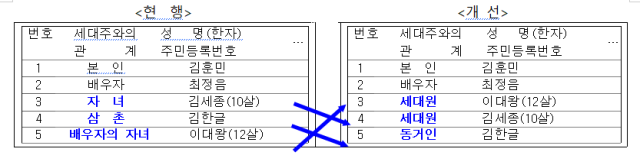
Under the revision, anyone considered family under the Civil Act — except the head of household’s spouse — will be labeled “household member,” while others will be labeled “cohabitant.” The listing order will also change so the head of household’s spouse’s lineal ascendants and descendants are placed at the same rank, replacing the previous practice in which a “spouse’s child” was listed after a “child.”
Rules for recording foreign residents’ names will also be updated. Previously, resident registration records used only Roman-letter names, while family relationship registers used only Hangul, creating difficulties in confirming identity. Going forward, resident registration records will show names in both Hangul and Roman letters to improve accuracy and convenience when using administrative and financial services.
In addition, applications to correct or change entries in resident registration records — previously limited to the foreign resident — will be expanded to allow the head of household or household members to apply.
The ministry said it will work with local governments to strengthen guidance and publicity to reduce confusion during implementation. The revision will take effect Oct. 29 after computer systems are updated.
Interior Minister Yoon Ho-jung said the revision is expected to provide stronger protection for sensitive personal information for remarried families and move administrative services toward greater inclusion of diverse family forms.
* This article has been translated by AI.
Copyright ⓒ Aju Press All rights reserved.