
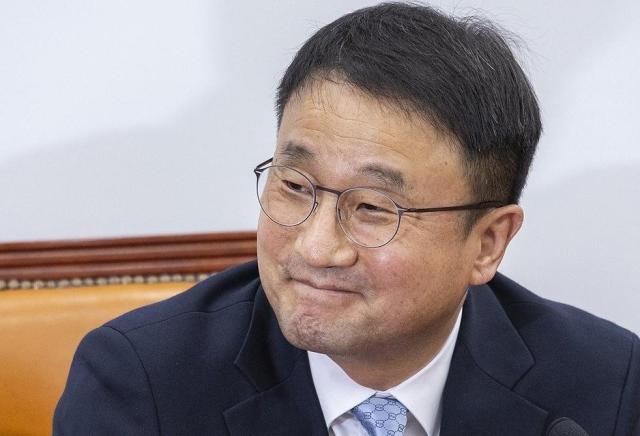
South Korea’s Democratic Party has begun the process of selecting its next floor leader and a nominee for National Assembly speaker for the second half of the year after the party’s steering committee on April 20 transferred authority to form election management committees to the party’s supreme council. Floor leader Han Byung-do, who had signaled he may seek a second term, said April 21 he will step down. The choices are expected to shape how the Assembly is run in the second half of the year.
Han told a news conference at the National Assembly that he was resigning “to fulfill my responsibility amid a pileup of pending issues,” adding, “In the 101 days since taking office, we have done a lot, but there is still much to do.” Han took office in January after Kim Byung-ki resigned amid controversies, and his term is set to end in May. The article said Han’s resignation was a preemptive move tied to a bid for another term.
Han said that if he wins another term, he will move faster on legislation related to a special counsel probe into what he called “political prosecutors’ fabricated indictments” involving Yoon Suk Yeol, and on bills aimed at responding to an economic crisis stemming from the Middle East. He also pledged to pass a constitutional amendment bill in a plenary session on May 7 and to complete legislation for state policy tasks by December.
The article said there has been no case of a Democratic Party floor leader winning a second term since the 19th National Assembly. Still, it said Han’s chances are being discussed because he took office through a by-election, served a short term and led the caucus without major internal conflict. Possible rivals mentioned include lawmakers Park Jung and Baek Hye-ryun, who faced Han in the by-election, and Seo Young-kyo, who competed with Kim for the post.
The next floor leader will have authority over the makeup of standing committees for the second half of the year. The Democratic Party has warned it could allocate committee chairmanships 18-0, arguing that bill processing has been delayed in committees chaired by the People Power Party. Han again said such a sweep could be possible if the People Power Party moves to obstruct state affairs, raising the prospect of a sharp shift in interparty dynamics depending on the new floor leader’s approach.
The selection of a new Assembly speaker could also trigger broader changes in how parliament operates. The article said possible successors to Speaker Woo Won-shik include six-term lawmaker Cho Jung-sik and five-term lawmakers Kim Tae-nyeon and Park Ji-won.
Under the process described in the article, the Democratic Party, as the largest party, recommends a candidate through an internal primary, and the speaker is then elected in a plenary session by secret ballot with support from a majority of sitting lawmakers. The speaker holds key powers, including putting items on the plenary agenda and coordinating the legislative schedule, and the article said the intensity of partisan confrontation could hinge on the new speaker’s orientation.
The Democratic Party plans to hold its primary to choose the next floor leader on May 6 and its primary to pick a speaker nominee on May 13, then bring the selections to a plenary session. The party hopes to elect the speaker on May 20, but the People Power Party wants to delay it until after the June 3 local elections, leaving the schedule subject to talks.
* This article has been translated by AI.
Copyright ⓒ Aju Press All rights reserved.