
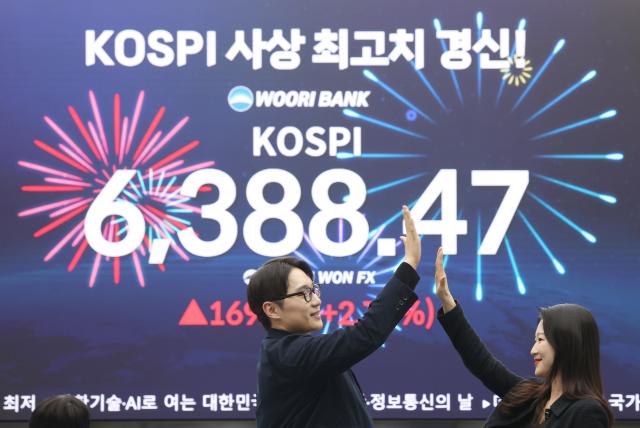
South Korea’s benchmark KOSPI surged to a fresh record on the 21st, extending its rally despite the fallout from the war in the Middle East.
According to the Korea Exchange, the KOSPI closed up 169.38 points, or 2.72%, at 6,388.47. It also set a new intraday high, surpassing the previous peak of 6,347.41, and topped the prior record close of 6,307.27 set Feb. 26.
Foreign investors and institutions led the advance. Foreigners bought a net 1.7472 trillion won worth of shares, while institutions posted net purchases of 796.0 billion won.
Buying was concentrated in semiconductors. Samsung Electronics and SK hynix, the No. 1 and No. 2 stocks by market capitalization on the KOSPI, rose 2.1% and 4.97% to close at 219,000 won and 1,224,000 won, respectively. Ahead of its earnings release on the 23rd, SK hynix finished above 1.2 million won for the first time on a closing basis.
As the index climbed, margin trading also accelerated. The Korea Financial Investment Association said outstanding credit loans for stock purchases stood at a record 34.2592 trillion won as of the 20th. The total included 23.6256 trillion won on the main board and 10.6336 trillion won on the KOSDAQ, exceeding the previous high of 34.0279 trillion won set April 17.
Analysts largely viewed the rally positively but urged investors to stay alert to geopolitical risks.
Kim Hak-kyun, head of the research center at Shinyoung Securities, said the rise was part of a global trend and that the Middle East issue was “short-term noise” within an existing uptrend. “There is no evidence that the upward trend has broken,” he said, adding that the case for gains remains intact, citing the semiconductor cycle and “manageable inflation.”
Lee Byeong-geon, head of the research center at DB Securities, said flexibility would be needed as external factors evolve. “It’s right to view the market positively because leaders such as semiconductors have not turned down,” he said. “But depending on negotiation outcomes, the beneficiaries and losers could diverge by stock. It is necessary to respond with a portfolio while closely watching external developments.”
* This article has been translated by AI.
Copyright ⓒ Aju Press All rights reserved.