
[Table = National Data Agency]
Employment in the second half of last year was concentrated in service industries such as residential care facilities and restaurants, and 1 in 5 wage workers earned 2 million won or less per month, according to official data.
The National Data Agency said in its report, “2025 second-half regional employment survey: characteristics of employed persons by industry and occupation,” that as of October in the second half of last year, residential care facilities were the largest of 234 detailed industry categories, with 1.77 million workers, or 6.1% of the total.
Restaurants followed with 1.692 million workers (5.8%), and crop cultivation ranked third with 1.297 million (4.5%).
Compared with a year earlier, employment rose most in residential care facilities, up 177,000, followed by hospitals, up 47,000, and clinics, up 39,000. The biggest declines were in crop cultivation, down 109,000, building construction, down 65,000, and interior construction and building finishing, down 33,000.
By age, restaurants accounted for the largest share of employment among young people ages 15-29 (10.6%) and those ages 30-49 (4.6%). Among those 50 and older, residential care facilities had the largest share (9.8%).
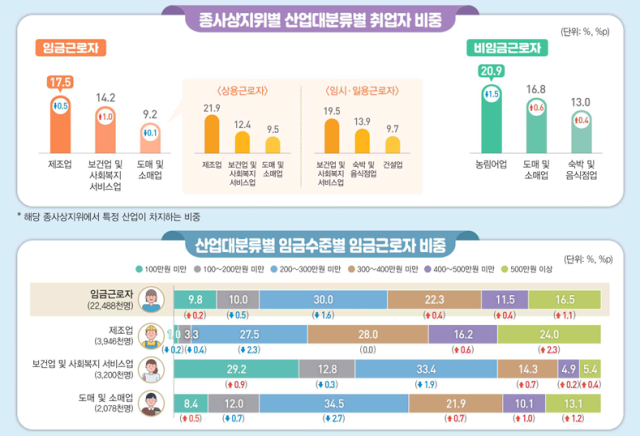
By employment status, regular employees were most concentrated in manufacturing (21.9%), followed by health and social welfare services (12.4%) and wholesale and retail trade (9.5%). For temporary and daily workers, the largest shares were health and social welfare services (19.5%), accommodation and food services (13.9%) and construction (9.7%). For nonwage workers, the largest shares were agriculture, forestry and fishing (20.9%), wholesale and retail trade (16.8%) and accommodation and food services (13.0%).
The number of wage workers totaled 22.488 million in the second half of last year, up 311,000 from a year earlier, the agency said.
By monthly pay, 9.8% earned less than 1 million won, 10.0% earned 1 million to less than 2 million won, 30.0% earned 2 million to less than 3 million won, 22.3% earned 3 million to less than 4 million won, 11.5% earned 4 million to less than 5 million won, and 16.5% earned 5 million won or more.
From a year earlier, the share earning 5 million won or more rose 1.1 percentage points. The shares earning 4 million to less than 5 million won and 3 million to less than 4 million won each rose 0.4 points, and the share earning less than 1 million won rose 0.2 points. The shares earning 2 million to less than 3 million won and 1 million to less than 2 million won fell 1.6 points and 0.5 points, respectively, suggesting a widening gap between low- and high-wage workers.
The share of workers earning 1 million won or less a month was highest in health and social welfare services (29.2%), accommodation and food services (23.5%), and public administration, defense and social security administration (18.4%).
The share earning 5 million won or more was highest in finance and insurance (38.0%), professional, scientific and technical services (35.8%), information and communications (34.8%), and manufacturing (24.0%).
The National Data Agency said in its report, “2025 second-half regional employment survey: characteristics of employed persons by industry and occupation,” that as of October in the second half of last year, residential care facilities were the largest of 234 detailed industry categories, with 1.77 million workers, or 6.1% of the total.
Restaurants followed with 1.692 million workers (5.8%), and crop cultivation ranked third with 1.297 million (4.5%).
Compared with a year earlier, employment rose most in residential care facilities, up 177,000, followed by hospitals, up 47,000, and clinics, up 39,000. The biggest declines were in crop cultivation, down 109,000, building construction, down 65,000, and interior construction and building finishing, down 33,000.
By age, restaurants accounted for the largest share of employment among young people ages 15-29 (10.6%) and those ages 30-49 (4.6%). Among those 50 and older, residential care facilities had the largest share (9.8%).
By employment status, regular employees were most concentrated in manufacturing (21.9%), followed by health and social welfare services (12.4%) and wholesale and retail trade (9.5%). For temporary and daily workers, the largest shares were health and social welfare services (19.5%), accommodation and food services (13.9%) and construction (9.7%). For nonwage workers, the largest shares were agriculture, forestry and fishing (20.9%), wholesale and retail trade (16.8%) and accommodation and food services (13.0%).
The number of wage workers totaled 22.488 million in the second half of last year, up 311,000 from a year earlier, the agency said.
By monthly pay, 9.8% earned less than 1 million won, 10.0% earned 1 million to less than 2 million won, 30.0% earned 2 million to less than 3 million won, 22.3% earned 3 million to less than 4 million won, 11.5% earned 4 million to less than 5 million won, and 16.5% earned 5 million won or more.
From a year earlier, the share earning 5 million won or more rose 1.1 percentage points. The shares earning 4 million to less than 5 million won and 3 million to less than 4 million won each rose 0.4 points, and the share earning less than 1 million won rose 0.2 points. The shares earning 2 million to less than 3 million won and 1 million to less than 2 million won fell 1.6 points and 0.5 points, respectively, suggesting a widening gap between low- and high-wage workers.
The share of workers earning 1 million won or less a month was highest in health and social welfare services (29.2%), accommodation and food services (23.5%), and public administration, defense and social security administration (18.4%).
The share earning 5 million won or more was highest in finance and insurance (38.0%), professional, scientific and technical services (35.8%), information and communications (34.8%), and manufacturing (24.0%).
* This article has been translated by AI.
Copyright ⓒ Aju Press All rights reserved.