
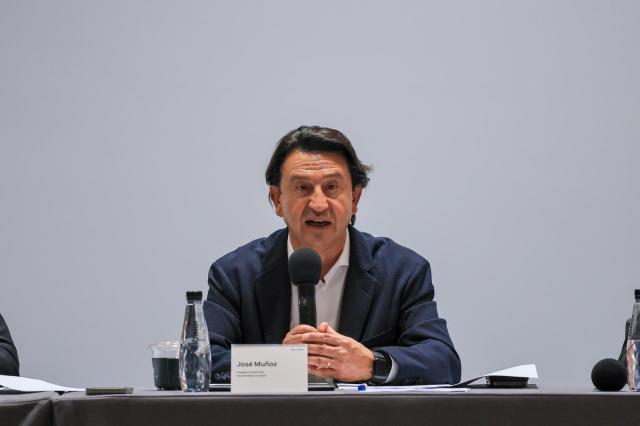
Hyundai Motor President Jose Munoz said at a meeting with reporters on April 24 at the China International Exhibition Center Convention Center in Beijing that the company will make this year the starting point for accelerating a turnaround in China. He said Hyundai plans to launch 20 new energy vehicles, or NEVs, by 2030 and show annual growth of 9%.
Hyundai on Thursday opened the 2026 Beijing Motor Show (Auto China 2026) by unveiling the China mass-production model Ioniq V for the first time in the world. The Ioniq V features a localized interior and exterior design, a naming strategy based on planet names, a battery from China’s CATL, and Momenta’s Level 2+ driver-assistance technology, including highway driving assistance and memory parking.
"China is the most important EV market, and Hyundai is one of the best-performing companies in EVs globally," Munoz said. He said Hyundai will strengthen its positioning in China by combining products, features, design, service and pricing proven in global markets with thorough localization.
China is often called a tough market for foreign brands because consumers strongly prefer domestic vehicles. With the economy weakening, global automakers including Mercedes-Benz, Volkswagen Group and BMW have also stepped up moves to reduce their exposure to China. Munoz said Hyundai’s Ioniq brand has been central to the company’s push to become a technology company, not just an automaker. He said Hyundai will combine Ioniq technology with localization efforts and the founder chairman’s “challenge DNA” to sustain Hyundai’s momentum in China.
Munoz also pledged to deepen partnerships in China. He said that with China’s NEV tax incentives being reduced, companies cannot build fundamental competitiveness simply by importing functions and technology, and that Hyundai will work with local partners to strengthen its core capabilities.
He also offered a blunt assessment of Hyundai’s struggles in China over the past decade. "We became overconfident and settled for the status quo," Munoz said, adding that the company learned humility in China and analyzed the causes of its failures through dialogue with partners and customers. He said China’s market and technology are changing faster than in the past, and that Hyundai will execute its strategy step by step with a learning mindset not only in autos but also in hydrogen and physical artificial intelligence.
The Ioniq V shown Thursday includes smart AI features, distinctive exterior and interior design, and advanced electronics aimed at Chinese consumers. Heo Jae-ho, Hyundai’s chief technology officer in China, said the vehicle will include a digital ecosystem centered on a smart cabin and autonomous driving, as well as LLM-based voice recognition and personalized services from Doubao, a ByteDance subsidiary. He said Hyundai will also reflect local preferences with Chinese apps such as Baidu, Amap and WeChat, along with Dolby sound and karaoke features.
Hyundai plans to build out the Ioniq V lineup to six models by 2028, using two platforms for compact and mid-to-large vehicles and offering both EV and extended-range electric vehicle, or EREV, variants. It will then expand sequentially to 20 models by 2030, depending on market conditions and China’s policies. Munoz said Hyundai’s ability to survive amid variables such as tariffs, the repeal of the Inflation Reduction Act and war in the Middle East has been driven by offering customers a wide range of choices. He said Hyundai will provide Chinese customers with flexible options including the Ioniq V, Ioniq E, a future D-segment SUV, a multipurpose vehicle and EREV models.
Munoz said Hyundai can apply its global playbook in China, citing the company’s position as No. 3 in global vehicle volume and No. 2 in profitability. He said growth in China is an important opportunity, including as a hedge against risks in other regions.
* This article has been translated by AI.
Copyright ⓒ Aju Press All rights reserved.