
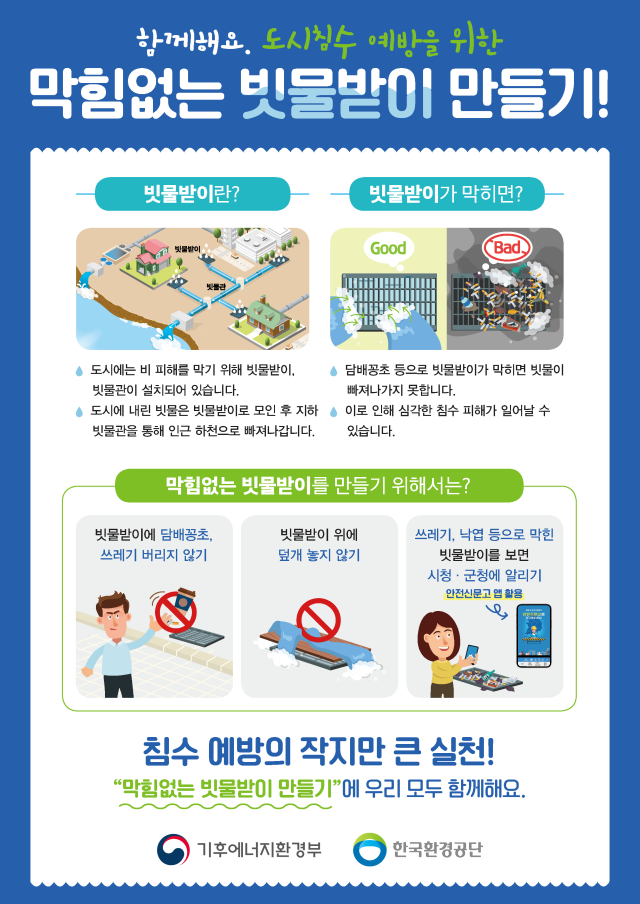
Public notice on keeping storm drains clear. [Photo provided by the Ministry of Climate, Energy and Environment]
The government will begin nationwide inspections of sewer facilities to help prevent urban flooding during summer downpours.
The Ministry of Climate, Energy and Environment said Saturday it will hold a series of meetings starting Sunday with officials from its regional environment offices and local governments to review sewer-facility management ahead of the summer natural-disaster response period, which runs from May 15 to Oct. 15.
On Sunday afternoon, the ministry will convene sewer officials from seven regional environment offices, including the Han River Basin Environment Office, at the Government Complex Sejong. On May 7, it will hold a separate review meeting for sewer officials from 17 cities and provinces, chaired by Kim Eun-kyeong, the ministry’s director general for water environment policy, also at the Government Complex Sejong.
The meetings will focus on local governments’ maintenance plans for sewer pipes, including storm-drain cleaning, and the status of installing fall-prevention devices on manholes in flood-prone areas. The ministry also plans to share best practices from local governments with strong maintenance records and discuss agency-by-agency steps to improve urban flood prevention.
With storm drains clogged by cigarette butts and trash cited as a factor that can worsen flooding during heavy rain, the ministry said it will ask local governments to complete intensive inspections and cleaning before the rainy season. It also plans to strengthen on-site checks in vulnerable areas and expand installation of manhole fall-prevention devices to reduce accidents.
During the summer response period, the ministry said it will continue monitoring local governments’ upkeep of storm drains and other sewer facilities and use field inspections to ensure prevention measures are being carried out.
Through the end of June, regional environment offices and the Korea Environment Corporation will jointly inspect local governments’ sewer-pipe maintenance plans and performance. The ministry said it will also conduct additional spot field inspections during the summer response period to keep verifying storm-drain conditions and the installation status of manhole fall-prevention devices.
It will compile and manage weekly results for storm-drain inspections and cleaning, and check monthly progress on installing manhole fall-prevention devices to help prevent safety accidents. It will also confirm whether such devices are installed in high-risk areas, including low-lying neighborhoods.
“Preventing urban flooding depends on advance inspections and ongoing maintenance of sewer facilities such as storm drains,” Kim said. “We will manage sewer facilities thoroughly so the public can stay safe even during torrential rain.”
The Ministry of Climate, Energy and Environment said Saturday it will hold a series of meetings starting Sunday with officials from its regional environment offices and local governments to review sewer-facility management ahead of the summer natural-disaster response period, which runs from May 15 to Oct. 15.
On Sunday afternoon, the ministry will convene sewer officials from seven regional environment offices, including the Han River Basin Environment Office, at the Government Complex Sejong. On May 7, it will hold a separate review meeting for sewer officials from 17 cities and provinces, chaired by Kim Eun-kyeong, the ministry’s director general for water environment policy, also at the Government Complex Sejong.
The meetings will focus on local governments’ maintenance plans for sewer pipes, including storm-drain cleaning, and the status of installing fall-prevention devices on manholes in flood-prone areas. The ministry also plans to share best practices from local governments with strong maintenance records and discuss agency-by-agency steps to improve urban flood prevention.
With storm drains clogged by cigarette butts and trash cited as a factor that can worsen flooding during heavy rain, the ministry said it will ask local governments to complete intensive inspections and cleaning before the rainy season. It also plans to strengthen on-site checks in vulnerable areas and expand installation of manhole fall-prevention devices to reduce accidents.
During the summer response period, the ministry said it will continue monitoring local governments’ upkeep of storm drains and other sewer facilities and use field inspections to ensure prevention measures are being carried out.
Through the end of June, regional environment offices and the Korea Environment Corporation will jointly inspect local governments’ sewer-pipe maintenance plans and performance. The ministry said it will also conduct additional spot field inspections during the summer response period to keep verifying storm-drain conditions and the installation status of manhole fall-prevention devices.
It will compile and manage weekly results for storm-drain inspections and cleaning, and check monthly progress on installing manhole fall-prevention devices to help prevent safety accidents. It will also confirm whether such devices are installed in high-risk areas, including low-lying neighborhoods.
“Preventing urban flooding depends on advance inspections and ongoing maintenance of sewer facilities such as storm drains,” Kim said. “We will manage sewer facilities thoroughly so the public can stay safe even during torrential rain.”
* This article has been translated by AI.
Copyright ⓒ Aju Press All rights reserved.