

The Korea Employers Federation said on April 26 that in a survey of 216 domestic companies on problems and improvements in the industrial safety and health inspection system, 89% (193 companies) responded negatively to being punished immediately during inspections without an opportunity to fix issues. The most common reason, cited by 38% (74 companies), was concern that inspectors could overuse findings of legal violations to boost performance.
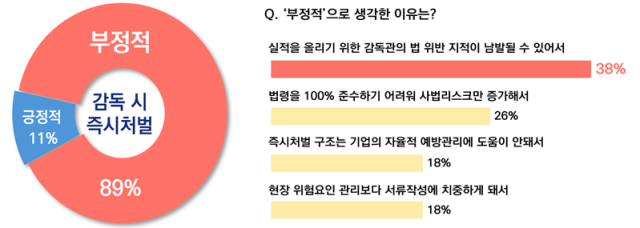
Companies also warned that if even minor violations lead to penalties, they may focus on paperwork and other administrative responses instead of reducing workplace hazards.
Distrust of inspectors was also widespread. In the survey, 56% (120 companies) said their level of trust in industrial safety inspectors was low. The top reason was “enforcing the law uniformly without understanding the industry,” cited by 41% (49 companies).
By company size, 65% of firms with 300 or more employees, 60% of firms with 50 to 299 employees, and 50% of firms with fewer than 50 employees said trust was low. Larger workplaces were more likely to see problems with punishment-centered inspections.
On whether the method of selecting inspection targets is appropriate, 53% (115 companies) responded negatively. Among them, 49% said detailed criteria are not disclosed, and 45% said workplace risk levels are not considered.
Companies called for a shift in inspection policy. The most common request was “granting an opportunity to correct minor violations,” at 64%, followed by “expanding guidance and consulting focused on improving risk factors,” at 62%.
Among companies inspected over the past three years, 49% said the main issues cited were minor violations such as posting material safety data sheets (MSDS) and missing safety signs. The biggest difficulties during inspections were the burden of assigning staff for administrative work such as preparing documents (82%) and the burden of criminal penalties and fines (78%).
Lim Woo-taek, head of the federation’s Safety and Health Headquarters, said companies have strong concerns about immediate punishment during inspections and that trust in inspectors is lacking. He said the government should shift inspections toward prevention rather than punishment, including giving companies a chance to correct minor violations, and should strengthen inspectors’ expertise and capabilities.
* This article has been translated by AI.
Copyright ⓒ Aju Press All rights reserved.