
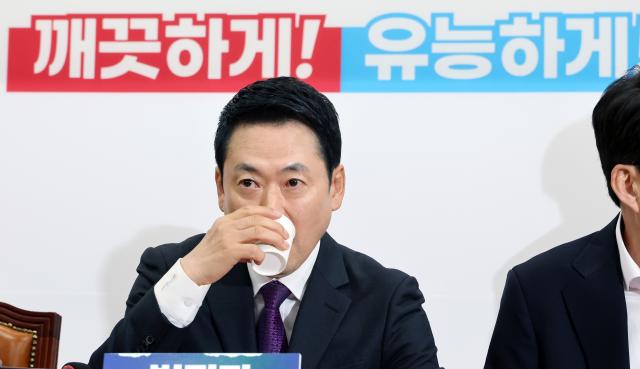
Jang Dong-hyeok, leader of the People Power Party, drinks water during a party leadership meeting at the National Assembly on April 27. [Photo=Yonhap]
South Korea’s People Power Party on Sunday called for what it described as a responsible government response to a threatened general strike by a Samsung Electronics labor union. The party also urged the government to roll back what it called pro-union policies and to pursue a new revision of the so-called Yellow Envelope Act, an amendment to Articles 2 and 3 of the Trade Union and Labor Relations Adjustment Act.
Party leader Jang Dong-hyeok said at a meeting of the party’s top leadership that “Samsung’s union is holding the South Korean economy hostage.” He said the issue had moved beyond labor-management relations to become “a national economy and livelihoods issue,” and criticized President Lee Jae-myung for offering what he called a meaningless call to “resolve it wisely through dialogue.”
Jang warned that with local elections approaching, if the government pressures Samsung and sides with the union, it would be “trading the country’s future for votes.” He said the government and the president should step in to persuade the union and mediate the conflict.
Floor leader Song Eon-seok cited the union’s demand for performance pay equal to 15% of operating profit and its notice of a general strike from May 21 to June 7. Industry observers have projected Samsung Electronics’ annual operating profit this year at about 45 trillion won, based on forecasts.
Song said demanding 600 million won per worker for all employees, not only top performers, “is difficult to see as meeting global standards.” He added that with semiconductors accounting for 55% of economic growth, he viewed the threatened action as repeatedly “holding the national economy hostage” and damaging shareholder interests and the country’s future.
Song blamed what he called one-sided, pro-union government policy for the repeated disputes and stressed the need to revise the Yellow Envelope Act again. He said the law should more clearly define employers through contractual and direct supervisory relationships and limit bargaining topics to wages and working conditions. He also called for more effective rules on liability for losses from illegal labor actions.
Supreme Council member Shin Dong-wook said workers’ contributions to South Korea’s industrialization should not be underestimated, but warned that alternative legislation is needed before confusion linked to the Yellow Envelope Act grows further.
Party leader Jang Dong-hyeok said at a meeting of the party’s top leadership that “Samsung’s union is holding the South Korean economy hostage.” He said the issue had moved beyond labor-management relations to become “a national economy and livelihoods issue,” and criticized President Lee Jae-myung for offering what he called a meaningless call to “resolve it wisely through dialogue.”
Jang warned that with local elections approaching, if the government pressures Samsung and sides with the union, it would be “trading the country’s future for votes.” He said the government and the president should step in to persuade the union and mediate the conflict.
Floor leader Song Eon-seok cited the union’s demand for performance pay equal to 15% of operating profit and its notice of a general strike from May 21 to June 7. Industry observers have projected Samsung Electronics’ annual operating profit this year at about 45 trillion won, based on forecasts.
Song said demanding 600 million won per worker for all employees, not only top performers, “is difficult to see as meeting global standards.” He added that with semiconductors accounting for 55% of economic growth, he viewed the threatened action as repeatedly “holding the national economy hostage” and damaging shareholder interests and the country’s future.
Song blamed what he called one-sided, pro-union government policy for the repeated disputes and stressed the need to revise the Yellow Envelope Act again. He said the law should more clearly define employers through contractual and direct supervisory relationships and limit bargaining topics to wages and working conditions. He also called for more effective rules on liability for losses from illegal labor actions.
Supreme Council member Shin Dong-wook said workers’ contributions to South Korea’s industrialization should not be underestimated, but warned that alternative legislation is needed before confusion linked to the Yellow Envelope Act grows further.
* This article has been translated by AI.
Copyright ⓒ Aju Press All rights reserved.