
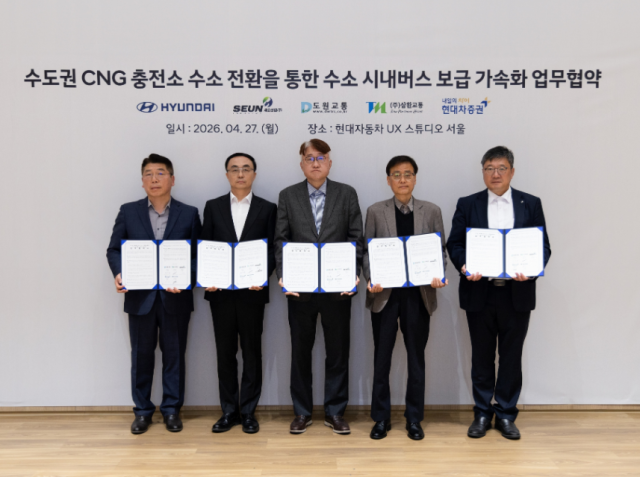
Hyundai Motor Co. said it is teaming up with major transit operators and related businesses in the Seoul metropolitan area to accelerate decarbonization in transportation.
The automaker said it signed a business agreement on April 27 at its UX Studio Seoul in its Gangnam-daero building with Dowon Transportation, Samhwan Transportation, Sewoon Industry and Hyundai Motor Securities to jointly speed the rollout of hydrogen-powered city buses in the capital region.
Participants included Hyundai Motor domestic sales chief Yeom Jae-seop, Dowon Transportation CEO Kim Jeong-hwan, Samhwan Transportation CEO Han Kang-su, Sewoon Industry CEO Ahn Gwang-heon and Hyundai Motor Securities planning and finance chief Yang Young-geun, the company said.
The agreement aims to build a foundation for wider adoption by converting CNG fueling stations in the region into hydrogen refueling stations. It also targets introducing a total of 400 hydrogen fuel cell city buses on routes operated by Dowon and Samhwan within five years.
Hyundai Motor said it will supply its Elec City hydrogen fuel cell buses to the two operators on schedule and support specialized maintenance training to help ensure smooth operations.
The Elec City hydrogen fuel cell bus is equipped with a 180-kW hydrogen fuel cell system, a motor rated at 180 kW with maximum torque of 4,500 N·m, and a 78.4-kWh high-output lithium-ion battery.
Based on an official efficiency rating, it can travel up to 751.2 kilometers on a single charge, supported by an efficiency-focused motor, a high-performance fuel cell system and what Hyundai Motor called best-in-class hydrogen tank capacity, making it suitable for power-intensive city routes.
Dowon and Samhwan said they will replace aging CNG buses with the Elec City hydrogen fuel cell model and gradually expand hydrogen city bus operations.
Sewoon Industry, a refueling business operator, said it will actively cooperate in converting existing CNG hubs in the capital region into hydrogen stations. It also plans to build 10 new hydrogen refueling stations in Seoul and Incheon by 2029.
Hyundai Motor Securities said it will support the project with advice and investment as needed.
Hyundai Motor said it expects the agreement to help expand hydrogen transportation and infrastructure and support South Korea’s 2030 Nationally Determined Contribution goal of cutting transport-sector greenhouse gas emissions by up to 37.8% from 2018 levels by 2030.
“This agreement with transit operators, a refueling business and a financial institution is meaningful in that it offers a practical solution to accelerate the adoption of hydrogen fuel cell buses,” a Hyundai Motor official said. “We will continue working to help strengthen the hydrogen ecosystem.”
* This article has been translated by AI.
Copyright ⓒ Aju Press All rights reserved.