
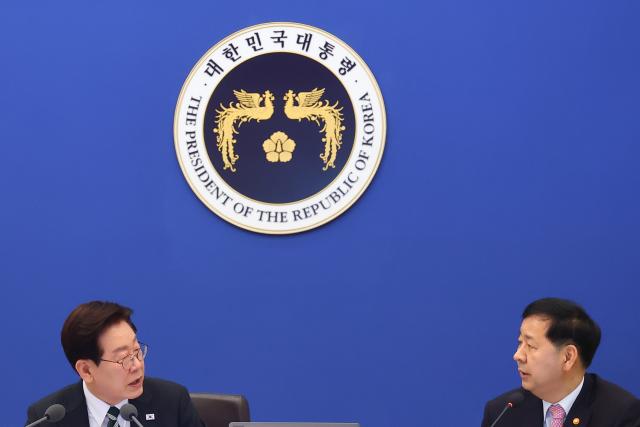
President Lee Jae-myung said the first round of relief payments for damage from high oil prices is expected to have an economic ripple effect similar to last year’s consumer spending coupons, which he said helped reignite a recovery.
Speaking while chairing a Cabinet meeting and emergency economic review meeting at Cheong Wa Dae on April 28, Lee said payments began the day before and urged officials to ensure people who have difficulty accessing online services are not inconvenienced during the application process. He also called for other supplementary budget funds to be executed as quickly as possible.
Lee stressed the need to check for policy blind spots in support for groups hit hardest by high oil prices, including cargo truck workers and farmers.
He also called for faster progress on structural reforms, including an “AI transformation” and a circular economy centered on recycled raw materials.
Lee said first-quarter GDP growth came in at 1.7%, nearly double the initial forecast of 0.9% and the highest in five years and six months, adding that the recovery that took hold in the second half of last year appears to be accelerating.
But he warned that external uncertainty remains high as the Middle East war enters its second month, and that signs are emerging that high oil prices could spill over into the real economy. He said the government should respond with more finely tuned policies and focus on maintaining growth momentum “with the mindset that the real test starts now.”
Lee said the war has expanded geopolitical risks and is driving structural realignments in the global economy and security environment. To secure stable growth engines amid the shifts, he said South Korea needs “strategic, flexible and practical diplomacy” that reduces dependence on any one region and steadily broadens its options.
He said his recent visits to India and Vietnam strengthened cooperation across multiple areas and should be viewed as a positive outcome in terms of long-term national interests. He added that South Korea should continue expanding its diplomatic horizons with the Global South from the perspective of “strategic national interest diplomacy.”
Lee also said cooperation with traditional allies should be advanced, calling for wisdom to resolve pending issues based on common sense and principles, with mutual respect, and to build healthy, forward-looking ties. He said South Korea would pursue diplomacy that builds genuine friendship with allies “with the confidence of a sovereign nation.”
Turning to education, Lee said a series of recent incidents have seriously infringed on teachers’ rights and educational activities. He said normalizing public education must start with protecting the rights and authority of teachers, “another key stakeholder in education,” as well as students.
He said the priority should be creating conditions that reduce excessive administrative work so teachers can focus on teaching and student guidance. Lee added that teachers’ rights and students’ rights are not a zero-sum relationship, and urged the government to promptly prepare measures to strengthen practical protections for teachers and stabilize schools.
Speaking while chairing a Cabinet meeting and emergency economic review meeting at Cheong Wa Dae on April 28, Lee said payments began the day before and urged officials to ensure people who have difficulty accessing online services are not inconvenienced during the application process. He also called for other supplementary budget funds to be executed as quickly as possible.
Lee stressed the need to check for policy blind spots in support for groups hit hardest by high oil prices, including cargo truck workers and farmers.
He also called for faster progress on structural reforms, including an “AI transformation” and a circular economy centered on recycled raw materials.
Lee said first-quarter GDP growth came in at 1.7%, nearly double the initial forecast of 0.9% and the highest in five years and six months, adding that the recovery that took hold in the second half of last year appears to be accelerating.
But he warned that external uncertainty remains high as the Middle East war enters its second month, and that signs are emerging that high oil prices could spill over into the real economy. He said the government should respond with more finely tuned policies and focus on maintaining growth momentum “with the mindset that the real test starts now.”
Lee said the war has expanded geopolitical risks and is driving structural realignments in the global economy and security environment. To secure stable growth engines amid the shifts, he said South Korea needs “strategic, flexible and practical diplomacy” that reduces dependence on any one region and steadily broadens its options.
He said his recent visits to India and Vietnam strengthened cooperation across multiple areas and should be viewed as a positive outcome in terms of long-term national interests. He added that South Korea should continue expanding its diplomatic horizons with the Global South from the perspective of “strategic national interest diplomacy.”
Lee also said cooperation with traditional allies should be advanced, calling for wisdom to resolve pending issues based on common sense and principles, with mutual respect, and to build healthy, forward-looking ties. He said South Korea would pursue diplomacy that builds genuine friendship with allies “with the confidence of a sovereign nation.”
Turning to education, Lee said a series of recent incidents have seriously infringed on teachers’ rights and educational activities. He said normalizing public education must start with protecting the rights and authority of teachers, “another key stakeholder in education,” as well as students.
He said the priority should be creating conditions that reduce excessive administrative work so teachers can focus on teaching and student guidance. Lee added that teachers’ rights and students’ rights are not a zero-sum relationship, and urged the government to promptly prepare measures to strengthen practical protections for teachers and stabilize schools.
* This article has been translated by AI.
Copyright ⓒ Aju Press All rights reserved.