
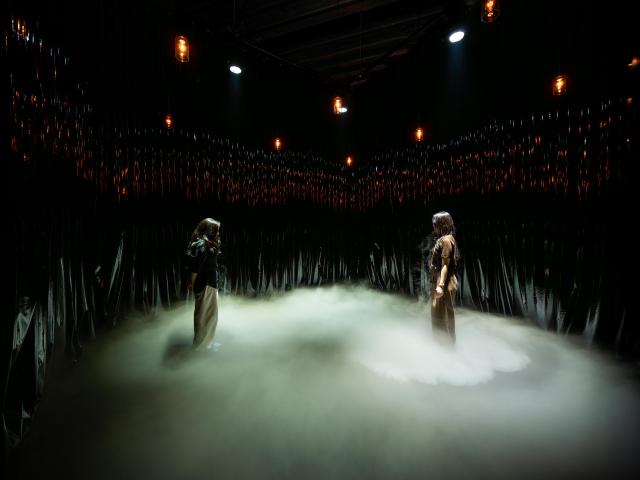
"You are now inside my work."
Jeong Kang-ja’s “Non-Body Exhibition” has no solid form, yet it creates a claustrophobic tension that pushes viewers backward. White smoke seeps from the corners of a square room. A red siren blares. A flat voice repeats, “You are now inside my work,” evoking the sense of being confined in South Korea’s closed society of the 1970s. The smoke, intangible but insistent, keeps rising to knee level no matter how far one retreats.
Leeum Museum of Art has revived “Non-Body Exhibition,” first shown at Jeong’s debut solo show at the National Public Information Center in 1970. The government at the time, which treated avant-garde art as political agitation, forcibly removed the work three days after the opening without consulting the artist. With Jeong now deceased, Leeum said it worked to reconstruct the original using past news reports, the artist’s notes and testimony from surviving family members.
According to Leeum on the 29th, visitors will be able to enter “Non-Body Exhibition” as part of the museum’s upcoming special exhibition, “Into Another Space: Women Artists’ Synesthetic Environments 1956-1976,” opening May 5.
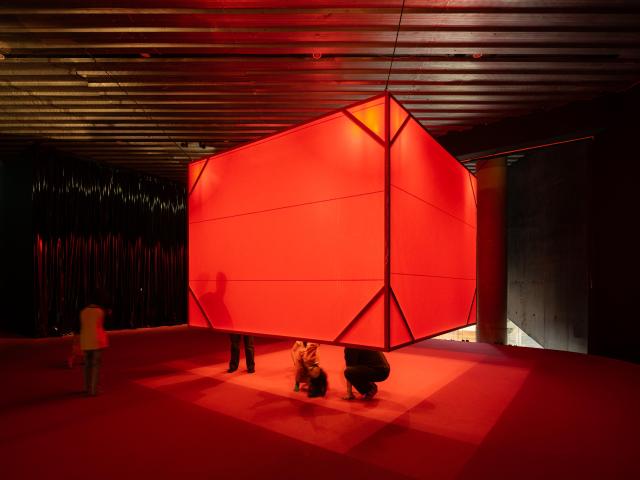
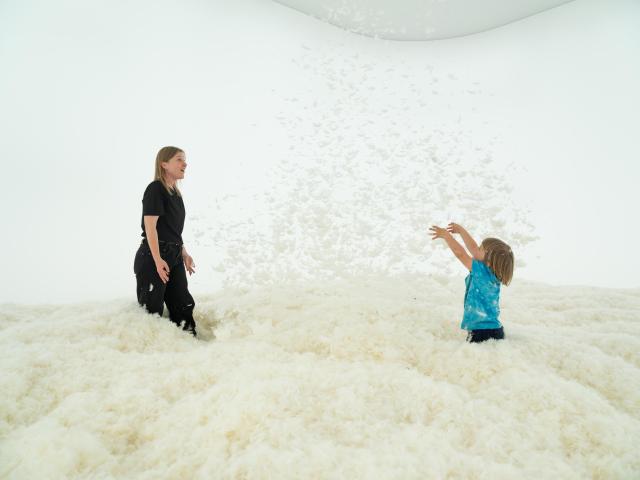
The exhibition was organized in 2023 at Haus der Kunst in Munich and expanded as it traveled via Rome and Hong Kong before arriving at Leeum. It revisits and reconstructs pioneering “environment” works by women artists long omitted from art history. Often seen as early models for today’s “experiential” or “immersive” exhibitions, the works allow visitors to step inside and experience light, sound, color, air and movement with their whole bodies.
At a press briefing, Leeum Deputy Director Kim Seong-won said environment works were often discarded, leaving little physical trace. He said two curators — Marina Pugliese, director of MUDEC in Milan, and Andrea Lissoni, artistic director of Haus der Kunst — restored the lost works one by one after three years of research.
Full-scale reconstructions include Yamazaki’s “Red,” along with environment works from about 50 years ago by Judy Chicago, Lygia Clark, Laura Grisi and Lea Lublin, among others.
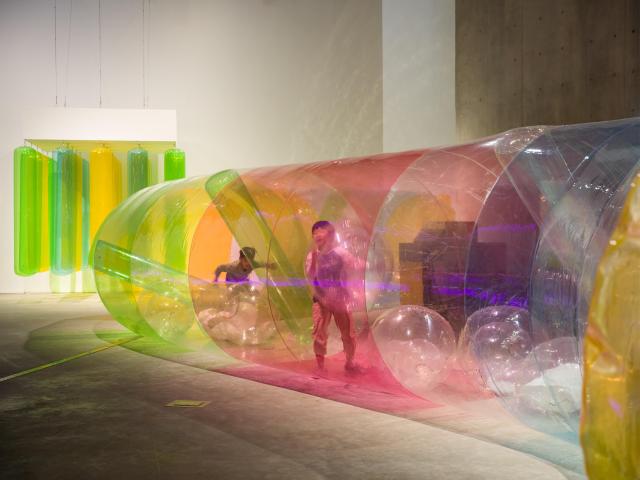
Pugliese said the team began by reviewing magazine coverage from the period, then visited institutions where the environment works were produced to see whether photographs remained. For artists who had died, she said, they searched for interview materials and other records.
She added that women artists in the past often struggled to fully realize what they wanted to express because galleries invested little and sales were rare. For living artists, she said, the team focused on realizing ideas that had been conceived but not properly executed at the time; for deceased artists, it focused on detailed re-creations of past works.
Jeong’s “Non-Body Exhibition” followed a similar path. The museum said it had difficulty identifying a South Korean woman artist who presented environment work between 1956 and 1976, searching across fields including crafts and architecture before finding Jeong’s piece.
Restoration was also challenging, Leeum said, because documentation was limited and the artist had died. The museum reviewed articles, notes and on-site photographs and conducted extensive verification, including meetings with family members and acquaintances, to get as close as possible to the original.
Kim said there were no drawings, exact measurements, descriptions or instructions. He said the line “You are now inside my work” was originally Jeong’s own voice, but no tape survived; the museum used AI to recreate the voice based on her recorded speech.
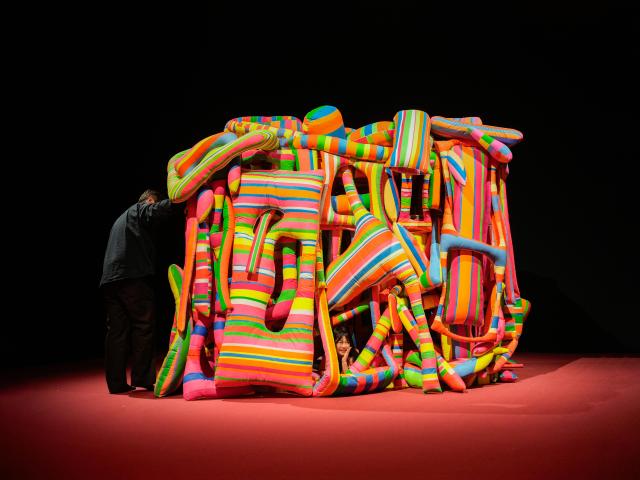
Lissoni said that among the versions presented so far, he was most proud of the one at Leeum. He said it clearly shows the period the organizers set — 1956 to 1976 — and presents works they had not been able to examine under the same criteria.
Kim said the exhibition is notable for highlighting women artists who played a formally important role in the development of contemporary art history.
"Exhibitions about women artists can easily fall into a trap. Social and cultural or psychological theories can bury the art itself," Kim said. "The two organizers pinpointed the core in a professional, elegant and refined way. It’s at a level where even children can immediately respond to what contemporary art is. It has professional and art-historical value, and yet it’s also popular. You could say it catches two rabbits at once."
The exhibition runs May 5 through Nov. 29 at Leeum Museum of Art in Seoul’s Yongsan district.
* This article has been translated by AI.
Copyright ⓒ Aju Press All rights reserved.