SEOUL, May 04 (AJP) - As South Korea observes the 104th anniversary of Children’s Day this Tuesday, the festive banners and gift-wrapped toys mask a sobering reality.
The holiday, envisioned by pioneer Bang Jeong-hwan as a day to prioritize the "happiness and well-being" of the nation’s youth, has become a poignant reminder of a childhood increasingly spent in the shadows of high-stakes testing and digital screens.
Data suggests that for the average South Korean child, the "right to play" is less a lived reality and more a luxury they simply cannot afford.
The most striking finding from the National Center for the Rights of the Child’s “2025 Key Statistics for Children” isn't just that children are busy—it’s the profound disconnect between their aspirations and their daily lives.
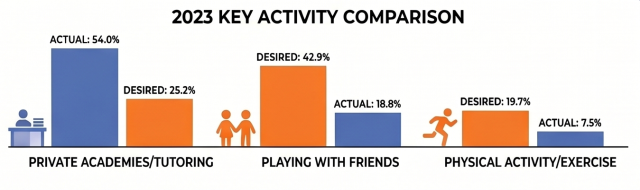
Four out of 10 desired to spend time and play with friends after school, but only two were able to do so as most were carried off to after-school academies and private tutoring.
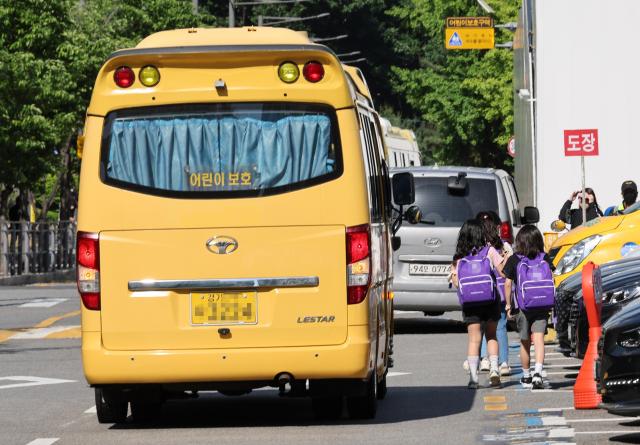
More than half of surveyed students identified after-school academies (hagwons) and tutoring as the main barriers to free play.
The pressure begins early in South Korea’s highly competitive education system, where preparation for elite university admissions increasingly starts in elementary school.
A 2024 survey by ChildFund Korea found that older elementary students aged 9 to 12 spent an average of 2 hours and 47 minutes a day studying outside school, while younger children aged 6 to 9 studied an additional 2 hours and 17 minutes daily.
Although school hours in South Korea are shorter than the OECD average, total study time including private education reaches nearly six hours a day, exceeding the OECD average of five hours.
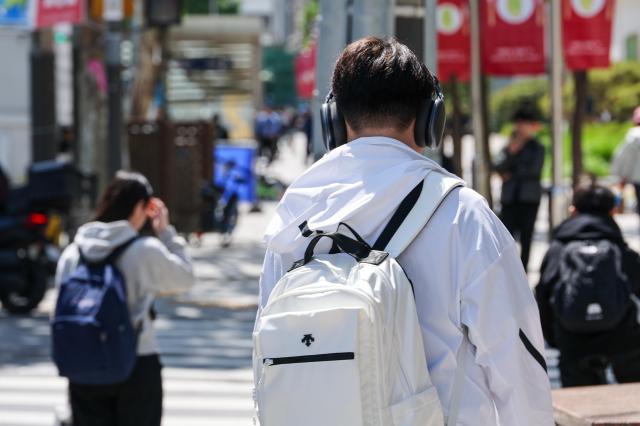
The consequences are increasingly visible.
In its report “Child Well-Being in an Unpredictable World,” the Organization for Economic Co-operation and Development ranked South Korea 28th out of 40 countries in children’s physical health and 34th out of 36 countries in mental health.
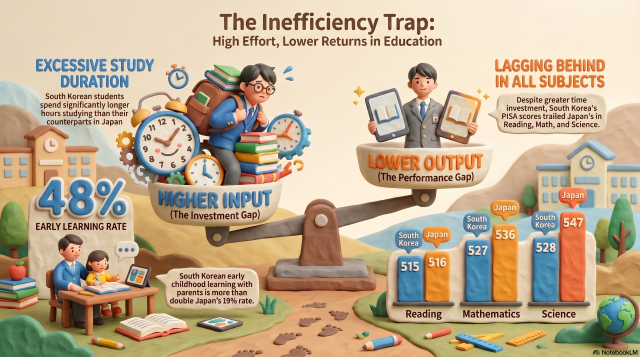
Despite significantly longer study hours than Japan, South Korean students also posted lower scores in reading, mathematics and science in the 2022 PISA assessment.
“When private education hours become excessively long, marginal utility inevitably decreases,” said Kim Hyun-chul, a professor at Seoul National University. “It is crucial to maintain proper balance in everything.”
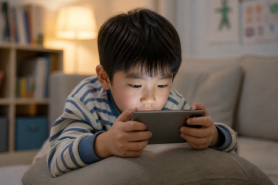
Where physical play and social interaction vanish, digital dependence fills the void. In a world where safe play spaces are scarce and time is tighter than ever, smartphones have become the default "playground."
A recent survey by the Korean Teachers and Education Workers Union reveals that 70% of upper elementary students are already engaging with generative AI like ChatGPT and Gemini and half of them spending more than two hours on smartphones after school.
While technological literacy is vital, researchers warn that this shift is often a survival mechanism. When children are too tired or too busy for the park, they turn to the screen for a quick, low-effort dopamine hit.
Globally, however, attitudes toward play are shifting in the opposite direction.
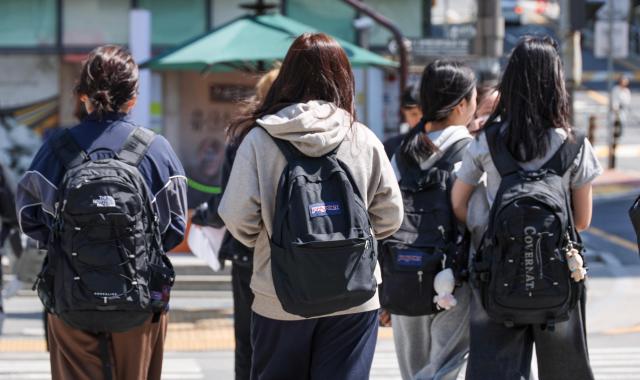
The United Nations Children's Fund and the LEGO Group last year established June 11 as the International Day of Play, emphasizing play as essential to healthy child development.
The World Health Organization has also stressed that regular physical activity and active play are critical for children’s physical and mental well-being.
“Allow them to sleep and exercise sufficiently,” Korean children’s rights pioneer Bang Jeong-hwan wrote in the original Children’s Day proclamation more than a century ago. “Let them go on walks or picnics occasionally.”
The words now sound less like celebration and more like a reminder of what many Korean children increasingly lack.

Copyright ⓒ Aju Press All rights reserved.