
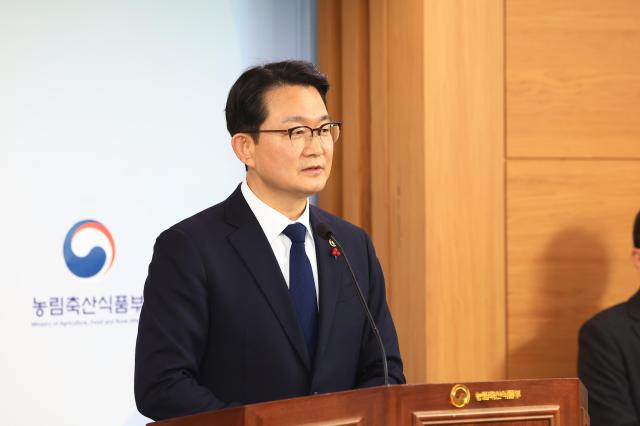
Kim Jong-gu, vice minister of agriculture, food and rural affairs, briefs reporters at the Government Complex Sejong in January on interim findings from a special audit of NongHyup’s central federation and foundation. [Photo by Yonhap]
As the government moves ahead with a broad overhaul of NongHyup, calls are growing from academics, cooperative members and the public to move faster. Critics say repeated misconduct involving the chair of the National Agricultural Cooperative Federation reflects structural problems and requires changes such as direct elections by members and a permanent oversight body.
According to relevant ministries on Tuesday, the National Assembly’s Agriculture, Food, Rural Affairs, Oceans and Fisheries Committee will hold a legislative hearing May 12 on revisions to the Agricultural Cooperatives Act. The hearing is expected to focus on an amendment proposed by Democratic Party lawmaker Yoon Jun-byeong that emerged from a ruling party-government consultation on April 1. The bill calls for introducing direct elections for the federation chair by cooperative members and creating an external audit body.
The push follows repeated allegations of lax management and misconduct at the federation. A joint government audit announced in March found widespread problems, including corruption and abuses of power by key executives, preferential loans and contracts, and loose budget spending. The government referred 14 cases for investigation.
A recent survey commissioned by the Korea Rural Economic Institute from Gallup Korea found strong support for reform: 94.5% of cooperative members and 95.1% of the general public said they favor changes. Many cited the need to address wrongdoing by executives and employees as the main reason, including 55.1% of members and 73% of the public.
Experts have also argued for stronger checks on the federation. In a recent report titled “NongHyup Reform: Creative Destruction and Innovation,” KREI researcher Kim Tae-hoo said existing cooperative committees and audit committees have limits in ensuring independence because the federation chair can exert influence. He said that is why reforms are needed, including requiring the appointment of outside experts as compliance officers, mandating reporting of crimes by executives and employees, and creating a legal basis to suspend officials from duty upon conviction.
Some cooperative heads, however, have raised concerns about direct elections and making audit bodies permanent. They argue direct elections could turn NongHyup into a political organization and weaken professionalism. Others say constant oversight runs counter to the cooperative principle of autonomy.
Ha Seung-soo, a lawyer with the NongHyup Reform Promotion Group, rejected that argument. “It is true that cooperatives should be guaranteed autonomy, but autonomy at a level that enables corruption cannot be accepted,” he said. He said the current indirect election system, in which only cooperative heads vote, has produced behavior close to “dividing up positions.” He added that breaking what he called an exclusive privilege through direct elections would make the organization healthier.
The government said it will accelerate work on a second package of reforms. A government official said the first package aimed to prevent misconduct by the federation and its chair, while the second will focus on remaking NongHyup into an organization for farmers. The official said the government plans to announce the second package next month, drawing in part on Japan’s agricultural cooperative reforms.
According to relevant ministries on Tuesday, the National Assembly’s Agriculture, Food, Rural Affairs, Oceans and Fisheries Committee will hold a legislative hearing May 12 on revisions to the Agricultural Cooperatives Act. The hearing is expected to focus on an amendment proposed by Democratic Party lawmaker Yoon Jun-byeong that emerged from a ruling party-government consultation on April 1. The bill calls for introducing direct elections for the federation chair by cooperative members and creating an external audit body.
The push follows repeated allegations of lax management and misconduct at the federation. A joint government audit announced in March found widespread problems, including corruption and abuses of power by key executives, preferential loans and contracts, and loose budget spending. The government referred 14 cases for investigation.
A recent survey commissioned by the Korea Rural Economic Institute from Gallup Korea found strong support for reform: 94.5% of cooperative members and 95.1% of the general public said they favor changes. Many cited the need to address wrongdoing by executives and employees as the main reason, including 55.1% of members and 73% of the public.
Experts have also argued for stronger checks on the federation. In a recent report titled “NongHyup Reform: Creative Destruction and Innovation,” KREI researcher Kim Tae-hoo said existing cooperative committees and audit committees have limits in ensuring independence because the federation chair can exert influence. He said that is why reforms are needed, including requiring the appointment of outside experts as compliance officers, mandating reporting of crimes by executives and employees, and creating a legal basis to suspend officials from duty upon conviction.
Some cooperative heads, however, have raised concerns about direct elections and making audit bodies permanent. They argue direct elections could turn NongHyup into a political organization and weaken professionalism. Others say constant oversight runs counter to the cooperative principle of autonomy.
Ha Seung-soo, a lawyer with the NongHyup Reform Promotion Group, rejected that argument. “It is true that cooperatives should be guaranteed autonomy, but autonomy at a level that enables corruption cannot be accepted,” he said. He said the current indirect election system, in which only cooperative heads vote, has produced behavior close to “dividing up positions.” He added that breaking what he called an exclusive privilege through direct elections would make the organization healthier.
The government said it will accelerate work on a second package of reforms. A government official said the first package aimed to prevent misconduct by the federation and its chair, while the second will focus on remaking NongHyup into an organization for farmers. The official said the government plans to announce the second package next month, drawing in part on Japan’s agricultural cooperative reforms.
* This article has been translated by AI.
Copyright ⓒ Aju Press All rights reserved.