
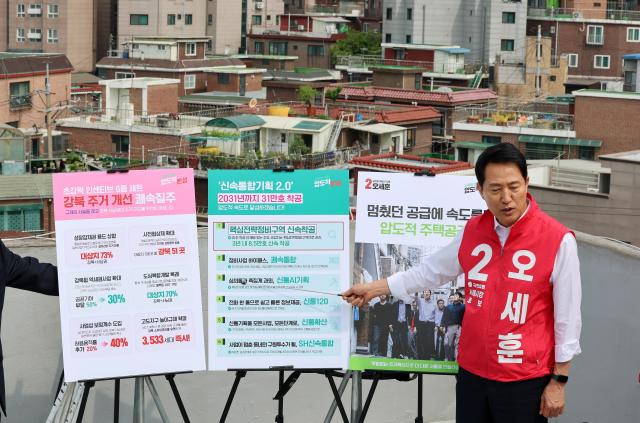
Oh Se-hoon, the People Power Party’s candidate for Seoul mayor, said May 7 he would introduce a “fast-track integrated” system and expand the city’s tailored consulting service known as “Shintong 120” to cut redevelopment and reconstruction timelines to within 10 years and broaden relocation-loan support for cooperative members.
Oh announced the housing pledges at a rooftop event at the Shilla Building in the Daerim 1 redevelopment area in Seoul’s Yeongdeungpo District. The plan followed his previous day’s pledge to supply 130,000 public housing units.
Oh said he has long pursued what he called a “supply-first” strategy and argued that speeding up stalled supply is key. He pledged to start construction on a total of 310,000 housing units by 2031, saying a chain of moves from older apartments and villas into newly built apartments would create a virtuous cycle in housing supply.
Of the groundbreaking target, 87,000 units would be net new supply, his campaign said. It said that figure is well above the 32,000 units the Lee Jae-myung government said it would start by 2030 under its Jan. 29 measures.
The pledges focus on shortening project timelines by building on the “rapid integrated planning” approach introduced during Oh’s time as mayor. Under the proposed fast-track integrated system, organizers would skip forming a redevelopment cooperative promotion committee and process project implementation approval and the management-and-disposition plan approval at the same time. Oh said the city would also provide guidelines so building plans and cost-sharing can be set while the two plans proceed in parallel.
Oh said Shintong 120, a unified phone-consultation platform, would provide guidance on land status and applicable development options to reduce confusion. He also pledged to introduce “Shintong AI Planning,” using artificial intelligence to prevent repeated rejections during review. In areas where private-sector 추진 is not smooth, he said the Seoul Housing & Communities Corp. (SH) would lead a “public rapid integrated” program.
Oh also pledged support for cooperative members struggling to relocate amid government lending restrictions. He said Seoul would significantly expand its housing promotion fund, financed by subscription-savings resources, to increase loans for relocating households and help projects break ground sooner.
Oh continued sharp criticism of Jung Won-oh, the Democratic Party’s Seoul mayoral candidate. “The housing type Seoul citizens prefer most is newly built apartments,” Oh said, calling Jung’s proposal to supply villas and residential-style lodging facilities an idea that ignores market principles. He added that the Democratic Party has been hostile to redevelopment and reconstruction and “still is,” in his view.
Responding to Jung’s criticism that housing supply fell sharply during Oh’s time as mayor, Oh said it misleads voters. “Construction is done by the private sector, and Seoul’s role is to create the business environment through swift permitting,” Oh said. He added that Jung, having served as a district mayor for more than 10 years, should know that, and said portraying an opponent as if he did not deliver housing supply is misleading and “not conscientious.”
* This article has been translated by AI.
Copyright ⓒ Aju Press All rights reserved.