
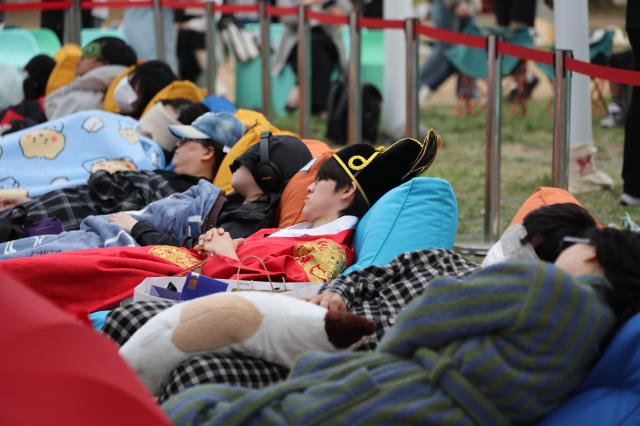
Now in its third year, the napping championship may seem lighthearted, but participants faced a competitive ratio of 70 to 1 to secure a spot. Each came prepared, armed with sleep masks labeled 'Offline,' mosquito repellent, ergonomic neck pillows, and even plush toys. One participant, dressed in a princess costume, had a sign that read, "Do not wake me unless you are a prince," while another, dressed as Jesus, peacefully closed his eyes.
Before the competition began, a brief commotion arose when members of the idol group ONF, E-shon and Seung-jun, appeared, momentarily breaking the silence with soft gasps and camera clicks. However, once the event commenced, fans and idols alike lay side by side on the mats, united in their quest for rest.
I was fortunate to join the event as a reporter after a spot opened up due to a no-show. Assigned number 58, I was surrounded by a weary college student and a fatigued office worker. Despite the uneven ground beneath my thin mat, a sense of calm washed over me as the noise from a pre-event yoga session faded away, leaving a heavy silence as 170 people closed their eyes together.
However, this was no ordinary nap. Every 30 minutes, the announcer's voice pierced the silence, and sounds of mosquitoes played over the speakers as staff members gently tickled participants' feet with feathers, attempting to rouse them. Any movement or opened eyes resulted in immediate disqualification, leading to a growing number of dropouts as time passed.
Those who remained had their heart rates monitored every half hour, with the participant maintaining the lowest, most stable heart rate declared the winner. This transformation of the basic act of sleeping into a quantified performance highlighted a societal shift.
A pressing question arises: when did we start learning how to 'sleep well'? Sleep was once a natural response to fatigue, but now many rely on sleep-inducing apps, white noise, melatonin, and sleep journals just to fall asleep. The heart rate monitoring during the napping contest starkly illustrates this change.
While each participant had their own story, a common thread emerged: exhaustion. "I can only sleep 3 to 4 hours a day," said 30-year-old office worker Nam Ji-soo, who attended with her team leader, both aware of each other's burnout. The irony of choosing a napping contest by the Han River as a form of rest was bittersweet.
College student Park Jun-seok, dressed in traditional attire inspired by the film 'The King's Man,' identified social media and smartphone notifications as modern-day sleep thieves. "Even when I lie down to rest, I end up scrolling through reels for hours. With exams approaching, I'm completely drained, so I actually feel confident about winning today," he said, his playful tone masking genuine fatigue.
Another participant, 53-year-old Hwang Doo-sung, clutched a blanket given to him by his girlfriend, who had come to support him. "I’m exhausted from work all week, and today I really want to win. My girlfriend is watching from outside, so I feel motivated," he shared, smiling at the thought of her cheering him on.
The high turnout for this event reflects a growing concern. In the past five years, the number of sleep disorder patients has increased by 1.3 million, and prescriptions for insomnia medications have quadrupled. South Koreans average just 6 hours and 58 minutes of sleep, ranking among the lowest in the OECD. In a country known for its hard work, sleep is becoming a luxury.
Professor Kim Jae-hwi from Chung-Ang University analyzed this phenomenon, noting that sleep, which should be a private act, has turned into a public performance. The liberating atmosphere of the Han River and the unusual experience of napping among strangers can help alleviate stress. Some participants remarked, "I can't sleep at home, but I fell asleep quickly here," suggesting that the permission to simply lie down is comforting.
Conversely, Professor Kim Yoon-tae from Korea University emphasized the need for structural changes that allow young people and workers to genuinely rest. He pointed out that while government-sponsored events like this are significant, they also highlight the paradox of many people struggling to find real relaxation. The napping contest, while festive, carries an underlying sense of melancholy.
The two-hour competition concluded with Kim Jong-pil maintaining the most stable heart rate, earning him first place. Hwang Doo-sung proudly secured second place, likely buoyed by the blanket from his girlfriend. Park Jun-seok also received recognition as the second-best dressed participant.
I, however, did not finish the competition. Although I could ignore the mosquito sounds, I instinctively flinched when a feather brushed my hand, leading to my disqualification. Yet, I felt no regret. The time spent napping under the guise of reporting was a sweet reprieve from a society that never stops producing.
In a world where productivity never pauses, even the act of doing nothing requires events, equipment, and justification. Regardless of who won, for me, number 58, that time spent napping was a rare and cherished moment of rest.
* This article has been translated by AI.
Copyright ⓒ Aju Press All rights reserved.