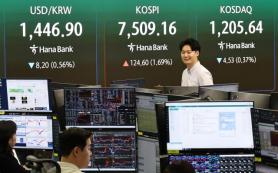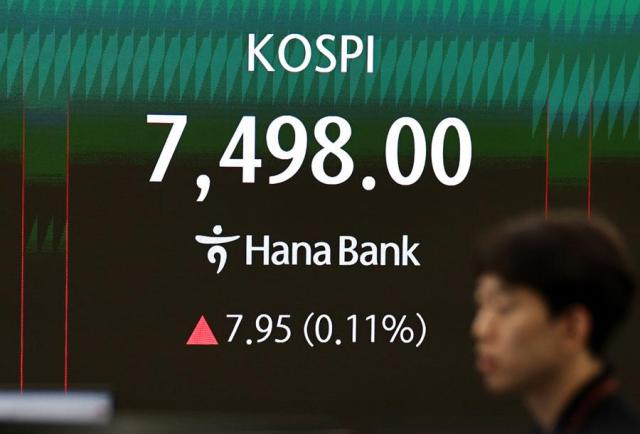
An electronic board at KEB Hana Bank's headquarters in central Seoul shows the Korea Composite Stock Price Index (KOSPI) closing at 7,498 points on May 8, 2026. Yonhap
SEOUL, May 10 (AJP) - South Koreans are increasingly borrowing money again to invest in stocks amid a frenzy fueled by a recent record-breaking rally in the Korean stock market.
According to financial data released on Sunday, outstanding balances on interest-bearing overdrafts at the country's five major banks - KB Kookmin, Hana, NH NongHyup, Shinhan and Woori - stood at 40.50 trillion Korean won (US$29 billion) as of last week.
The amount surged by 715.2 billion won in less than a week from the end of April, marking the fastest increase and the highest level since 2023, when individual investors rushed to take advantage of ultra-low interest rates to buy stocks and cryptocurrency.
The surge came amid renewed expectations for the long-depressed South Korean bourse, as the Korea Composite Stock Price Index (KOSPI), which had fallen below 2,500 points in January last year shortly after disgraced former President Yoon Suk Yeol's botched, short-lived martial law debacle, has since fully recovered and continued its historic rally, closing at 7,498 points last Friday after briefly surpassing the psychologically important, unprecedented level of 7,500 in intraday trading.
The benchmark KOSPI's record bull run into uncharted territory, driven by an artificial intelligence (AI)-fueled chip supercycle, appears to be prompting more investors to take out loans and pour their money into stocks in search of higher returns.
Even those who had shunned the stock market for years are returning, though some still hesitate, fearing they may have already missed the peak.
Cash parked in bank accounts has also been on the decline, with liquid balances at the five major banks dropping by 501.3 billion won to 696.51 trillion won over the same period, a sign that more people are pulling their money out to invest in stocks rather than leaving it in banks.
"Stock investment is likely the main factor, but some of the borrowed money may also be used for housing costs, as tighter loan regulations have made it harder for households to secure funds through other means," said one banking staffer.
According to financial data released on Sunday, outstanding balances on interest-bearing overdrafts at the country's five major banks - KB Kookmin, Hana, NH NongHyup, Shinhan and Woori - stood at 40.50 trillion Korean won (US$29 billion) as of last week.
The amount surged by 715.2 billion won in less than a week from the end of April, marking the fastest increase and the highest level since 2023, when individual investors rushed to take advantage of ultra-low interest rates to buy stocks and cryptocurrency.
The surge came amid renewed expectations for the long-depressed South Korean bourse, as the Korea Composite Stock Price Index (KOSPI), which had fallen below 2,500 points in January last year shortly after disgraced former President Yoon Suk Yeol's botched, short-lived martial law debacle, has since fully recovered and continued its historic rally, closing at 7,498 points last Friday after briefly surpassing the psychologically important, unprecedented level of 7,500 in intraday trading.
The benchmark KOSPI's record bull run into uncharted territory, driven by an artificial intelligence (AI)-fueled chip supercycle, appears to be prompting more investors to take out loans and pour their money into stocks in search of higher returns.
Even those who had shunned the stock market for years are returning, though some still hesitate, fearing they may have already missed the peak.
Cash parked in bank accounts has also been on the decline, with liquid balances at the five major banks dropping by 501.3 billion won to 696.51 trillion won over the same period, a sign that more people are pulling their money out to invest in stocks rather than leaving it in banks.
"Stock investment is likely the main factor, but some of the borrowed money may also be used for housing costs, as tighter loan regulations have made it harder for households to secure funds through other means," said one banking staffer.
Copyright ⓒ Aju Press All rights reserved.