
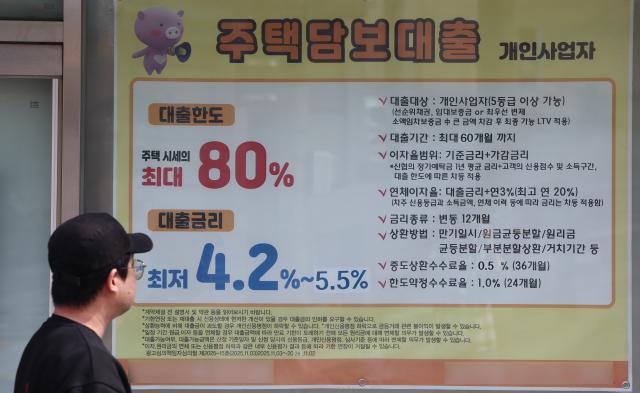
Household loans from major banks have seen an unprecedented decline as financial authorities tighten their management policies. While the growth rate of loans has slowed, concerns are rising that access to funds for genuine borrowers and those with lower credit ratings may be restricted.
On May 11, data received by Lee In-young, a member of the National Assembly from the Democratic Party, from the Financial Supervisory Service revealed that KB Kookmin Bank's loan performance at the end of the first quarter was recorded at -178.0% compared to its annual loan growth target (excluding policy-based products).
KB Kookmin Bank had set a household loan growth target of 909.2 billion won for this year, but instead saw a decrease of 1.6143 trillion won. The bank exceeded its loan target last year, resulting in penalties this year.
Other banks are experiencing similar situations. NH Nonghyup Bank had a growth target of 870 billion won but reported a decrease of 1.3551 trillion won (-156.0%) by the end of the first quarter. Shinhan Bank, aiming for a target of 850 billion won, saw a reduction of 1.5896 trillion won (-187.0%). Hana Bank and Woori Bank reported decreases of 1.5402 trillion won and 344.7 billion won, respectively, marking -175.0% and -41.7% against their targets.
Banks appear to have adopted a conservative approach to lending until the total household loan management targets were finalized in April. The overall household loan growth target for this year is set at 1.5%, lower than last year's 1.7%. The five major banks are required to adhere to stricter management, limiting their growth rate to around 1%.
Additionally, authorities have established separate management targets for mortgage loans this year, setting ratios based on each bank's past performance in this area. With the introduction of monthly and quarterly management systems, banks are now required to adjust their lending speeds regularly. Ongoing real estate loan regulations have also contributed to the overall reduction in loan amounts.
Internet-only banks have generally followed a conservative trend as well. K-Bank has a target of 667.3 billion won but reported a decrease of 223.7 billion won (-33.5%) in the first quarter, while Toss Bank executed only 370 million won out of its 550.2 billion won target (7.0%).
However, the ongoing conservative lending stance in the financial sector raises concerns that genuine borrowers, particularly those with lower credit ratings, may face diminished opportunities for loans. Lee In-young cautioned, "If banks focus solely on total management targets and raise their thresholds uniformly, the burden will inevitably fall on lower-credit borrowers and those in need of loans for living expenses."
* This article has been translated by AI.
Copyright ⓒ Aju Press All rights reserved.