
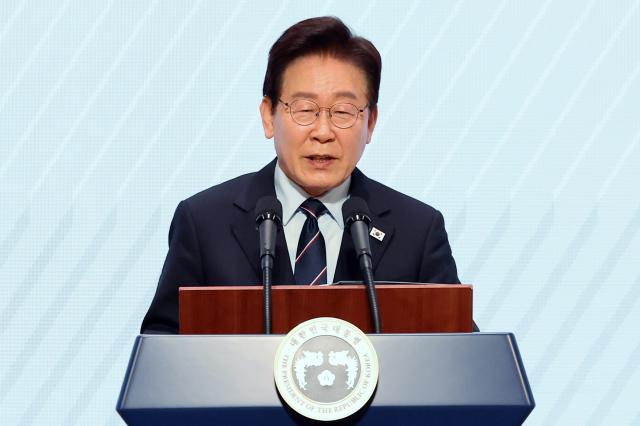
President Lee Jae-myung stated on May 11 that the preference voting system being implemented by the Democratic Party in the race for the 22nd National Assembly Speaker is designed to save time and costs associated with runoff elections. The preference voting system allows voters to rank their preferred candidates to determine the winner.
In a post on X (formerly Twitter), President Lee explained, "The preference voting system was introduced alongside the runoff voting system when I was the leader of the Democratic Party."
He further elaborated, "If the leading candidate does not achieve a majority in the first vote, there is no need for an additional runoff. Instead, we can conduct a preliminary runoff. For example, in a three-candidate race, if a voter who supported the third candidate has a second choice among the top two, adding their second-choice votes would yield the same effect as a runoff."
However, he noted a limitation: "Voters who select the first and second candidates are assumed to maintain those choices in the runoff."
The Democratic Party began voting among its party members on the same day to select candidates for the next National Assembly Speaker. The online voting by party members, which accounts for 20% of the total, will continue until the following day, while the in-person voting by lawmakers, making up 80%, will take place on May 13.
Given the tradition that the leading party holds the Speaker position and the structure of the National Assembly, the winner of the Democratic Party's internal election is effectively confirmed as the next Speaker. The candidates for the Speaker election include lawmakers Kim Tae-nyeon, Park Ji-won, and Jo Jung-sik.
President Lee urged voters to be mindful, saying, "If you do not select a second choice, and your preferred candidate is eliminated in the runoff, you will end up abstaining. Please do not misunderstand and make sure to select both your first and second choices."
He added, "If our country were to adopt a runoff voting system for presidential elections, discussions on simultaneously introducing a preference voting system would likely follow."
* This article has been translated by AI.
Copyright ⓒ Aju Press All rights reserved.