

The competition in the mobile payment market is shifting from securing app users to establishing dominance in offline payment infrastructure. As the mobile app market reaches saturation, the battle for control over payment terminals and networks is intensifying.
According to a report released in January by global market research firm Mordor Intelligence, near-field communication (NFC) payment methods accounted for 54.2% of South Korea's mobile payment market last year.
As a result, the penetration rate of NFC terminals in South Korea is expected to have increased significantly this year. The country's card payment infrastructure has primarily been built around magnetic secure transmission (MST) and integrated circuit (IC) terminals. Even after the introduction of Apple Pay, NFC-based payments remained at around 10% as of the end of last year.
Recently, major tech companies Naver Pay and Toss have ramped up their competition to distribute their own NFC terminals. Toss is leading the charge, expanding its reach through its subsidiary Toss Place, which has been distributing the smart terminal Toss Front since 2023. As of April, the number of Toss Front installations surpassed 330,000. Initially focused on popular areas in Seoul, such as Seongsu and Hongdae, the infrastructure is now expanding to traditional markets and regions outside the metropolitan area.
Naver Pay, a latecomer in the offline market, is accelerating its efforts. Its smart terminal, Npay Connect, launched in November, supports card payments, mobile payments, QR codes, and facial recognition payment service Face Sign. The company is employing a two-track strategy targeting both small businesses and franchises. A Naver Pay representative stated, "While we cannot disclose specific distribution figures, we believe we have exceeded our internal targets within five months of launch," adding that they are also working to introduce terminals at Paris Baguette in the second half of the year, which will increase availability in offline stores.
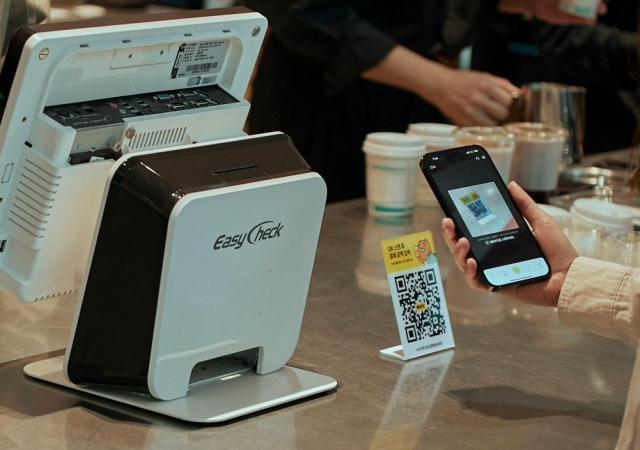
Kakao Pay is focusing on expanding its QR-based payment network rather than distributing its own terminals. The company has opted to collaborate with existing point-of-sale (POS) and value-added network (VAN) providers instead of building its own hardware. A Kakao Pay representative emphasized, "The key is not to own the terminals but to enable Kakao Pay transactions anywhere," noting that they are expanding offline touchpoints through QR orders, kiosk payments, and international QR payments.
Industry experts believe that control over offline payment data will be a crucial factor in determining the future success of the mobile payment market. As mobile payments expand beyond online transactions into the offline consumer landscape, companies that secure payment infrastructure can achieve both user lock-in effects and data competitiveness.
Jeong Yu-shin, a professor at Sogang University's Business School, stated, "Fintech platforms have traditionally grown around non-face-to-face services, but they are now transitioning to strengthen offline touchpoints to enhance customer loyalty. Online services allow users to switch easily to better platforms, so there is a trend to combine offline infrastructure to solidify customer bases."
The competition in offline payments is expected to intensify further if Apple Pay expands its partnerships with card issuers. Seo Ji-yong, a professor at Sangmyung University’s Business School, remarked, "Once Apple Pay is introduced, fintech companies will seek partnerships to expand in the offline market, leading to intensified competition for market share in face-to-face payment channels."
* This article has been translated by AI.
Copyright ⓒ Aju Press All rights reserved.