
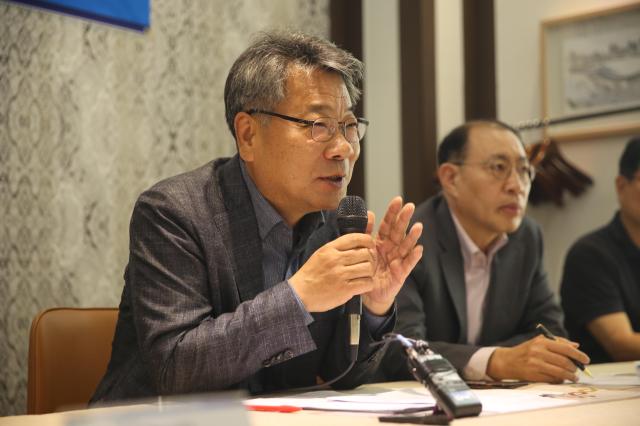
"I believe a new type of 'AI reader' is emerging. It's a market where AI reads books and answers our questions," said Kim Tae-hun, the newly appointed president of the Korea Publishing Culture Association (KPCA), during a press conference held in Jongno-gu, Seoul, on May 13. He emphasized the need for the publishing industry to respond quickly and rationally to the AI era, stating, "We will contribute to the development of Korea's AI industry."
Kim highlighted the importance of fair compensation, saying, "We will establish a direction for what the publishing industry should do in the AI era and how to do it. Books are a crucial foundation for AI training data." He added, "We will create a system that ensures normal copyright protection and fair compensation during the distribution of books as training data, establishing a utilization framework based on the rights of authors and publishers."
The KPCA plans to gather opinions from the publishing industry through meetings and establish a distribution method for AI training data, along with building infrastructure such as a database service. Last year, the KPCA supplied data worth approximately 3.6 billion won to the Korea Data Agency. They have requested government cooperation, including budget support from the Ministry of Culture, Sports and Tourism, to expand the related industry.
Kim noted, "The government and public institutions are creating book data to build sovereign AI," adding that the value of books as high-quality training data is increasing. He predicted that the demand for related data will continue to grow across various fields, including educational AI, robotic AI, and medical AI.
For university textbooks, the KPCA is considering establishing an AI-based distribution platform that would implement a subscription service model similar to Netflix or Melon. This platform is expected to include features such as content summarization, chatbots, and exam question generation. Kim stated, "We need a platform that allows students to discuss and learn, which will not only help prevent illegal copying but also contribute to achieving lower textbook prices."
Regarding the Seoul International Book Fair, starting next year, the KPCA plans to expand participation by utilizing the entire A and B halls of COEX. They will also present plans for improving the governance and public interest of the fair by the end of the year. The goal is to establish the fair as a leading international book fair in Asia by promoting copyright transactions and expanding discussions on technological changes in the publishing industry.
Kim also expressed his intention to improve the previously strained relationship with the government, noting that the KPCA had faced conflicts during the Yoon Suk-yeol administration, resulting in a complete cut of government funding.
He explained, "The government is currently in the process of establishing next year's budget by the end of this month, and we are discussing budget issues with the Ministry of Culture, Sports and Tourism." He added, "The KPCA has received no budget from the government this year," and emphasized that, from an efficiency standpoint, projects related to the publishing industry should be conducted by publishing organizations to yield at least three times the effect compared to the budget.
Kim stressed the need to approach publishing from an industrial perspective, stating, "I think we have neglected the industrial perspective in the past. We aim to view the publishing industry from a balanced perspective, allowing it to develop and grow, ultimately blossoming into a cultural flower."
* This article has been translated by AI.
Copyright ⓒ Aju Press All rights reserved.