
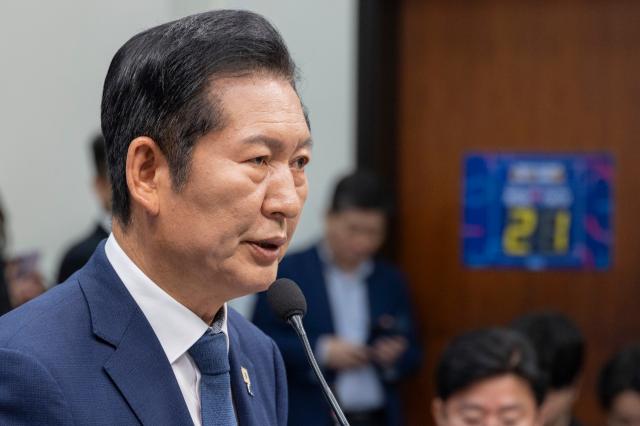
The upcoming by-elections, held alongside the June 3 local elections and featuring 14 races, are generating significant interest. Both major parties have declared their commitment to a full-scale effort in these elections, leading experts to express mixed opinions on the Democratic Party's goal of retaining 13 districts and the potential for unification in key battlegrounds. As the elections approach, the outcome remains uncertain.
In an interview with Aju Economy on May 14, six political experts largely predicted a comfortable victory for the Democratic Party in districts outside of key battlegrounds like Busan North and Pyeongtaek, which Democratic Party leader Jeong Cheong-rae has identified as critical.
Political commentator Lee Jong-hoon noted the influence of President Lee Jae-myung's popularity and the lack of progress on unification among conservative candidates in Busan North, stating, "Unless there are unexpected developments, the Democratic Party will retain all 13 districts." Cho Sung-joo, head of the Political Development Institute, echoed this sentiment, suggesting that outside of the battlegrounds, the Democratic Party is likely to win comfortably.
Choi Jin, director of the Presidential Leadership Research Institute, acknowledged the People Power Party's potential to secure victories in Daegu Dalseong and the conservative strongholds of Chungnam Gongju, Buyeo, and Cheongyang, but predicted that the Democratic Party would dominate in all other areas.
However, some experts cautioned against premature conclusions, anticipating a possible resurgence for the People Power Party. Eom Kyung-young, director of the Era Spirit Research Institute, remarked, "It will be difficult for the Democratic Party to secure all 13 districts. The People Power Party has a strong chance of winning in Ulsan Nam-gu as well," adding that the Pyeongtaek race could see the People Power Party's Yoo Ui-dong gaining traction, and that the true outcome in Hanam Gap would only be clear once the votes are counted.
In the most competitive districts, including Pyeongtaek and Busan North, experts offered differing views on the likelihood of unification efforts between the progressive and conservative camps. Choi Jin predicted that both districts would see unification, suggesting that negotiations between the Democratic Party and the Justice Party are likely in Pyeongtaek, where both parties may engage in some form of deal regarding candidacies. He noted, "Discussions will likely center around Justice Party candidate Cho and independent candidate Han Dong-hoon, both of whom are polling well and are unlikely to withdraw from the race."
Conversely, some experts speculated that unification could occur among conservative candidates in Pyeongtaek, traditionally a conservative stronghold. Shin Yul, a professor of political science at Myongji University, stated, "While unification in Busan North seems challenging, there is a possibility of unification among conservative candidates Yoo and Hwang Kyo-ahn in Pyeongtaek."
On the other hand, there are pessimistic views suggesting that unification efforts may ultimately fail in both Pyeongtaek and Busan North. Political commentator Park Sang-byeong indicated that both districts, often cited as likely candidates for unification, may see candidates Cho and Democratic Party's Ha Jung-woo winning instead. He noted, "Cho is aligned with the broader democratic camp, while Kim Yong-nam of the Democratic Party is not a traditional party member. Therefore, voting for Cho may not be a burden for Democratic supporters."
Some experts also pointed out that the high approval ratings for candidates Cho and Han could complicate unification efforts. Lee Jong-hoon remarked, "Given Cho's strong support in Pyeongtaek, he is likely to actively promote unification messages. As the deadline for unification approaches, we may see movements toward consolidation within the conservative camp. Ultimately, support ratings will determine the outcome."
Eom Kyung-young added, "For unification to occur, one side must hold a clear advantage, but currently, both People Power Party candidate Park Min-sik and Han are showing competitive support levels. In Pyeongtaek, either Kim or Cho needs to gain a decisive edge, which complicates unification efforts. If this trend continues, it may favor Han and Yoo."
Additionally, experts emphasized that while the so-called 'shy conservatives' may rally, they are unlikely to significantly alter the overall dynamics favoring the Democratic Party. Park Sang-byeong noted, "Shy conservatives will naturally come together and may perform better on election day than current polling suggests, but their numbers are not sufficient to overcome the Democratic Party's lead." Lee Jong-hoon also mentioned, "Not only shy conservatives but also 'shy Lee Jae-myung' supporters exist, raising doubts about whether the consolidation of shy conservatives will lead to victories for People Power Party candidates."
* This article has been translated by AI.
Copyright ⓒ Aju Press All rights reserved.