
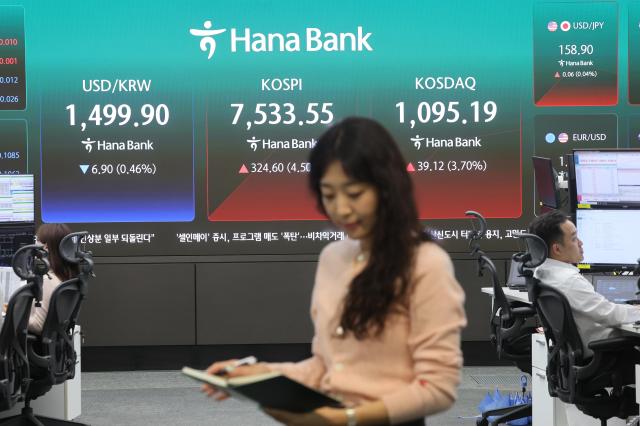
Expectations for peace negotiations in the Middle East have revived, leading to a decline in the won-dollar exchange rate, which had previously exceeded 1500 won.
As of 9:14 a.m. on May 21, the exchange rate in the Seoul foreign exchange market was 1499.7 won per U.S. dollar, opening 7.3 won lower at 1499.5 won.
The stabilization of international oil prices and a surge in U.S. Treasury yields appear to have restored some appetite for riskier assets.
Overnight, renewed hopes for peace talks between the U.S. and Iran led to a sharp drop in international oil prices. The July futures for Brent crude fell by 5.63% to $105.02 per barrel, while West Texas Intermediate (WTI) futures for July delivery closed down 5.66% at $98.26.
Analysts suggest that comments from President Donald Trump indicating that negotiations with Iran are in the final stages influenced this decline.
Additionally, the yield on 30-year U.S. Treasury bonds fell by 6.6 basis points to 5.114%. The benchmark 10-year Treasury yield also decreased by 10 basis points to 4.569%.
U.S. stock markets saw all three major indices rise, buoyed by optimism surrounding Middle East negotiations and strong earnings expectations for Nvidia. The Dow Jones Industrial Average closed up 645.47 points (1.31%) at 50,059.35.
The S&P 500 rose by 79.30 points (1.08%) to finish at 7,432.91, while the Nasdaq Composite gained 399.65 points (1.55%) to close at 26,270.36.
The exchange rate is expected to decline further due to a weaker dollar and strong stock market performance. Min Kyung-won, an economist at Woori Bank, stated, "News that negotiations will begin in Pakistan this weekend is likely to further boost risk appetite, positively impacting the domestic stock market. Consequently, foreign net buying could lead to an influx of funds, creating a supply advantage for the dollar due to offshore custody selling."
* This article has been translated by AI.
Copyright ⓒ Aju Press All rights reserved.