
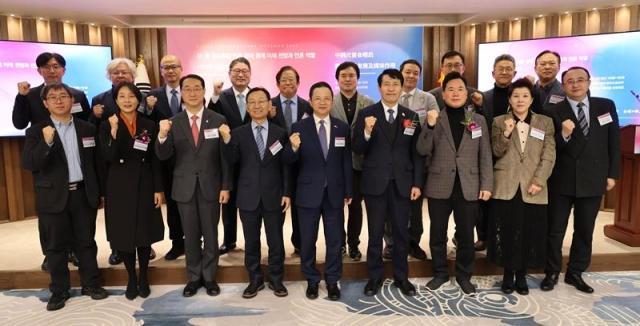
SEOUL, December 07 (AJP) - A media forum held in Seoul on December 5 brought together senior officials, diplomats, and scholars to assess the direction of South Korea–China relations following the recent summit between the two leaders. Participants broadly agreed that the biggest bottlenecks in bilateral ties are declining trust and widening perception gaps, compounded by intensifying U.S.–China competition.
The event, titled "Future Outlook of Bilateral Relations and the Role of the Media after the South Korea–China Summit," was co-hosted by Aju Daily and the Embassy of the People's Republic of China at China Construction Bank's Seoul headquarters.
Aju Daily President Yang Kyu-hyun, National Assembly Deputy Speaker Lee Hak-young of the Democratic Party, Representative Kim Geon of the People Power Party, Deputy Minister for Public Diplomacy Jeong Ui-hye of South Korea's Ministry of Foreign Affairs, and Chinese Ambassador to South Korea Dai Bing were among those in attendance, along with figures from business and academia.
Shin Bong-seop, former Consul General in Shenyang and now a professor at Kwangwoon University, opened the first session with an analysis of how South Korea's foreign policy structure is shifting under prolonged U.S.–China strategic rivalry. He argued that the long-used formula of "security with the United States and the economy with China" has heightened structural risks, adding that security, technology, and supply-chain issues need to be managed separately. He suggested restructuring cooperation with China around so-called "blue-zone" areas such as climate, public health, food security, and small- and medium-sized enterprises, where political risk remains relatively low.
Meng Guoxin, Seoul bureau chief for People's Daily, delivered the second presentation. He noted the significance of the summit, the first state visit and first in-person meeting between the leaders in five years, calling South Korea and China "partners that cannot be separated." He said the summit laid out four key directions for future ties: stronger strategic communication, economic cooperation in emerging industries, broader cultural and youth exchanges, and deeper coordination in international forums.
Meng added that despite the high level of interdependence in the economic and industrial supply chain, anti-China sentiment and online misinformation in South Korea are real obstacles to stability, underscoring the media's responsibility to provide fact-based reporting.
During the first session's panel discussion, Kwangwoon University Professor Kim Hee-gyo and Yonsei University Graduate School of International Studies visiting professor Hwang Jae-joon, who also serves as a policy adviser to the Democratic Research Institute, described the bilateral structure as a mix of security competition, economic dependence, technological rivalry, and volatile public opinion. They stressed the need to manage domestic sentiment alongside strategic realism in foreign policy.
The second session examined the role of the media and opportunities for media-sector cooperation. Lee Seok-woo, international affairs editor at Financial News, said the South Korea–China summit centered on practical, people-focused cooperation in areas such as financial-crime prevention, currency-swap discussions, follow-up negotiations to the bilateral free-trade agreement, and expanded person-to-person exchanges. He also noted that structural limitations remain in issues such as North Korea and China's restrictions on Korean cultural content.
Lee warned that distorted information and hate-driven narratives circulating online continue to shape public attitudes in both countries, creating what he described as a long-term bottleneck in bilateral ties.
Noh Seong-hae, Seoul bureau chief for China Media Group (CMG), outlined areas where South Korean and Chinese media could strengthen cooperation, including improving communication of national policies, easing misunderstandings, and expanding cultural and academic exchanges. He pointed to political sensitivities, rapidly shifting online sentiment, the spread of false information, and gaps in information access as major challenges.
Noh proposed building a sustained cooperation platform grounded in trust and accuracy, suggesting joint reporting projects, co-produced programs, regular briefings, fact-checking partnerships, youth-reporter exchanges, and collaboration on video and AI-based content. He added that a phased roadmap — from expanding joint reporting to developing co-branded content — could help broaden cultural and economic engagement and improve public understanding in both countries.
In the final discussion, former JTBC Beijing correspondent Park Sung-hoon, now with the investigative team at JoongAng Ilbo, and KBS producer Jeong Yong-jae drew on their reporting experience in China to highlight practical challenges in covering bilateral issues. Both noted that consistent reporting on youth exchanges and everyday cooperation can help improve public perceptions.
Throughout the forum, speakers shared the view that South Korea–China relations now reflect overlapping dynamics: security tensions, economic interdependence, technological competition, and cooperation in daily life. Participants emphasized that for the positive momentum created by the recent summit to continue, sustained media-to-media engagement will be essential.
Copyright ⓒ Aju Press All rights reserved.
