
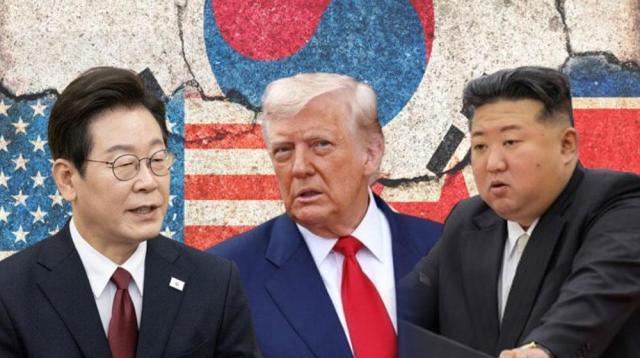
SEOUL, December 08 (AJP) - The United States and China have both subtly or explicitly backed away from the long-held principle of "complete denuclearization" of North Korea, yet Seoul appears largely unconcerned — a stance that is raising alarms among security watchers.
Analysts say the shift is not abrupt but rather an unmistakable acknowledgment of a transformed strategic landscape.
North Korea is now a constitutionally protected nuclear-armed state; the United States is drifting toward a more transactional alliance centered on burden-sharing; China has effectively deprioritized denuclearization; and Russia has deepened military cooperation with Pyongyang, including missile transfers.
Against this backdrop, Seoul remains committed to a framework designed for a very different era — one in which denuclearization seemed at least theoretically possible, major powers worked in loose alignment, and North Korea still engaged in negotiations.
Dr. Cheong Seong-chang, vice president of the Sejong Institute's Center for Korean Peninsula Strategy, said recent signals from Washington and Beijing represent not a policy reversal but a public recognition of this structural shift.
"North Korea is developing multiple-warhead ICBMs and a strategic nuclear submarine. Expecting Pyongyang to give up nuclear weapons at this stage is unrealistic," he told AJP in a phone interview Monday, stressing that any meaningful window for rollback "closed long ago."
Washington's new National Security Strategy, released last week, reflects that recalibration. The document makes no mention of North Korea and drops the familiar phrase "denuclearization of the Korean Peninsula," instead focusing on deterring China and maintaining stability in the Taiwan Strait.
It also excludes the term "extended deterrence," a shift many interpret as a sign that allies are expected to shoulder more of their own defense burdens.
China has also moved further from the denuclearization agenda. Since March 2024, Beijing has omitted the term from its external statements and again avoided it in its September summit readout with Pyongyang. For the first time in nearly two decades, China removed "complete denuclearization" from its arms-control white paper.
Russia, meanwhile, has strengthened military ties with North Korea, trading weapons and technology in ways that further undercut the conditions that once sustained a denuclearization framework.
Despite these changes, the South Korean government maintains that nothing fundamental has changed.
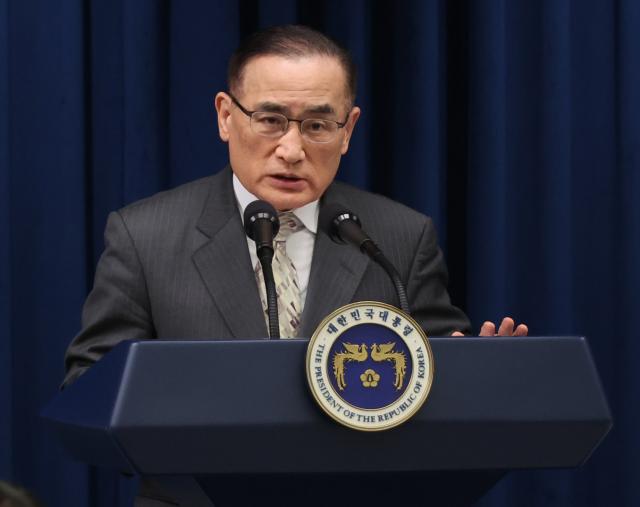
National Security Director Wi Sung-lac on Sunday downplayed the meaning of the NSS language, telling reporters that the omission of North Korea stemmed from structural choices in drafting rather than reduced American interest.
"There is no need to view this as meaning the U.S. has no interest in resolving the North Korean nuclear issue or in resuming U.S.–North Korea dialogue," he said. Wi explained that the NSS was organized around an "America First" framework, with detailed regional content expected in subordinate documents.
He added that Seoul has "strengthened its international connections" with neighboring countries and intends to build on that groundwork to reopen dialogue with Pyongyang. Asked whether joint military exercises might be adjusted as part of that effort, Wi said "many possible cards" exist, but stressed the government is "not directly considering reduction of joint drills."
Speculation about a shift in Seoul's own phrasing emerged after President Lee Jae Myung used the term "a nuclear-free Korean Peninsula" during a press conference with foreign correspondents in Seoul on Dec.2.
At a briefing Monday, Ministry of Unification spokesperson Yoon Min-ho clarified that "a nuclear-free Korean Peninsula" and "denuclearization of the Korean Peninsula" carry the same meaning.
He added that South Korea will continue working with key countries toward denuclearization, regardless of how other governments frame the issue in their internal documents.
Cheong of Sejong argues that Seoul's current framework is increasingly misaligned with the strategic environment.
"If North Korea has made clear it will never give up nuclear weapons, then a policy that depends on asking Pyongyang to do so will not lead to dialogue," he said. He believes South Korea should adopt a deterrence-centered approach while leaving room for negotiations built on a balance of power rather than expectations of disarmament.
One option he highlighted is building nuclear latency comparable to Japan's — strengthening industrial and technological capacity to enable rapid nuclear armament if circumstances require it. With full state mobilization, he estimated, weaponization could be technically achievable in about a year.
He also pointed to the recent U.S.–South Korea agreement allowing reprocessing and enrichment of used nuclear fuel, which enhances low-enriched uranium capability and reduces barriers to future high enrichment.
Copyright ⓒ Aju Press All rights reserved.
