
SEOUL, Mar. 18 (AJP) — South Korea’s labour market showed a deceptive resilience in February, with headline employment rising for the second consecutive month, but the underlying data reveals a deteriorating quality of jobs and a deepening structural crisis, as high-value industries shed workers and youth unemployment surged to its highest level in years.
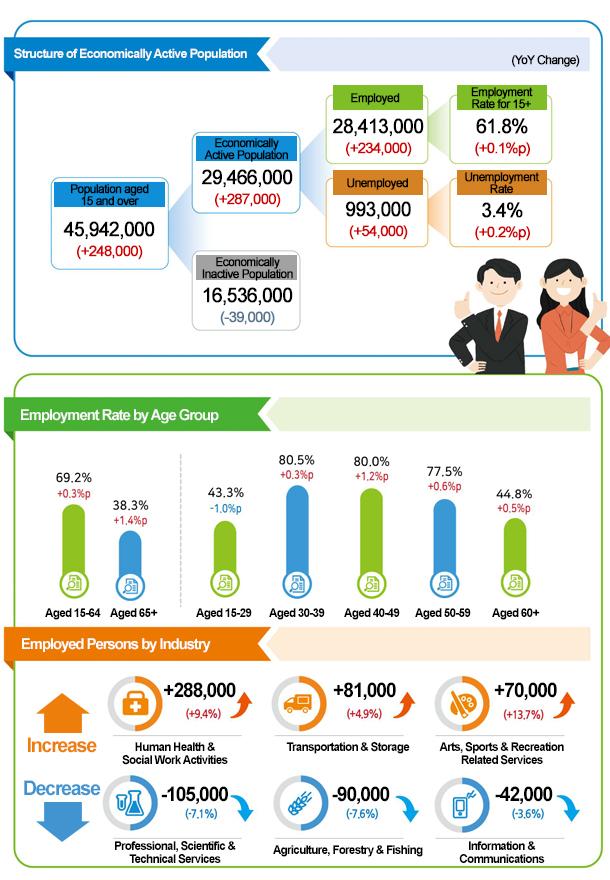
The number of employed people rose by 234,000 (0.8 percent) from a year earlier to 28.41 million, according to data released by the Ministry of Data and Statistics on Wednesday. While this marks a modest rebound from January's 194,000 (0.7 percent) gain, it remains significantly lower than the 300,000-plus levels seen late last year. The employment rate for those aged 15 to 64 stood at 69.2 percent, up 0.3 percentage points on-year.
Youth employment hit by "hiring freeze" and automation
The headline growth failed to hide a grim reality for the younger generation. The employment rate for those aged 15 to 29 plummeted by 1.0 percentage point to 43.3 percent, marking the sharpest decline in recent years. Simultaneously, the youth unemployment rate jumped 0.7 percentage points to 7.0 percent.
In stark contrast, job gains were almost entirely driven by the elderly. Employment among those aged 60 and above surged by 284,000 (4.5 percent), indicating that the nation’s job growth is currently sustained by government-led welfare positions and roles for senior citizens rather than private-sector hiring for the youth.
The impact of AI-driven automation is a significant factor in this shift. According to a Bank of Korea report released last October, 98.6 percent of the 211,000 youth jobs lost over the past three years were in occupations with high exposure to AI. This underscores a rapid structural displacement in the entry-level job market.
High-value sectors in retreat
A particularly concerning trend is the ongoing contraction in knowledge-intensive industries, a sector previously identified as a key engine for high-quality job creation. The professional, scientific, and technical services sector—which includes R&D and specialized consulting—shed 105,000 jobs (7.8 percent) in February. This marks a second consecutive month of decline following a loss of 107,000 jobs (8.0 percent) in the previous month.
This follows a broader trend of weakening demand in high-value services, compounded by a decline of 42,000 jobs (3.2 percent) in the information and communications sector. The combination of high interest rates and reduced corporate investment has led to a noticeable contraction in quality employment opportunities within these knowledge-based industries.
Service sector bloat and shorter hours
The concentration of job growth in the service sector further underscores the fragile nature of the recovery. The health and social welfare sector added 284,000 jobs (9.9 percent), effectively accounting for more than the total increase in headline employment. Meanwhile, the agriculture, forestry, and fisheries sector saw a sharp decline of 90,000 jobs (8.2 percent), the largest drop since 2017.
Furthermore, the quality of employment is shifting towards precarious, short-term roles. The number of people working less than 36 hours a week rose by 281,000 (4.6 percent), while the headcount for those working 36 hours or more fell by 94,000 (0.4 percent). Average weekly working hours dropped by 0.4 hours to 37.7 hours, signaling a softening in overall labor demand despite the increase in headcount.
Rising unemployment and inactivity
The total number of unemployed reached 993,000, up 54,000 (5.8 percent) on-year, with the overall jobless rate rising to 3.4 percent, up 0.2 percentage points. As inflation persists, more individuals are entering the job market, yet the economy is failing to absorb them into productive roles.
While the economically inactive population decreased slightly by 39,000 (0.2 percent), the number of people who reported they were simply "taking a break"—not seeking work despite being capable—remains a persistent concern, particularly among those in their 20s and 30s. The February data confirms that while the quantity of jobs is being propped up by an aging population and welfare demand, the structural core of the labor market is facing increasing fragility.

Copyright ⓒ Aju Press All rights reserved.